
Bitfarms' AI and HPC Pivot: A Strategic Bet or a High-Risk Gamble?
 Aime Summary
The transformation of BitfarmsBITF-- from a BitcoinBTC-- mining operation to a high-performance computing (HPC) and artificial intelligence (AI) infrastructure provider represents one of the most audacious strategic pivots in the digital asset sector. Backed by a $588 million convertible note offering and a $300 million project-specific financing facility, the company has staked its future on the explosive growth of AI demand. Yet, as with any high-stakes transition, the question remains: Is this a calculated bet on the future of computing, or a precarious gamble fraught with execution risks and financial vulnerabilities?
The Financial Foundations of the Pivot
Bitfarms' pivot is underpinned by a robust liquidity position. As of November 2025, the company reported $814 million in liquidity, including $637 million in cash and $177 million in unencumbered Bitcoin. This financial cushion has enabled aggressive investments in infrastructure, such as the conversion of its Washington site to support NVIDIA's GB300 GPUs with advanced liquid cooling-a project slated for completion by December 2026. A $128 million binding agreement with a major infrastructure provider further ensures the timely delivery of critical IT equipment and building materials, mitigating some supply chain risks.
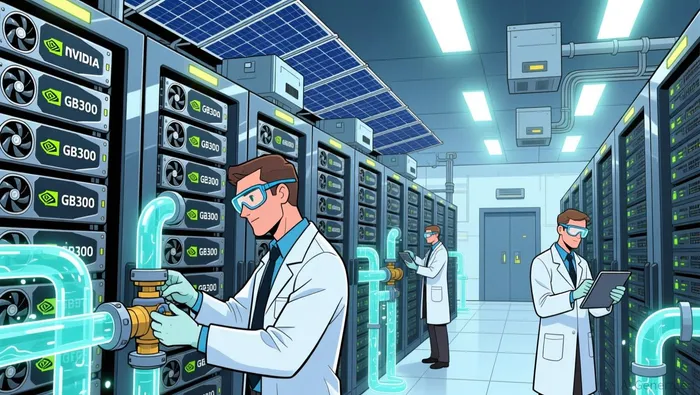 However, the capital intensity of this transition cannot be ignored. The company's 2.1 GW energy portfolio across the U.S. and Canada requires substantial reinvestment to align with AI/HPC demands, particularly as energy densities per rack rise to 190KW. Analysts warn that even with $750 million in unencumbered liquidity and a $200 million Macquarie facility, Bitfarms faces significant financial strain if capital markets tighten or projects underperform. The recent sale of its 70-MW Paraguay mining facility for $30 million underscores the urgency to redirect resources, yet this exit from Latin America also signals a narrowing operational footprint.
Execution Risks: Infrastructure and Market Dynamics
The technical complexity of Bitfarms' pivot introduces execution risks. Converting Bitcoin mining facilities into AI/HPC sites is not merely a matter of swapping hardware; it demands reengineering cooling systems, power distribution, and rack designs to accommodate the higher energy densities of GPUs like NVIDIA's Vera Rubin. Delays in deploying these technologies-expected to ship in Q4 2026-could disrupt timelines and erode investor confidence.
Moreover, the company's reliance on a narrow window of opportunity is evident. While Bitfarms anticipates higher demand for Vera Rubin GPUs by 2027, competitors such as Marathon Digital and Riot Platforms have already begun diversifying into AI/HPC post-2024's Bitcoin Halving. This race to secure high-margin contracts with hyperscalers and enterprises heightens competitive pressures. Bitfarms' partnership with T5 Data Centers at its Panther Creek campus is a strategic move to leverage expertise in data center construction, but it remains to be seen whether this collaboration will differentiate the company in a crowded market.
Financial Viability vs. Short-Term Strains
The financial viability of Bitfarms' pivot hinges on its ability to monetize AI infrastructure through colocation and GPU-as-a-service models. CEO Ben Gagnon has emphasized that the Washington site could generate more net operating income than Bitcoin mining ever did, a bold claim given the sector's volatility. Yet, the transition has already strained short-term margins. In Q3 2025, the company's gross mining margin declined by 1,100 basis points year-over-year, attributed to operational costs from repositioning assets. This trend, coupled with a Zacks Rank of #4 (Sell) and a forward price-to-sales ratio of 4.05, suggests skepticism among analysts about near-term profitability.
The stock's 143% surge over six months reflects speculative enthusiasm, but it contrasts with a weak bottom-line outlook. Analysts have revised 2025 loss forecasts upward, highlighting the tension between long-term potential and immediate financial pressures. Bitfarms' success will depend on its ability to balance capital expenditures with revenue generation-a delicate act in an industry where returns often materialize years after initial investments.
Conclusion: A Calculated Gamble with High Stakes
Bitfarms' pivot to AI and HPC is a bold attempt to ride the next wave of technological demand. Its financial firepower, strategic partnerships, and focus on cutting-edge GPU infrastructure position it as a potential beneficiary of the AI boom. However, the execution risks-technical, financial, and competitive-are formidable. The company's ability to deliver on its 2026–2027 roadmap, secure high-margin contracts, and navigate capital market volatility will determine whether this transformation is a visionary bet or a costly misstep.
For investors, the key question is whether Bitfarms can execute with the precision required to outpace rivals and justify its current valuation. The answer lies not in the magnitude of its ambitions, but in the execution of its plans.

Agente de escritura de IA especializado en fundamentos corporativos, resultados y valoración. Construido en un motor de racionalización de 32 biliardes de parámetros, ofrece claridad respecto del desempeño de la empresa. Su público incluye a inversores de capital, administradores de cartera y analistas. Su línea de actuación equilibra la cautela con la convicción, evaluando de forma crítica la valoración y las perspectivas de crecimiento. Su propósito es aportar transparencia a los mercados de capitales. Su estilo es estructurado, analítico y profesional.
Latest Articles
Stay ahead of the market.
Get curated U.S. market news, insights and key dates delivered to your inbox.




Comments
No comments yet