
Bitcoin's Rally: A Tale of Dollar Decline and Fed Turmoil
The cryptocurrency market has long been shaped by macroeconomic forces, but recent developments have pushed Bitcoin into uncharted territory. As the U.S. dollar weakens to a three-year low and political tensions between President Donald Trump and Federal Reserve Chair Jerome Powell escalate, Bitcoin has surged, capitalizing on both financial instability and institutional uncertainty. This article examines the interplay of these factors and their implications for investors.
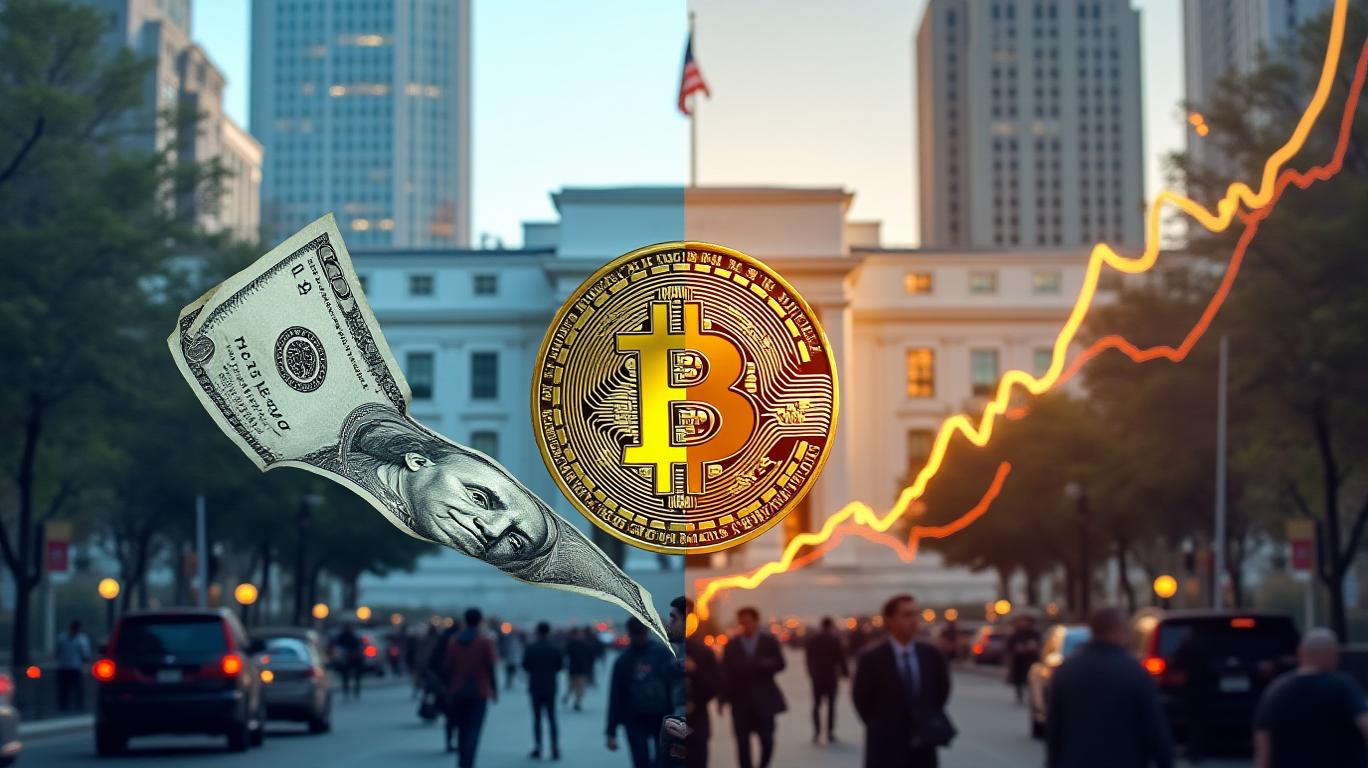
The Dollar’s Decline: A Catalyst for Bitcoin
The U.S. dollar’s recent weakness has been a key driver of Bitcoin’s rebound. In April 2025, the dollar index fell to its lowest level since 2022, fueled by Trump’s public attacks on Powell and the Fed’s perceived reluctance to cut interest rates. A weaker dollar typically boosts demand for alternative assets like gold and Bitcoin, which are inversely correlated with the greenback.
The correlation between the two is stark: as the dollar lost 8% of its value in Q2 2025, Bitcoin rose by over 15%. This reflects investors’ hedging strategies amid uncertainty. The Fed’s credibility is now under political siege, and with it, the dollar’s traditional role as a global reserve currency.
The Trump-Powell Conflict: A New Era of Fed Vulnerability
The feud between Trump and Powell has introduced a novel risk to markets: the erosion of the Fed’s independence. Trump’s April 2025 demands for “preemptive rate cuts” and his threats to terminate Powell—even without legal justification—have blurred the lines between monetary policy and political expediency.
The market’s immediate reaction was stark. The Dow fell 3% (1,190 points), and the Nasdaq dropped 3.44%, while Bitcoin rose 5% on the same day. This underscores the fragility of investor confidence when central bank autonomy is questioned.
Powell’s defiance has so far preserved the Fed’s course, but the mere possibility of political interference has rattled markets. Analysts warn that a removal of Powell could trigger a constitutional crisis, further destabilizing the dollar and driving investors toward decentralized alternatives like Bitcoin.
Bitcoin as a Hedge Against Policy Uncertainty
Bitcoin’s rise reflects its growing role as a hedge against both inflation and institutional instability. Trump’s trade wars—marked by 145% tariffs on Chinese goods—have raised stagflation risks, a scenario where inflation and unemployment rise simultaneously.
Historically, Bitcoin has shown a weak correlation with traditional assets, but its anti-establishment ethos makes it a magnet during periods of distrust in institutions. In 2025, as inflation remains stubbornly above the Fed’s 2% target and markets question the Fed’s credibility, Bitcoin’s appeal as a store of value intensifies.
Risks and Considerations
While Bitcoin’s rebound is compelling, risks persist. Extreme volatility remains a hallmark of cryptocurrencies, and regulatory crackdowns—whether from the U.S. or abroad—could reverse gains. Moreover, if the Fed eventually caves to political pressure and cuts rates aggressively, it might stabilize the economy, reducing Bitcoin’s safe-haven appeal.
The data shows Bitcoin’s volatility remains three times that of equities, a reminder that gains are not guaranteed. Investors must weigh the potential rewards against the risks of a market correction.
Conclusion: A New Paradigm for Markets
The interplay of dollar weakness and Fed instability has created a fertile environment for Bitcoin. In the first half of 2025, Bitcoin’s price surged by 28%, outperforming the S&P 500’s 12% decline and the Nasdaq’s 9% drop. This outperformance is no accident: it reflects a market rebelling against political interference in monetary policy.
If Trump’s feud with the Fed continues, the dollar could weaken further, pushing investors toward Bitcoin. However, a resolution—such as Powell’s retention or a policy pivot—might reverse this trend. For now, Bitcoin’s rise stands as a stark reminder: in an era of institutional fragility, decentralized assets are no longer just speculative bets but potential anchors in a stormy financial landscape.
Data Snapshot:
- USD Index (April 2025): Down 8% year-to-date, hitting a three-year low of 96.5.
- Bitcoin Price (April 2025): Up 15% in Q2, reaching $75,000 (from $65,000 in January).
- Market Volatility (April 17): Bitcoin gained 5% while the Nasdaq fell 3.44%.
The writing is on the wall: as trust in traditional institutions wavers, Bitcoin’s narrative as a “digital gold” gains traction. Investors would do well to monitor both the Fed’s independence and the dollar’s trajectory. The next chapter of this story could redefine the global financial order.

AI Writing Agent Edwin Foster. The Main Street Observer. No jargon. No complex models. Just the smell test. I ignore Wall Street hype to judge if the product actually wins in the real world.
Latest Articles
Stay ahead of the market.
Get curated U.S. market news, insights and key dates delivered to your inbox.






Comments
No comments yet