
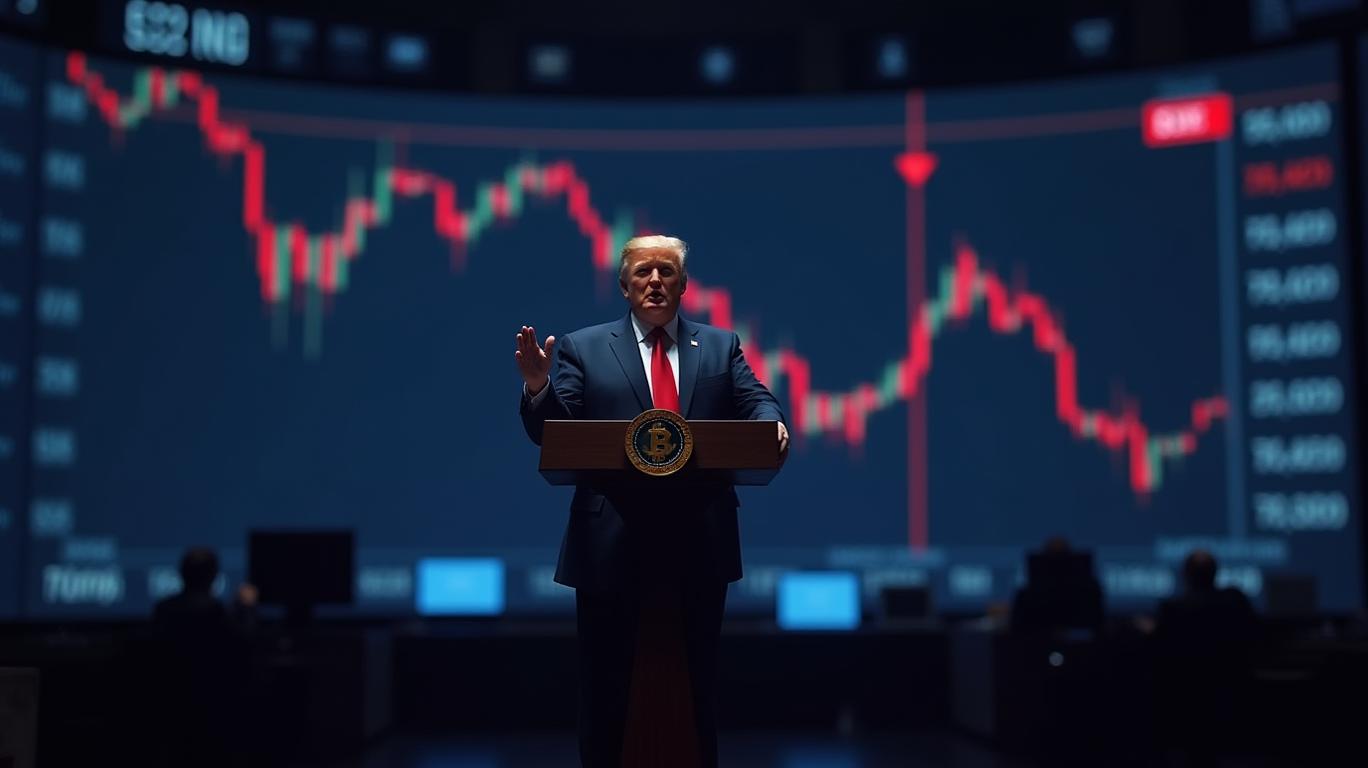
Bitcoin Drops 0.8% to $83,421.50 After Trump's Trade Policy Announcement
Bitcoin's price experienced a notable decline, dropping to approximately $83,400 following President Donald Trump's announcement of a comprehensive overhaul of U.S. trade policy. This policy includes a 10% universalUVV-- tariff on all imported goods, effective April 5, 2025, and additional reciprocal tariffs targeting specific nations with trade barriers against U.S. products, set to take effect on April 9, 2025. Under this new policy, China faces a combined tariff of 54%, with Japan at 24%, the European Union at 20%, India at 26%, and Vietnam at 46%. Additionally, a 25% tariff on foreign-made automobiles and key auto parts will take effect on April 3, 2025.
In response to these announcements, Bitcoin dropped 0.8% to $83,421.50, reflecting broader market concerns about potential global trade wars. Major U.S. stock index futures and most Asian stock indices also tumbled in response. Shares of crypto-related companies fell sharply in extended trading, with Coinbase GlobalCOIN-- shares dropping 7.5%, while Bitcoin miners Marathon Digital and Riot PlatformsRIOT-- slid 7.3% and 7% respectively. Strategy (formerly MicroStrategy) saw its shares fall 4.6% after the bell. Altcoins followed Bitcoin’s downward trend, with Ethereum falling 1.2% to $1,832.57, while XRP edged 0.2% lower to $2.0687. Solana declined 3.2%, Cardano fell 1.8%, and Polygon dropped 3.5%. Among meme tokens, Dogecoin lost 1%, while $TRUMP slumped over 7%.
Despite recent price struggles, key metrics suggest Bitcoin holders remain optimistic about long-term prospects. Bitcoin’s velocity, which measures the circulation of the cryptocurrency, dipped to a five-month low last week. This indicates that holders are becoming more cautious, with fewer coins being transacted. The reduced velocity reflects a shift in investor sentiment, with a general sense of hesitation among market participants. This cautious approach has contributed to Bitcoin’s sluggish price recovery. In contrast to short-term caution, mid-term holders (those holding for 3-6 months) have seen an increase in wealth during this period. Many are transitioning into long-term holders, showing strengthening investor confidence. Spending from this cohort has reached its lowest levels since mid-2021. This suggests that long-term holders are less likely to sell, even during periods of market uncertainty.
At the time of writing, Bitcoin’s price stands at $83,403, just below the crucial $85,000 resistance level. Earlier this week, Bitcoin surged to $88,500 but experienced a decline after Trump’s tariff announcements. The price has since stabilized above the $80,000 mark. For recovery to occur, Bitcoin must first reclaim $85,000 as support. A confirmed recovery would be marked by Bitcoin pushing past $89,800, potentially opening a path toward higher levels. If Bitcoin fails to breach $85,000 and circulation remains low, price could fall back to the next key support level at $80,301. Such a decline would invalidate the bullish outlook and could lead to further consolidation or bearish price action in the short term. Gold, meanwhile, was trading at a record high in Asian trading on Friday, highlighting investors’ shift toward traditional safe-haven assets during periods of economic uncertainty.

Stay ahead of the market.
Get curated U.S. market news, insights and key dates delivered to your inbox.
AInvest
PRO
AInvest
PRO



Comments
No comments yet