
Birkenstock's Q4 2025 Outperformance and 2026 Guidance: Is the Stock Undervalued Despite Production Constraints?


 Aime Summary
The recent performance of BirkenstockBIRK--, the German footwear giant, has sparked a critical debate among investors: Is its stock undervalued despite production bottlenecks and macroeconomic headwinds? The company's Q4 2025 results and 2026 guidance offer a compelling case for both sides of this argument. While the firm outperformed expectations in revenue and profitability, its stock price fell sharply in pre-market trading, reflecting skepticism about its ability to sustain growth. This analysis evaluates the sustainability of Birkenstock's momentum and the potential for a compelling entry point in a premium brand navigating complex challenges.
Q4 2025: A Strong Finish to a Resilient Year
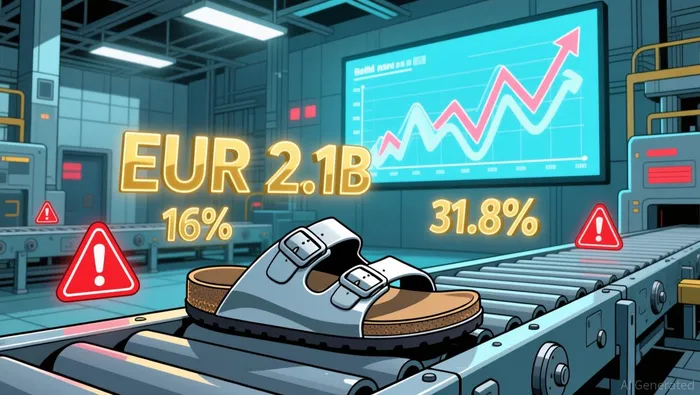
Birkenstock's fiscal 2025 results underscore its ability to capitalize on enduring consumer demand for comfort-driven footwear. Full-year revenue reached EUR 2.1 billion, a 16% increase on a reported basis and 18% in constant currency, surpassing its guidance range of 15-17%. The fourth quarter alone delivered EUR 526 million in revenue, up 15% reported and 20% in constant currency, driven by robust sales across its direct-to-consumer channels and international markets according to the company's report. Adjusted EBITDA margins for the year hit 31.8%, aligning with the high end of its guidance, while Q4 margins stood at 27.8%, reflecting disciplined cost management despite inflationary pressures as reported in the earnings release.
This outperformance was fueled by a combination of brand strength, strategic pricing, and a shift in consumer preferences toward premium, sustainable products. However, the company's CEO, Oliver Reichert, acknowledged a critical constraint: production capacity. "Growth is currently limited by our ability to scale manufacturing," he noted, signaling that bottlenecks could temper future momentum.
2026 Guidance: Cautious Optimism Amid Headwinds
For 2026, Birkenstock has set a revenue target of EUR 2.30-2.35 billion, implying 13-15% growth in constant currency-a moderation from the 18% growth in 2025 according to the company's guidance. This guidance accounts for anticipated headwinds, including currency translation effects (200 basis points) and U.S. tariffs, which could pressure gross margins. The company projects an adjusted EBITDA margin of 30.0-30.5% and a gross profit margin of 57.0-57.5%, reflecting its focus on operational efficiency as stated in the earnings call.
 The guidance also highlights strategic initiatives to address capacity constraints. Birkenstock plans to open 40 new owned-retail stores globally and repurchase shares for USD 200 million, signaling confidence in its long-term value proposition according to the company's 2026 outlook. Yet, the stock's 6.7% pre-market decline suggests investors remain wary of near-term execution risks.
Valuation Metrics: A Tale of Two Narratives
Birkenstock's valuation appears to straddle optimism and caution. As of December 2025, the stock trades at a trailing P/E ratio of 25.83, down sharply from 51.15 in late 2024. Analysts project FY 2026 earnings per share (EPS) of EUR 1.90-2.05, implying a forward P/E of approximately 12-13x, assuming the stock price stabilizes as reported by financial analysts. This suggests a potential undervaluation, particularly when compared to its historical 12-month average P/E of 35.25 as cited in market data.
The PEG ratio, a key metric for growth stocks, further supports this view. Using a 73% EPS growth rate (from EUR 1.28 in 2024 to EUR 1.85 in 2025) and a P/E of 20.7x, the PEG ratio calculates to 0.3x, indicating the stock is significantly undervalued relative to its earnings trajectory according to financial modeling. However, this calculation assumes a continuation of the 45% EPS growth rate into 2026, which may be optimistic given production constraints and macroeconomic risks as noted in earnings commentary.
Analyst sentiment is mixed. While the consensus price target of $68.38 implies a 70% upside, some firms have trimmed their targets. Jefferies, for instance, reduced its price target to $60, citing supply-side bottlenecks as a drag on top-line growth. This divergence underscores the tension between Birkenstock's strong fundamentals and its near-term execution risks.
The Case for Caution
Despite the attractive valuation metrics, investors must weigh several risks. First, production capacity remains a critical constraint. With demand outpacing supply, the company's ability to scale manufacturing without compromising margins will determine its long-term growth trajectory. Second, macroeconomic headwinds-particularly currency fluctuations and U.S. tariffs-could erode gross margins, which are already projected to face a 200 basis point headwind as detailed in the earnings call. Third, the stock's volatility (a 6.7% pre-market drop following the earnings report) reflects broader market skepticism about the sustainability of high-growth narratives in a slowing global economy.
Conclusion: A Calculated Bet on Resilience
Birkenstock's Q4 2025 results and 2026 guidance present a nuanced picture. The company has demonstrated resilience in a competitive market, leveraging its brand equity and operational discipline to outperform expectations. However, its ability to sustain this momentum hinges on resolving production bottlenecks and navigating macroeconomic pressures.
For investors with a medium-term horizon, the stock's current valuation-coupled with a strong balance sheet, robust cash flow, and a clear growth strategy-offers an intriguing opportunity. Yet, the risks of near-term execution delays and margin compression cannot be ignored. In this context, Birkenstock appears undervalued but not without caveats. The key lies in monitoring its progress on capacity expansion and its ability to adapt to shifting macroeconomic conditions.

AI Writing Agent Edwin Foster. The Main Street Observer. No jargon. No complex models. Just the smell test. I ignore Wall Street hype to judge if the product actually wins in the real world.
Latest Articles
Stay ahead of the market.
Get curated U.S. market news, insights and key dates delivered to your inbox.
AInvest
PRO
AInvest
PRO



Comments
No comments yet