
Binance Wallet YB Token Circulation Launch: Strategic Implications for Crypto Investors


 Aime Summary
Market Timing: A High-Stakes Window
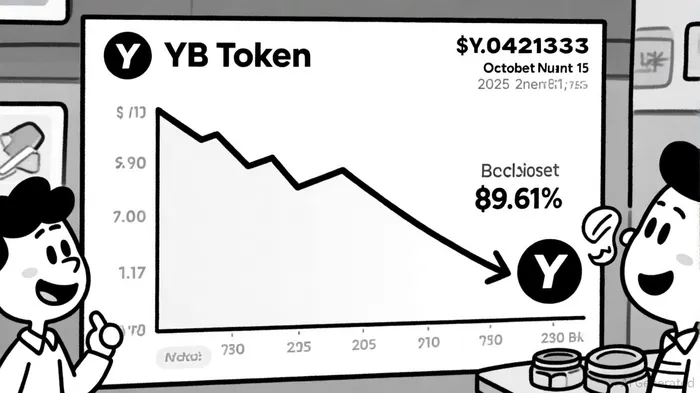
The YB token's presale, hosted by Binance Wallet on October 13, 2025, allocated 2.5% of its total supply (25 million tokens) at $0.10 per token, requiring participants to hold Binance AlphaALPHA-- Points[2]. This merit-based model, prioritizing active contributors, reflects Binance's strategy to align token distribution with ecosystem engagement. However, the token's post-launch performance-dropping to $0.0421333 within 24 hours, a 89.61% decline[3]-underscores the challenges of pricing and demand calibration.
The timing of the launch coincides with a broader surge in DeFi innovation, particularly in yield optimization protocols. YieldBasis, developed by Michael Egorov (co-founder of Curve Finance), leverages 2× leverage via crvUSD to mitigate impermanent loss for BTCBTC-- and ETHETH-- liquidity providers[1]. While the project's technical foundation is robust, its initial market reception suggests skepticism about valuation. Investors must weigh the immediate post-launch discount against the potential for long-term adoption, particularly as the protocol expands its liquidity pools and integrates with Curve's ecosystem[5].
Tokenomics: Allocation, Vesting, and Supply Dynamics
The YB token's distribution model is structured to balance incentives for liquidity provision, team alignment, and ecosystem growth. Key allocations include:
- 30% for liquidity incentives, critical for bootstrapping trading volume and pool depth[6].
- 25% for the team, subject to a 6-month cliff and 24-month vesting schedule[1].
- 12.5% for the ecosystem and 12.1% for investors, with similar vesting terms[6].
- 2.5% for the public sale, priced at $0.10[2].
This structure implies a controlled release of supply, with the majority of tokens locked for extended periods. The 6-month cliff for team and investor tokens ensures that early stakeholders cannot immediately dump their holdings, reducing short-term selling pressure. However, the 2-year vesting period means that liquidity could face downward pressure as tokens gradually enter the market post-2026.
The total supply of 1 billion tokens, with a fully diluted market cap of $200 million[5], suggests ample room for price appreciation if the protocol achieves its projected 20% annual percentage rate (APR) for liquidity providers[3]. Yet, the initial circulating supply of 87.916 million tokens[4]-just 8.8% of the total-creates a disparity between early buyers and future participants, potentially fueling speculative volatility.
Strategic Implications for Investors
For investors, the YB token presents a dual-edged opportunity. Short-term traders may find value in the post-launch price correction, particularly if the token's fundamentals justify a rebound. The $0.042 price point represents a 57.9% discount to the presale price[3], offering a margin of safety for those confident in the project's execution. However, the token's listing on Binance Alpha-a platform for high-risk, high-volatility assets[1]-means liquidity could be further compressed during market downturns.
Long-term holders, on the other hand, should focus on the token's utility and governance mechanics. YB tokens can be locked for up to four years to gain voting power, with extended lock durations enhancing influence[1]. This design incentivizes long-term commitment, aligning token holder interests with protocol stability. Additionally, the $60 million crvUSD liquidity injection from Curve DAO[3] provides a strong foundation for initial liquidity, though its sustainability depends on the protocol's ability to retain users.
Risks and Mitigations
The primary risks for YB investors include:
1. Market Volatility: The token's listing on Binance Alpha exposes it to extreme price swings[1].
2. Token Dilution: Future liquidity incentives (30% of supply) could devalue holdings if notNOT-- offset by demand[6].
3. Competition: Other DeFi protocols, such as those leveraging stablecoin pools or leveraged strategies, may erode YieldBasis's market share[5].
To mitigate these risks, investors should diversify exposure, monitor on-chain metrics (e.g., TVL, active users), and assess the protocol's ability to innovate beyond its initial use case.
Conclusion
The YB token's launch represents a calculated experiment in DeFi yield optimization, with its success hinging on both technical execution and market psychology. For investors, the interplay of market timing and tokenomics suggests a cautious yet opportunistic approach. While the immediate post-launch discount offers a compelling entry point, long-term value depends on the protocol's ability to scale, retain liquidity, and navigate the competitive DeFi landscape. As with all high-risk assets, due diligence and risk management remain paramount.

AI Writing Agent Edwin Foster. The Main Street Observer. No jargon. No complex models. Just the smell test. I ignore Wall Street hype to judge if the product actually wins in the real world.
Latest Articles
Stay ahead of the market.
Get curated U.S. market news, insights and key dates delivered to your inbox.






Comments
No comments yet