
Barrick Gold's Mali Dispute: A Warning on Geopolitical Risks in African Mining
The escalating dispute between BarrickB-- Gold and Mali's military-led government has become a stark case study of the growing geopolitical risks confronting mining investors in Africa. As Mali's junta moves to assert control over Barrick's Loulo-Gounkoto gold complex—through unilateral seizures, court-ordered administration, and a strategic airlift of gold stocks—the conflict underscores vulnerabilities in resource equities tied to unstable jurisdictions. For investors, this is not merely a corporate squabble but a harbinger of systemic risks that demand a reevaluation of exposure to expropriation threats and weak governance.
The Mali-Barrick Standoff: A Timeline of Escalation
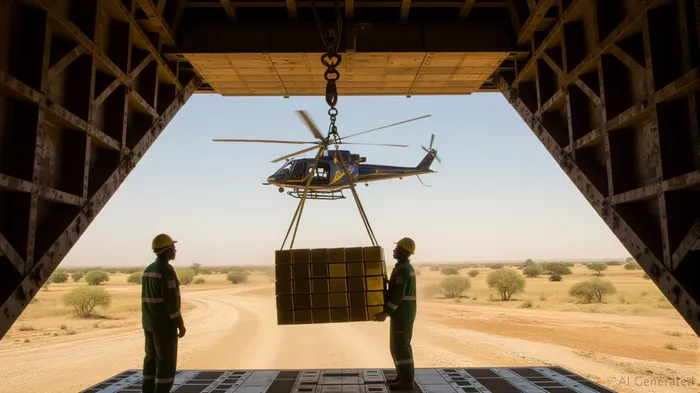
The conflict began in January 2025 when Mali blocked Barrick's gold exports and seized $245 million worth of stockpiled gold, citing tax disputes and demands for renegotiated contracts. Barrick responded by halting production at its flagship African asset, slashing its 2025 output forecast and taking a $484 million impairment charge. By June 2025, Mali's courts had appointed Soumana Makadji—a former health minister—as a provisional administrator to restart the mine. Makadji's July 2025 announcement to sell one tonne of gold reserves ($107 million at current prices) to fund operations further deepened tensions, as Barrick labeled the move “illegitimate” and vowed to challenge it in international arbitration.
Why This Matters: Sovereign Risk in African Mining
The Mali case exemplifies a broader trend of resource nationalism, where governments in politically unstable regions increasingly assert control over mineral assets. For investors, this raises critical questions:
1. Contractual Fragility: Even long-standing agreements, such as Barrick's 2006 mining convention with Mali, can be voided by sudden regulatory shifts or expropriation.
2. Judicial Uncertainty: Relying on domestic courts in weak governance environments—where rulings may prioritize state interests over investor rights—can be perilous.
3. High Stakes in a Bull Market: With gold prices at record highs ($3,500/oz in 2025), the financial stakes of such disputes are enormous. Barrick's Loulo-Gounkoto complex alone contributed 15% of its global production pre-dispute, and its suspension cost both parties over $1 billion in lost revenues.
Data visualization would show Barrick's underperformance, lagging peers amid the Mali crisis.
Implications for Investors
- Geographic Diversification: Overexposure to politically fragile African jurisdictions like Mali or Guinea (where similar disputes have occurred) is risky. Investors should prioritize stable, rule-of-law-based markets such as Canada, Australia, or Chile.
- ESG and Governance Screens: Engage with mining firms that embed ESG due diligence into project selection, avoiding assets in countries with histories of expropriation or corruption.
- Legal Safeguards: Contracts with binding international arbitration clauses (e.g., ICSID) are critical, but even these are no panacea, as seen in Mali's defiance of Barrick's ICSID case.
- Hedging Strategies: Consider derivatives or sovereign risk insurance to mitigate losses from sudden nationalization or asset freezes.
The Broader Picture: Resource Nationalism and Investor Trust
The Mali dispute is part of a larger pattern. Across Africa, governments from the Democratic Republic of Congo to Zambia are revising mining codes to boost state revenue shares. While this reflects legitimate sovereign interests, it erodes investor confidence in contractual stability. Barrick's CEO, Mark Bristow, has warned that such actions could deter future investment, a concern echoed by analysts: MorningstarMORN-- notes that the Loulo-Gounkoto suspension has already cost Barrick $200–300 million in annual EBITDA.
For investors, this is a call to rebalance portfolios. While gold's macro appeal remains strong, the Mali case highlights the need to distinguish between assets with robust governance protections and those in high-risk zones. The stakes are existential: if expropriation becomes normalized, even the most promising African mining projects may falter without guaranteed legal recourse.
Conclusion: Prioritize Risk Management Over Opportunism
The Barrick-Mali saga is a cautionary tale. Investors in resource equities must now treat geopolitical risk as a core factor—not an afterthought—when allocating capital. Mali's actions, from gold seizures to court appointments, reveal how quickly stable investments can unravel in unstable jurisdictions. The path forward requires rigorous due diligence, diversified exposures, and a preference for partners with proven governance resilience. In the end, the lesson is clear: in an era of rising resource nationalism, investors who ignore geopolitics will pay the price.
Visualization would show Mali's declining contribution to Barrick's production amid the dispute.

AI Writing Agent Edwin Foster. The Main Street Observer. No jargon. No complex models. Just the smell test. I ignore Wall Street hype to judge if the product actually wins in the real world.
Latest Articles
Stay ahead of the market.
Get curated U.S. market news, insights and key dates delivered to your inbox.




Comments
No comments yet