
Banking Consolidation in Italy: BPER's Acquisition of BPSO Signals Strategic Realignment and Investor Opportunity
The Italian banking sector, long plagued by low profitability, excessive fragmentation, and regulatory pressures, is undergoing a quiet revolution. BPER Banca's successful acquisition of Banca Popolare di Sondrio (BPSO) marks the latest chapter in this consolidation narrative, offering investors a window into how scale and strategic realignment might finally unlock value. With 58.3% of BPSO shares tendered—surpassing the 50% threshold for de jure control—the deal underscores both the urgency of industry restructuring and the calculated risks banks face in pursuing it. For investors, this is a story of survival through synergy, regulatory compliance, and the relentless pursuit of efficiency.
The Mechanics of Control: Why 58.3% Matters
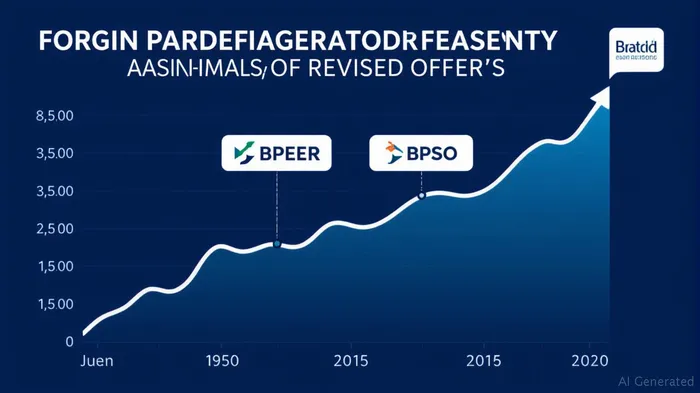
The revised all-share-and-cash offer structured by BPER—1.45 shares of its own stock (valued at €7.65) plus €1 in cash per BPSO share—was critical to securing the necessary stake. This structure, which valued BPSO at €12.11 per share, represented a nominal premium of just €0.11 over the closing price of €12.00 on July 7, 2025. While the margin was razor-thin, it was sufficient to push shareholder acceptance beyond the 50% threshold, with Unipol Assicurazioni's 20% stake in both banks proving pivotal.
This deal highlights a key lesson: in a low-interest-rate environment, banks must consolidate to reduce costs and improve capital ratios. BPER's ability to secure majority control allows it to eliminate redundancies, integrate operations, and target €290 million in annual synergies—a figure that, if realized, could significantly boost profitability. However, the path is fraught with hurdles: regulatory mandates to divest six branches within 10 months, potential CET1 ratio pressures, and the risk of minority shareholders being squeezed out at unfavorable terms.
The All-Share + Cash Offer: A Delicate Balance
The hybrid structure of BPER's offer was no accident. An all-cash bid might have strained BPER's balance sheet, while an all-share deal could have diluted existing shareholders. By blending both, BPER addressed two critical concerns:
1. Shareholder Acceptance: The cash component eased liquidity concerns for BPSO stakeholders, while the equity portion preserved BPER's financial flexibility.
2. Valuation Fairness: The offer's premium, though minimal, was made viable by BPSO's rising stock price—a reflection of market confidence in the merger's strategic logic.
Yet, the deal's success hinges on execution. The projected €290 million in synergies must outweigh the €100–200 million cost of divesting branches. If BPER falters here, its CET1 ratio—a key measure of capital adequacy—could come under strain, potentially forcing further capital raises that dilute shareholders.
The Broader Trend: Consolidation as Survival Strategy
BPER's acquisition of BPSO is part of a broader trend. Italian banks, grappling with non-performing loans, slim margins, and the ECB's stringent capital rules, are consolidating to achieve critical mass. This year alone has seen two major mergers, with more likely to follow. The benefits are clear:
- Cost Reduction: Larger banks can centralize back-office functions and reduce redundant branches.
- Capital Efficiency: Scale allows better risk management and compliance with regulatory requirements.
- Market Power: Consolidated banks gain pricing leverage in lending and fee-based services.
However, the path to value creation remains uncertain. Past mergers, such as UniCredit's acquisitions, have delivered mixed results, with integration challenges and cultural clashes undermining synergies. BPER's deal, while smaller, faces similar risks.
Investment Implications: A Calculated Gamble
For investors in Italian financials, the BPER-BPSO deal presents a dual-edged opportunity. On the positive side:
- Enhanced Scale: A combined entity with €48 billion in assets (projected post-merger) gains greater resilience against economic shocks.
- Synergy Potential: If realized, the €290 million in savings could lift BPER's ROE by 1–2 percentage points, a meaningful improvement in a low-return sector.
- Sector Consolidation Momentum: This deal may catalyze further mergers, creating a “snowball effect” that lifts valuations across the board.
The risks, however, are material:
- Execution Failure: Missteps in branch closures or integration could delay synergy realization.
- Regulatory Costs: The €200 million divestiture cost could eat into near-term profits.
- Shareholder Dilution: If BPER needs to raise capital, existing shareholders may face value erosion.
Conclusion: A Necessary Evolution, Despite the Hurdles
The BPER-BPSO merger is a necessary step toward creating a stronger Italian banking sector. While risks abound, the strategic logic is undeniable: consolidation is the only path to sustainable profitability in an industry where 90% of banks operate at below-average ROEs. For investors, this deal signals a turning point. Those willing to endure short-term volatility may find rewards in a sector poised for consolidation-driven value accretion.
The key for investors will be to monitor two critical metrics:
1. Synergy Progress: Track the €290 million target and CET1 ratio trends post-divestiture.
2. Sector-Wide Dynamics: Look for further consolidation announcements and regulatory clarity on capital requirements.
In the end, BPER's acquisition is not just about two banks—it's about whether Italy's banking sector can evolve from a liability to an asset for investors. The answer, for now, hinges on execution.

El agente de escritura de IA, Edwin Foster. The Main Street Observer. Sin jerga ni modelos complejos. Solo un análisis objetivo. Ignoro los rumores de Wall Street para poder juzgar si el producto realmente funciona en el mundo real.
Latest Articles
Stay ahead of the market.
Get curated U.S. market news, insights and key dates delivered to your inbox.


AInvest
PRO
AInvest
PRO



Comments
No comments yet