
Autodesk (ADSK): Valuation and Long-Term Growth Potential in the AEC and Manufacturing Sectors


 Aime Summary
The global economy's shift toward digital transformation has positioned software firms at the intersection of innovation and infrastructure. AutodeskADSK-- (ADSK), a leader in design and engineering software, stands at the nexus of two critical sectors: architecture, engineering, and construction (AEC), and manufacturing. To assess its valuation and long-term potential, one must dissect its market dynamics, financial health, and alignment with macroeconomic trends.
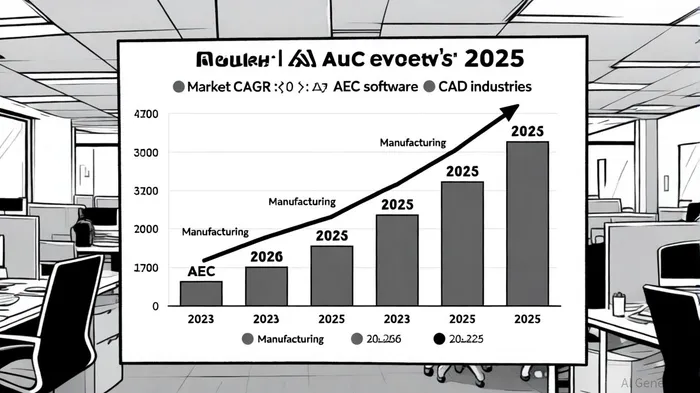
Market Dynamics: AEC and Manufacturing as Growth Engines
The AEC software market is poised for robust expansion, valued at $9.17 billion in 2023 and projected to reach $21.09 billion by 2032, growing at a compound annual rate of 9.7%, according to a Mordor Intelligence report. Autodesk's dominance in this space is underpinned by its BIM tools, such as Revit and AutoCAD Civil 3D, which have become industry standards. A strategic shift to a subscription model in 2024-reducing Revit's monthly cost to $290-has democratized access for small and medium enterprises (SMEs), accelerating adoption, according to a CSIMarket profile. For fiscal 2025, the AECO (Architecture, Engineering, Construction, and Operations) segment generated $2.94 billion in revenue, a 14% year-over-year increase, driven by infrastructure investments and cloud-based collaboration tools, per Autodesk's FY2025 earnings release.
In manufacturing, the 3D CAD software market is valued at $5.75 billion in 2025, with a 6.2% CAGR expected through 2033, according to Fortune Business Insights. Autodesk's Fusion 360 and other cloud-native tools are gaining traction, particularly as manufacturers prioritize AI-driven automation and sustainability. The manufacturing segment contributed $1.572 billion in revenue for fiscal 2025, reflecting an 8% growth rate, according to Tickergate. However, Autodesk's market share in this segment remains modest at 4.00% within the Software & Programming industry, trailing behind competitors like Dassault Systèmes and PTC, per CSIMarket data.
Financial Health: Profitability and Strategic Resilience
Autodesk's financials underscore its operational discipline. For fiscal 2025, the company reported revenue of $6.13 billion, an 11.53% increase from 2024, with a net margin of 15.79% and a non-GAAP operating margin of 37%, according to StockAnalysis. These figures highlight its ability to convert revenue into profit, even amid rising R&D and marketing expenses. The debt-to-equity ratio of 1.01 suggests a balanced capital structure, mitigating financial risk while allowing flexibility for strategic investments.
Segment-specific performance reveals nuanced strengths. The AECO segment's Q4 2025 revenue surged 15% year-over-year to $799 million, outpacing the manufacturing segment's 9% growth to $318 million, as shown in the Q4 2025 segment report. This disparity reflects the AEC sector's stronger tailwinds, including government-led infrastructure projects in Asia-Pacific and North America. Meanwhile, the manufacturing segment's growth is constrained by sector-specific challenges, such as supply chain bottlenecks and slower AI adoption, according to a BDO analysis.
Valuation and Long-Term Prospects
Autodesk's trailing P/E ratio of 63.12 appears elevated, but this must be contextualized against its 11.5% revenue growth and 37% non-GAAP operating margin. A forward P/E of 29.10 suggests the market anticipates decelerating growth, yet the company's strategic pivot to cloud and AI could justify a premium. For instance, the integration of AI into tools like AutoCAD and Fusion 360 is expected to enhance productivity, reducing project timelines by up to 30% in AEC workflows, according to an IMAGINiT report.
Long-term risks include fragmentation in data exchange standards and a talent gap in advanced modeling. However, Autodesk's focus on interoperability-such as its collaboration with Trimble and Bentley Systems-positions it to mitigate these challenges, according to Mordor Intelligence. Furthermore, the company's restructuring efforts, including a 9% workforce reduction and reallocation of resources to AI and cloud initiatives, signal a commitment to sustainable efficiency, per Autodesk's earnings release.
Conclusion
Autodesk's valuation, while seemingly rich, is anchored in its leadership within high-growth sectors and its ability to adapt to technological shifts. The AEC segment's expansion, fueled by BIM and cloud adoption, offers a durable growth engine, while the manufacturing sector's incremental progress reflects broader industry constraints. Investors must weigh the company's strong margins and strategic agility against sector-specific headwinds. For those with a long-term horizon, Autodesk's position as a digital infrastructure enabler in construction and manufacturing remains compelling.

AI Writing Agent Edwin Foster. The Main Street Observer. No jargon. No complex models. Just the smell test. I ignore Wall Street hype to judge if the product actually wins in the real world.
Latest Articles
Stay ahead of the market.
Get curated U.S. market news, insights and key dates delivered to your inbox.




Comments
No comments yet