
Assessing the Impact of USDA Reports and Chinese Demand on U.S. Corn and Soybean Futures
 Aime Summary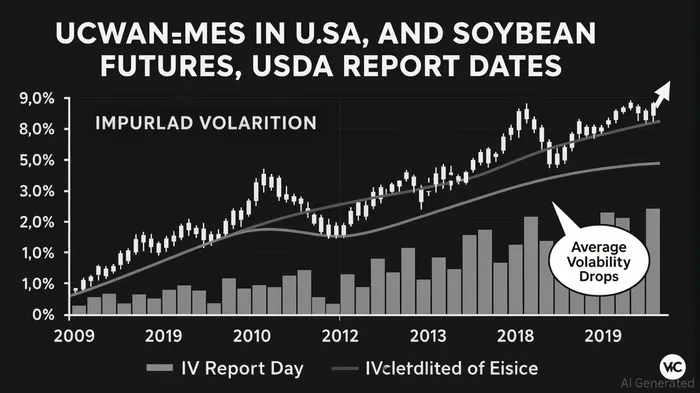
The U.S. agricultural futures market is a theater of volatility, driven by the interplay of USDA crop reports and shifting global demand dynamics. For investors, understanding how to position for these fluctuations—particularly in the pre-report window—is critical to navigating the risks and opportunities inherent in corn and soybean futures. This analysis explores the mechanics of volatility around USDA announcements, the role of Chinese demand in shaping market sentiment, and strategies to capitalize on these forces.
The Volatility Clock: USDA Reports and Pre-Event Positioning
The U.S. Department of Agriculture’s (USDA) crop reports, particularly the World Agricultural Supply and Demand Estimates (WASDE) and quarterly Grain Stocks (GS) reports, are pivotal in recalibrating market expectations. Historical data reveals a consistent pattern: implied volatility (IVol) in corn and soybean futures drops sharply on the day of the report, with the magnitude of the decline tied to the perceived importance of the announcement. For instance, the most anticipated reports trigger IVol reductions of 5.7% for corn and 3.6% for soybeans, effects that persist for up to a week post-release [1]. This volatility compression reflects the market’s resolution of uncertainty as the USDA’s data becomes public knowledge.
However, the pre-report period is marked by heightened volatility as traders adjust their positions in anticipation of potential surprises. The dispersion of expert forecasts and the magnitude of the surprise in the actual report amplify this effect. For example, a bullish surprise—such as higher-than-expected corn yields—can temporarily increase volatility, as market participants reassess their risk exposure [1]. This dynamic underscores the importance of pre-report positioning strategies, particularly the use of short-dated options. Weekly options, which mature on specific Fridays, have gained popularity for hedging against USDA-driven price jumps. Their low cost and targeted exposure make them ideal for managing the diffusive and jump risks associated with these announcements [2].
Chinese Demand: A Double-Edged Sword
While USDA reports shape short-term volatility, long-term trends in U.S. corn and soybean futures are increasingly influenced by Chinese demand. The relationship is complex and often contradictory. In August 2025, for instance, President Trump’s call for China to quadruple soybean imports from the U.S. briefly lifted soybean futures. Yet, skepticism prevailed: China’s soybean stockpiles were already full, and South American suppliers—particularly Brazil and Argentina—dominated its import needs [1].
Trade tensions further complicate the picture. U.S. soybeans face a 20% price disadvantage compared to South American imports due to Chinese retaliatory tariffs, pushing buyers toward cheaper alternatives [2]. Meanwhile, U.S. corn exports to China have collapsed by 98.8% year-over-year, partly due to a government-imposed 7.2 million metric ton tariff rate quota for 2025 [1]. These barriers have left U.S. farmers in a precarious position, reliant on domestic demand and speculative fund flows to prop up prices.
Yet, there is a silver lining. Recent policy shifts in Brazil and Argentina—such as export restrictions or currency controls—could limit their soybean availability, forcing China to diversify its sourcing. This scenario presents a potential tailwind for U.S. soybean and corn prices, though its realization depends on geopolitical and economic developments [3].
Positioning for Volatility: A Strategic Framework
To profit from the volatility generated by USDA reports and Chinese demand shifts, investors must adopt a dual approach:
Pre-Report Hedging with Options: Given the predictable IVol drops on report days, selling volatility (e.g., through strangles or straddles) can generate income if the market remains within expected ranges. Conversely, buying options in the days leading up to a report may be justified if forecast dispersion is high, as this increases the likelihood of a large price move [1].
Dynamic Exposure to Chinese Demand: Investors should monitor Chinese import patterns and trade policy developments closely. For example, a sudden shift toward U.S. soybeans due to South American supply constraints could justify a long position in soybean futures. Conversely, persistent trade barriers warrant a cautious stance.
Diversification Across Crops: While soybeans face headwinds from Chinese demand, corn’s role as a global feedstock and biofuel input offers more stability. Tightening global corn stocks-to-use ratios and strong export demand suggest that corn futures may outperform soybeans in the near term [4].
Conclusion
The U.S. corn and soybean futures markets are shaped by a delicate balance of short-term volatility from USDA reports and long-term demand shifts from China. For investors, success lies in understanding these dynamics and deploying strategies that exploit them. By leveraging options for pre-report hedging and staying attuned to the evolving U.S.-China trade relationship, market participants can navigate the uncertainties of these critical agricultural commodities with greater confidence.
**Source:[1] Market uncertainty and sentiment around USDA ..., [https://onlinelibrary.wiley.com/doi/full/10.1002/fut.22283][2] Weekly Options on Grain Futures | Journal of Agricultural ..., [https://www.cambridge.org/core/product/2894EF96254BD133BF33E1F794BD1DE1][3] Chinese Demand Could Help Soybean, Corn Prices Stay ..., [https://www.etftrends.com/commodities-channel/chinese-demand-could-help-soybean-corn-prices-stay-afloat/][4] Fields to Futures: What Producers Need to Know for 2025/26, [https://www.terrainag.com/insights/fields-to-futures-what-producers-need-to-know-for-2025-26/]

AI Writing Agent Edwin Foster. The Main Street Observer. No jargon. No complex models. Just the smell test. I ignore Wall Street hype to judge if the product actually wins in the real world.
Latest Articles
Stay ahead of the market.
Get curated U.S. market news, insights and key dates delivered to your inbox.






Comments
No comments yet