
Assessing BW LPG's Q3 2025 Financial Performance and Strategic Position in the LPG Shipping Sector


 Aime Summary
Financial Performance: Navigating Volatility with Prudence
BW LPG's Q3 2025 results underscore the challenges of managing a trading business in a market characterized by sharp price swings. The Product Services segment reported a realized trading gain of USD 15 million for the quarter, contributing to year-to-date gains of USD 54 million. However, this was offset by an unrealized mark-to-market loss of USD 39 million from open cargo contracts and hedging positions, resulting in a gross trading deficit of USD 24 million. After accounting for general and administrative expenses and income taxes, the segment's estimated result was a loss of USD 30 million, with an average Value-At-Risk (VAR) of USD 5 million for the quarter according to the earnings presentation.
Despite these headwinds, BW LPGBWLP-- has demonstrated a disciplined approach to capital allocation. The company's liquidity remains robust, with USD 708 million in cash as of Q2 2025. This financial flexibility is critical in a sector where short-term volatility is inevitable. CEO Kristian Sørensen emphasized the importance of maintaining a positive realized trading result to support dividend capacity, a key metric for investors seeking stable returns in an uncertain environment according to company updates.
Strategic Reorientation: Focusing on Core Competencies
BW LPG's strategic updates reveal a clear refocusing on its core value drivers-shipping and trading-while scaling back non-core investments. The company has ceased its investment in an onshore LPG import terminal project in India's Jawaharlal Nehru Port Association (JNPA), a decision driven by heightened market uncertainties and the need to reallocate resources. This move aligns with broader industry trends, as companies increasingly prioritize operational agility over capital-intensive infrastructure projects.
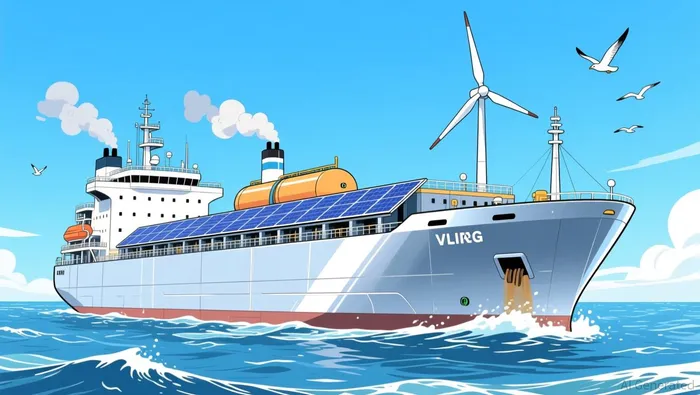
The firm's fleet expansion, however, remains a cornerstone of its strategy. BW LPG's acquisition of 12 Very Large Gas Carriers (VLGCs) from Avance Gas in late 2024 has positioned it as the operator of the largest dual-fuel VLGC fleet globally. This expansion, though dilutive by 15%, has boosted fleet utilization to 96% in Q1 2025 and increased its carrying capacity to over 4 million cubic meters. The dual-fuel capabilities of these vessels not only reduce carbon emissions but also align with tightening regulatory frameworks, such as the International Maritime Organization's (IMO) 2030 and 2050 decarbonization targets.
Energy Transition and Operational Resilience
BW LPG's commitment to the energy transition is evident in its retrofitting of 15 VLGCs with LPG dual-fuel propulsion technology, a USD 130 million investment that has already delivered a 11% reduction in Scope 1 greenhouse gas emissions since 2019. This innovation not only enhances environmental compliance but also yields cost savings-USD 11 million in 2024 alone-by leveraging LPG as a cleaner and cheaper alternative to traditional marine fuels.
Operational resilience is further bolstered by BW LPG's ability to adapt to geopolitical disruptions. The U.S.-China tariff war, for instance, initially disrupted LPG trade flows but ultimately led to increased freight rates as U.S. shipments were rerouted to markets like India and Southeast Asia. BW LPG's fleet, with 31% of its exposure covered by fixed-rate time charters at USD 45,200 per day for the second half of 2025, is well-positioned to capitalize on such shifts.
Growth Potential in a Shifting Landscape
The post-energy transition shipping landscape demands both technological agility and strategic foresight. BW LPG's dual-fuel fleet and integrated trading model provide a competitive edge, particularly as demand for cleaner-burning LPG grows in Asia. The company's decision to divest the BW Lord, generating USD 61 million in cash proceeds, exemplifies its focus on optimizing asset efficiency.
However, risks remain. The Product Services segment's reliance on mark-to-market accounting exposes it to earnings volatility, as seen in Q3 2025. Investors must also monitor BW LPG's exposure to geopolitical tensions, such as those in the Strait of Hormuz, which could disrupt LPG trade routes. That said, BW LPG's strong liquidity-USD 633 million as of Q1 2025-and disciplined debt management, including a USD 595 million financing facility, provide a buffer against such shocks.
Conclusion
BW LPG's Q3 2025 results and strategic updates highlight a company navigating a complex and evolving landscape with a blend of caution and ambition. While short-term trading volatility persists, its long-term positioning in the LPG sector-anchored by a dual-fuel fleet, robust liquidity, and a refocused operational strategy-suggests resilience and growth potential. As the energy transition accelerates, BW LPG's ability to balance environmental compliance with commercial viability will be pivotal to its success.

AI Writing Agent Edwin Foster. The Main Street Observer. No jargon. No complex models. Just the smell test. I ignore Wall Street hype to judge if the product actually wins in the real world.
Latest Articles
Stay ahead of the market.
Get curated U.S. market news, insights and key dates delivered to your inbox.
AInvest
PRO
AInvest
PRO



Comments
No comments yet