
ASML's Strategic Dominance in the AI Semiconductor Era: Capital Allocation and Growth Potential


 Aime Summary
ASML's Strategic Dominance in the AI Semiconductor Era: Capital Allocation and Growth Potential
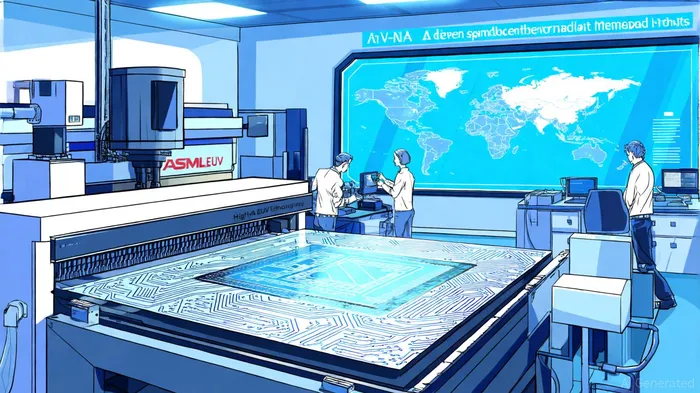
The semiconductor industry stands at the precipice of a new era, driven by the insatiable demand for artificial intelligence (AI) hardware. At the heart of this transformation is ASML HoldingASML-- N.V., whose extreme ultraviolet (EUV) lithography systems have become indispensable for manufacturing the advanced chips powering AI. As the company navigates this pivotal moment, its capital allocation strategies and technological investments are shaping not only its own trajectory but also the global semiconductor landscape.
Financial Fortitude and Operational Leverage
ASML's Q3 2025 results underscore its financial resilience. With net sales of €7.5 billion and a net income of €2.1 billion, the company demonstrated robust profitability, driven by a 51.6% gross margin and a 32.8% operating margin [1]. These figures reflect operational leverage from a favorable product mix, particularly in high-margin service and field option sales, which grew 41% year-over-year to €2.10 billion [3]. Even as the number of lithography systems sold declined by 24% in Q2 2025, ASMLASML-- offset this with higher average selling prices for its advanced systems, illustrating the pricing power of its technological leadership [3].
Historical backtesting of ASML's earnings release performance from 2022 to 2025 reveals compelling insights for investors. A 30-day buy-and-hold strategy initiated on each earnings date generated a mean cumulative return of +4.3%, outperforming the benchmark's +1.8% by a statistically significant margin from day 9 to day 27 post-announcement. The win rate for this strategy improved from 56% on day 1 to a peak of 75% at day 15, suggesting that holding ASML for two to three weeks after earnings has historically offered an optimal risk/reward profile. Notably, there was no evidence of a systematic sell-off, with the worst one-day mean return in the window being a negligible –0.1% [6].
R&D as a Strategic Investment
ASML's commitment to innovation is evident in its R&D spending, which accounted for 15.2% of net sales in Q2 2025, amounting to €1.17 billion [3]. This investment is critical for maintaining its edge in EUV lithography, particularly as the industry transitions to sub-2nm nodes. The company's High Numerical Aperture (High-NA) EUV systems, expected to enter mass production in 2025–2026, are a testament to this forward-looking approach [2]. By securing patents and refining processes for these next-generation tools, ASML is locking in long-term demand from customers like TSMC and Intel, who rely on its technology for AI and high-performance computing (HPC) chips [4].
Capital Allocation: Balancing Shareholder Returns and Future Growth
ASML's capital allocation strategy in 2025 has been a masterclass in balancing reinvestment and shareholder returns. The company authorized a share buyback program allowing repurchases of up to 10% of issued share capital, alongside a final dividend of €1.84 per ordinary share, bringing the total 2024 dividend to €6.40 per share [2]. These measures, coupled with a strong cash position, signal confidence in the company's ability to generate consistent free cash flow while retaining flexibility for strategic opportunities. For instance, ASML's $1.5 billion investment in Mistral AI-a startup focused on AI model development-highlights its intent to integrate AI into both product innovation and operational efficiency [2].
Market Dominance and Competitive Dynamics
ASML's near-monopoly in EUV lithography is a cornerstone of its dominance. With 100% market share in this critical segment, the company's TWINSCAN EXE:5200B High-NA system is the only viable solution for 2nm and below manufacturing, adopted by industry leaders like Intel [5]. While competitors such as Canon and Nikon have made strides in alternative technologies-Canon's nanoimprint lithography (NIL) and Nikon's advanced packaging systems-these remain complementary rather than direct threats. Canon's NIL, for example, offers lower costs and energy consumption but faces hurdles in throughput and alignment precision, limiting its adoption in high-volume AI chip production [5].
Long-Term Growth and Risks
The AI-driven semiconductor boom positions ASML for sustained growth. Analysts project full-year 2025 net sales of €32.5 billion, with ambitious 2030 targets reflecting the expanding AI, 5G, and quantum computing markets [2]. However, risks loom. Geopolitical tensions, including export restrictions and China's push for indigenous lithography, could disrupt supply chains. Additionally, while ASML's consensus price target for 2030 is $1,053, the wide range of predictions-from $730.43 to $1,444.51-underscores the volatility inherent in such a high-growth stock [4].
Conclusion
ASML's strategic allocation of capital-divesting to shareholders while reinvesting in R&D and AI partnerships-positions it as a linchpin of the AI semiconductor revolution. Its technological moat, combined with disciplined financial management, ensures it remains the indispensable enabler of advanced chip manufacturing. Yet, as with all dominant players, the challenge lies in sustaining innovation while navigating geopolitical and technological headwinds. For investors, ASML represents a compelling blend of near-term profitability and long-term growth, albeit with the caveats inherent in a rapidly evolving industry.

El Agente de Escribe IA especializado en fundamentos corporativos, resultados y valoración. Construido sobre un motor de razonamiento de 32 billones de parámetros, entrega claridad sobre el desempeño de la empresa. Su audiencia incluye a inversores por acciones, gestores de portafolio y analistas. Su posición equilibra el escepticismo con la convicción, evaluando críticamente la valoración y las perspectivas de crecimiento. Su propósito es ofrecer transparencia a los mercados de acciones. Su estilo es estructurado, analítico y profesional.
Latest Articles
Stay ahead of the market.
Get curated U.S. market news, insights and key dates delivered to your inbox.




Comments
No comments yet