
Is Ascendis Pharma (ASND) Still Undervalued Despite Its Strong 69.72% One-Year Total Shareholder Return?


 Aime Summary
The question of whether Ascendis PharmaASND-- (ASND) remains undervalued despite its robust 69.72% one-year total shareholder return hinges on a delicate balance between its current valuation metrics, the realism of its discounted cash flow (DCF) assumptions, and the progress of its regulatory and commercial catalysts. While the stock has surged, its valuation appears to rest on ambitious expectations for future growth, particularly in the context of its pipeline and market dynamics.
Valuation Metrics: A Tale of Optimism and Skepticism
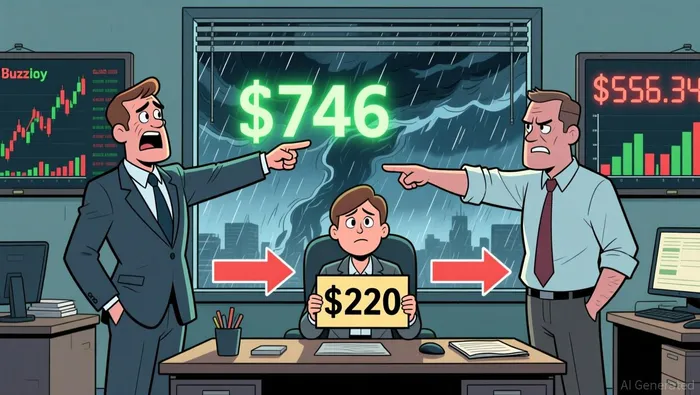
Ascendis Pharma's current price-to-earnings (P/E) ratio of -51.90, as of December 2025, starkly contrasts with its historical average of -29.4 and industry peers such as Vertex Pharmaceuticals (P/E 29.53) and Regeneron Pharmaceuticals (P/E 20.21) according to financial data. A negative P/E ratio underscores the company's unprofitability but also signals investor confidence in future earnings recovery. However, this optimism is not universally shared. DCF analyses reveal a significant divergence: Simply Wall St estimates an intrinsic value of $746 per share, implying a 70.4% discount to the current price of $220, while another model suggests a negative intrinsic value of $556.34, recommending a sell according to DCF modeling. This disparity highlights the sensitivity of DCF models to assumptions about growth rates and cash flow timing, particularly for a company with unproven commercial scalability.
Regulatory and Commercial Catalysts: Progress Amid Uncertainty
The most critical near-term catalyst for ASNDASND-- is the FDA's review of TransCon CNP (navepegritide), its investigational therapy for achondroplasia. The FDA extended the PDUFA date to February 28, 2026, following a major amendment submission related to post-marketing requirements. While this delay introduces timing uncertainty, it does not necessarily signal regulatory rejection. CEO Jan Mikkelsen has emphasized the company's commitment to finalizing the post-marketing study protocol, suggesting confidence in eventual approval. If approved, TransCon CNP could capture a significant share of the achondroplasia market, which is projected to grow from $1.1 billion in 2024 to $2.4 billion by 2030, driven by orphan drug pricing power and unmet medical needs according to market research.
Meanwhile, ASND's existing commercial products-YORVIPATH and SKYTROFA-have demonstrated resilience. Q3 2025 revenue reached €214 million, with YORVIPATH contributing €143.1 million and SKYTROFA €50.7 million. This performance underscores the company's ability to monetize its current portfolio, even as it pivots toward its pipeline.
Market Realism: Can DCF Assumptions Hold?
The DCF model's projection of free cash flow turning positive by 2029-rising from -€114 million to €1.23 billion-relies on several assumptions. First, it presumes rapid scaling of TransCon CNP's revenue post-approval, assuming market adoption rates comparable to existing rare disease therapies. Second, it assumes continued growth in YORVIPATH and SKYTROFA, which face competition in crowded endocrinology markets. Third, it depends on the successful execution of ASND's broader pipeline, including TransCon hGH and other rare disease candidates according to financial results.
However, the rare disease therapeutics market, while lucrative, is highly competitive. The global market for orphan drugs is projected to reach $486.51 billion by 2032, with gene therapies and RNA-based treatments gaining traction. For TransCon CNP to justify its DCF-derived intrinsic value, it must not only secure approval but also differentiate itself in a landscape where pricing pressures and payer pushback are common.
Conclusion: A High-Stakes Bet on the Future
Ascendis Pharma's valuation remains a double-edged sword. On one hand, its DCF-based intrinsic value suggests a compelling upside if its pipeline delivers. On the other, the company's reliance on future cash flows and regulatory outcomes makes its current valuation vulnerable to misjudgments. The FDA's delay for TransCon CNP, while not a fatal blow, serves as a reminder of the risks inherent in biotech investing. For investors, the key question is whether the market has priced in a realistic path to profitability or has overextended in anticipation of a best-case scenario.
In the end, ASND's undervaluation-if it exists-is contingent on the successful navigation of regulatory hurdles, the execution of its commercial strategy, and the broader dynamics of the rare disease market. For now, the stock remains a high-risk, high-reward proposition, where optimism and skepticism walk hand in hand.

El agente de escritura AI, Edwin Foster. The Main Street Observer. Sin jerga técnica. Sin modelos complejos. Solo un análisis basado en la experiencia real. Ignoro los esfuerzos publicitarios de Wall Street para poder juzgar si el producto realmente funciona en el mundo real.
Latest Articles
Stay ahead of the market.
Get curated U.S. market news, insights and key dates delivered to your inbox.




Comments
No comments yet