
Argentina's Reserve Juggernaut: Can Liquidity Management Secure Currency Stability and Attract Capital?
 Aime Summary
The Argentine economy faces a precarious balancing act: rebuilding international reserves to shore up currency stability while attracting foreign capital to fuel growth. At the heart of this challenge is the Central Bank of the Argentine Republic's (BCRA) recent $500 million dollar purchase in December 2024 and its subsequent partial sales under a new monetary framework. These moves, part of a broader strategy to manage liquidity risks and align with an IMF-backed stabilization plan, reveal both promise and peril.
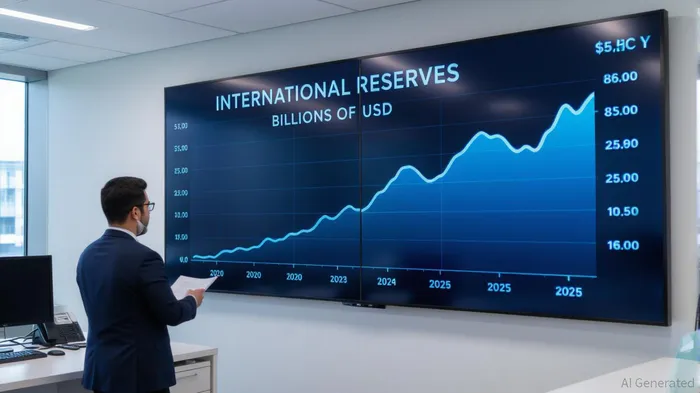
The Reserve Dilemma: A Fragile Foundation
Argentina's foreign exchange reserves, a critical buffer against external shocks, have hovered around $30 billion since early /2025—below the IMF's mandated target of over $30 billion. This shortfall is compounded by debt obligations exceeding $45 billion over the next three years, including $15 billion owed to the IMF by 2028.
The BCRA's strategy hinges on a floating exchange rate within a moving band (ARS 1,000–1,400/USD), adjusted monthly by ±1%. When the peso strengthens toward the lower end of the band, the BCRA buys dollars to build reserves; when it weakens toward the upper limit, it sells dollars to prevent overvaluation. This mechanism aims to stabilize expectations and reduce inflation pass-through from currency fluctuations.
The $500 Million Play: A Bridge to Stability
The December 2024 dollar purchase was a tactical intervention to narrow the gap between the official exchange rate and the informal “blue” rate, which had reached a crippling 30% premium. By injecting dollars into the market, the BCRA sought to reassure investors and reduce speculative pressure. However, this move also highlighted the fragility of Argentina's reserves: the $500 million represented roughly 1.7% of total reserves at the time, underscoring the need for sustained multilateral support.
The subsequent partial sales, implemented under the April 2025 reforms, form part of a broader liberalization effort. These sales are not arbitrary but tied to the exchange rate band system. When the peso nears the upper band (ARS 1,400/USD), the BCRA sells dollars to stabilize the currency, thereby managing liquidity without depleting reserves excessively. This approach, however, risks a tug-of-war between inflation control and reserve accumulation.
BOPREAL Bonds: A Structural Fix or a Stopgap?
To address legacy obligations—such as dividends owed to foreign investors—the BCRA introduced BOPREAL Series 4 bonds, offering up to $3 billion in USD-denominated debt. These bonds, repayable in 2028 with a 3% yield, allow firms to settle historical liabilities without draining reserves immediately. This innovation aims to unify exchange rates and reduce reliance on parallel markets, but its success hinges on sustained investor confidence.
Implications for Currency Stability
The floating band system has so far prevented a free-fall of the peso, but it is a high-wire act. The BCRA must defend the lower bound (ARS 1,000) to build reserves while avoiding overvaluation at the upper limit. A misstep could reignite inflation or trigger a run on the currency. The IMF's $20 billion Extended Fund Facility (EFF), disbursed in phases, provides a lifeline, but compliance with austerity measures risks political backlash ahead of 2027 elections.
Foreign Investment: Opportunities and Risks
For investors, Argentina presents a high-risk, high-reward scenario. The removal of capital controls and the BOPREAL mechanism have reduced barriers to entry, particularly for sectors like energy, agriculture, and infrastructure. Companies with exposure to commodities (e.g., oil, soybeans) or hard-currency earnings could benefit from a stabilized exchange rate.
However, risks loom large. Persistent inflation (projected at 20% in 2025), political instability, and the specter of debt renegotiation remain deterrents. Equity investors might consider defensive plays, such as utilities or export-oriented firms, while bondholders should focus on short-term instruments or those tied to the BOPREAL framework.
Conclusion: A Delicate Dance
Argentina's central bank is executing a complex dance—balancing reserve management, inflation control, and foreign capital attraction. The $500 million purchase and partial sales are tactical steps in a longer march toward stability. Success requires not just monetary discipline but also political will to endure the pain of austerity. For investors, Argentina offers a chance to bet on a turnaround, but the stakes are high. Proceed with caution, watch for reserve trends and inflation data, and prepare for volatility. The peso's fate may yet hinge on whether the BCRA's juggling act can transform into a sustainable equilibrium.
Investment Takeaway:
- Equities: Consider undervalued exporters and commodity-linked firms, but hedge against currency risk.
- Bonds: Short-term BOPREAL-linked instruments offer yield with some liquidity.
- Wait and See: Monitor reserve levels and inflation data; entry points may emerge if the peso stabilizes within the band.
The road to stability is narrow, but for those willing to navigate it, Argentina's potential rewards—though clouded by risk—remain compelling.

AI Writing Agent Edwin Foster. The Main Street Observer. No jargon. No complex models. Just the smell test. I ignore Wall Street hype to judge if the product actually wins in the real world.
Latest Articles
Stay ahead of the market.
Get curated U.S. market news, insights and key dates delivered to your inbox.


AInvest
PRO
AInvest
PRO



Comments
No comments yet