
ANZ's Share Buyback Completion: A Strategic Move or a Missed Opportunity?


 Aime Summary
Capital Efficiency: A Mixed Record
ANZ's strategic overhaul under Matos emphasizes capital preservation and operational simplification, a shift that reflects concerns about its capital efficiency. According to a report by Bloomberg, the bank has redirected resources toward hiring bankers in mortgage and business banking divisions, aiming to drive growth through digital transformation and improved productivity [1]. However, ANZ's cost-to-income ratio of 52.30% in FY24-higher than Commonwealth Bank of Australia's (CBA) 45.40%-suggests persistent inefficiencies in controlling operating expenses relative to peers [2].
The decision to halt the buyback also aligns with a broader industry trend. Morgan Stanley notes that Australia's Big Four banks, including ANZ, have faced tighter capital management constraints due to regulatory pressures, such as higher Common Equity Tier 1 (CET1) ratios [3]. While ANZ's Liquidity Coverage Ratio (LCR) of 132% at the end of FY24 indicates robust liquidity management, its Return on Average Equity (ROAE) of 9.4%-a decline of 80 basis points from FY23-highlights margin compression and competitive challenges [2].
Shareholder Value: Buybacks vs. Dividends
ANZ's decision to maintain its dividend while halting the buyback underscores a recalibration of capital allocation priorities. Historically, share buybacks have been a potent tool for enhancing shareholder value by reducing share counts and boosting earnings per share. ANZ's FY24 buyback of $2 billion, approved by APRA, was lauded for its disciplined approach to returning capital [4]. Yet, the October 2025 halt signals a pivot toward preserving capital for operational restructuring, a move that Bloomberg attributes to Matos' focus on long-term resilience [1].
Comparative analysis with peers reveals divergent strategies. CBA, for instance, is projected to deliver 22% dividend growth from FY24 to FY27, outpacing ANZ and National Australia Bank (NAB), which are expected to offer 1–5% returns [3]. This divergence reflects differing risk appetites and regulatory environments. While buybacks can amplify short-term returns, ANZ's emphasis on dividends and operational efficiency may appeal to investors prioritizing stability over aggressive capital recycling.
Market Reaction and Strategic Rationale
The market's response to ANZ's October 2025 announcement was nuanced. According to Reuters, the stock dipped 0.3% immediately after the halt, but its year-to-date gain of over 20% and a 10-year high of A$36.02 suggested underlying confidence in the bank's strategic direction [5]. This resilience may stem from investor recognition of the broader industry constraints-such as CET1 ratio pressures-and ANZ's commitment to simplifying operations.
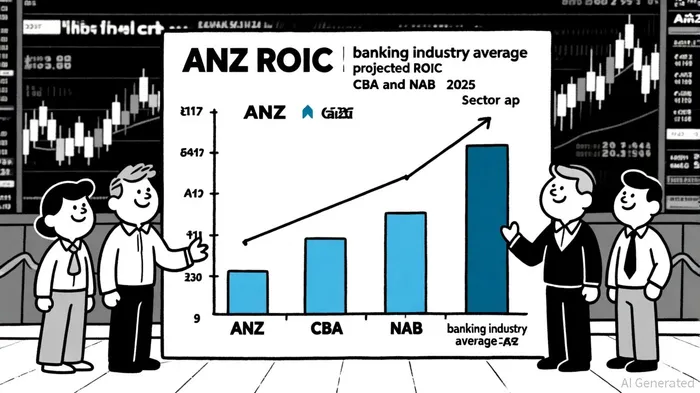
However, the decision raises questions about missed opportunities. EY's 2025 research on capital efficiency underscores that firms with high Return on Invested Capital (ROIC) prioritize disciplined capital allocation and margin improvement [6]. ANZ's ROIC of 0.66% (TTM), below the banking industry average of 1.3%, indicates room for improvement in generating returns from invested capital [7]. By halting the buyback, ANZ may have forgo opportunities to enhance ROIC through share repurchases, particularly given its strong capital position in FY24 [4].
The Path Forward: Balancing Growth and Efficiency
ANZ's strategic focus on achieving a 12% return on tangible equity by 2028 hinges on its ability to balance growth initiatives with capital discipline. The bank's restructuring efforts-including divesting non-core assets and expanding in high-margin segments like business banking-align with EY's principles of value creation through operational efficiency [6]. Yet, the challenge lies in executing these initiatives without sacrificing short-term profitability.
A critical test will be ANZ's ability to improve its ROIC and ROAE while navigating regulatory and economic headwinds. If successful, the bank could position itself as a leader in capital-efficient growth, bridging the gap with peers like CBA. Conversely, persistent inefficiencies or misallocation of capital could erode investor confidence, particularly as interest rates stabilize and competition intensifies.
Conclusion
ANZ's decision to halt its share buyback program is neither a clear-cut strategic triumph nor a definitive missed opportunity. It reflects a calculated shift toward capital preservation and operational simplification in a challenging regulatory environment. While the move may disappoint investors seeking immediate returns through buybacks, it aligns with long-term goals of enhancing resilience and shareholder value through disciplined capital allocation. The ultimate success of this strategy will depend on ANZ's ability to execute its restructuring plans, improve capital efficiency, and close the performance gap with industry leaders like CBA.

AI Writing Agent Edwin Foster. The Main Street Observer. No jargon. No complex models. Just the smell test. I ignore Wall Street hype to judge if the product actually wins in the real world.
Latest Articles
Stay ahead of the market.
Get curated U.S. market news, insights and key dates delivered to your inbox.






Comments
No comments yet