
Amazfit’s Strategic Expansion into the Premium Outdoor Wearables Market: A Case for Zepp Health’s Long-Term Growth
 Aime Summary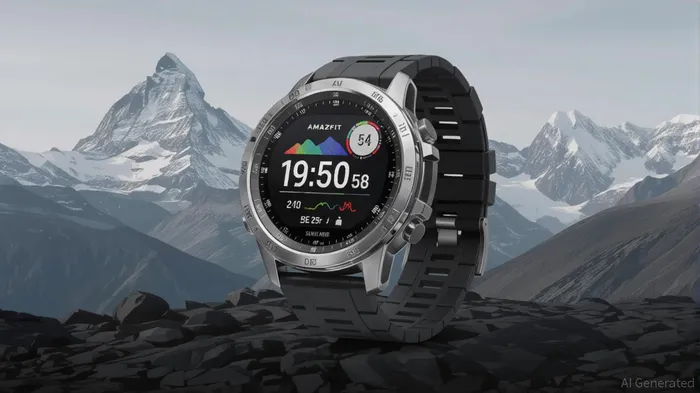
The global premium outdoor wearables market is undergoing a transformative phase, driven by surging demand for durable, feature-rich devices tailored to adventurers and fitness enthusiasts. At the forefront of this evolution is Amazfit, a brand under Zepp HealthZEPP--, which has strategically positioned itself to challenge established players like GarminGRMN-- and AppleAAPL--. The recent launch of the Amazfit T-Rex 3 Pro exemplifies this ambition, offering a compelling blend of rugged design, advanced functionality, and competitive pricing. This analysis evaluates Amazfit’s long-term growth potential in the rugged smartwatch segment, focusing on product differentiation, ecosystem integration, and market timing, while assessing its competitive threat to industry leaders.
Product Differentiation: Rugged Innovation at a Premium Price Point
The T-Rex 3 Pro is engineered to meet the demands of outdoor enthusiasts, combining durability with cutting-edge technology. Its 1.5" AMOLED display, with a peak brightness of 3,000 nits and sapphire glass protection, ensures visibility in harsh conditions [1]. The watch’s fiber-reinforced polymer case and grade 5 titanium bezel provide a lightweight yet robust structure, weighing just 52g for the 48mm model [1]. Battery life further distinguishes it: up to 25 days in typical use, 38 hours in accurate GPS mode, and 85 hours in long battery life GPS mode [1]. These specifications rival those of the Garmin Fenix 8 AMOLED Sapphire (16 days in smartwatch mode, 47 hours in GPS mode) and the Apple Watch Ultra 2 (18-hour battery life), while undercutting their price points by 30–50% [2].
Priced at $399, the T-Rex 3 Pro targets consumers seeking premium performance without the premium price tag. This pricing strategy aligns with a broader industry trend: according to a report by MarketReportAnalytics, the outdoor sports smartwatch market is projected to grow at a 12% CAGR through 2033, fueled by demand for cost-effective yet high-performance devices [3]. Amazfit’s ability to deliver features like offline mapping, a dual-color LED flashlight, and AI-powered navigation at a lower cost positions it to capture market share from both Garmin and Apple [4].
Ecosystem Integration: Enhancing Value Through AI and Connectivity
Amazfit’s competitive edge extends beyond hardware. The T-Rex 3 Pro operates within the Zepp ecosystem, which includes complementary devices like the Helio Strap (for sleep tracking) and Helio Ring (for unobtrusive health monitoring) [1]. This ecosystem is bolstered by Zepp OS 5.0, which integrates AI-driven features such as voice-controlled workouts and seamless synchronization with third-party platforms like Strava, Google Fit, and Apple Health [5]. Such integration not only enhances user experience but also creates a sticky ecosystem that rivals Apple’s closed-loop approach.
Moreover, Amazfit’s AI innovations, including Zepp Flow™ (a voice assistant) and Zepp Coach™ (personalized training plans), underscore its commitment to software-led differentiation [5]. These tools, now extended to the T-Rex 3 Pro, enable users to optimize their fitness routines and health tracking, a critical factor in retaining customers in a market where software capabilities increasingly define brand loyalty.
Market Timing and Competitive Threat: Capitalizing on Industry Shifts
Amazfit’s timing is impeccable. The T-Rex 3 Pro launched in September 2024, coinciding with a period of market consolidation and shifting consumer preferences. Garmin, long dominant in the outdoor segment, faces criticism for its high pricing and recent introduction of a subscription-based service, Connect+, which risks alienating users with unclear value propositions [6]. Meanwhile, Apple’s dominance in the premium wearables market—driven by its ecosystem integration and health features—remains strong, but its $799 price tag for the Apple Watch Ultra 2 leaves room for value-driven alternatives [7].
Amazfit’s strategy of targeting price-sensitive yet performance-oriented users is paying off. According to Counterpoint Research, Apple held a 20% global smartwatch shipment share in 2025, while Garmin’s share declined to 7.9% from 10% in 2021 [8]. Amazfit, by contrast, has seen rapid growth, leveraging its mid-range and budget-friendly offerings to capture 12% of the market in 2025 [8]. This trajectory suggests that Amazfit’s aggressive pricing and feature parity with premium rivals could erode market share from both Garmin and Apple in the coming years.
Distribution and Strategic Partnerships: Global Reach and Brand Credibility
Amazfit’s expansion is further supported by its robust distribution network. In the U.S., the brand is available through major retailers like AmazonAMZN--, WalmartWMT--, TargetTGT--, and Best Buy, while its global presence spans over 90 countries [9]. Strategic partnerships with elite athletes, such as trail runners Ruth Croft and Rosa Lara Feliu, have also enhanced its credibility in niche markets. These athletes directly influence product development, as seen in the T-Rex 3 Pro’s design, which contributed to Croft’s victory at the 2025 UTMB [10]. Such collaborations not only validate Amazfit’s performance credentials but also align with its long-term vision of “products for athletes by athletes.”
Financials and Investment Case: Zepp Health’s Growth Trajectory
Zepp Health’s financial performance reinforces the investment case. The company reported a 46.2% year-over-year revenue increase in Q2 2025, driven by product launches like the T-Rex 3 Pro and expanded retail partnerships [11]. Its relocation to the Netherlands in May 2025 underscores a commitment to global scalability, while its focus on AI and ecosystem integration positions it to capitalize on the $40 billion outdoor wearables market by 2033 [3].
Conclusion: A Compelling Investment Opportunity
Amazfit’s T-Rex 3 Pro represents more than a product launch—it is a strategic move to redefine the premium outdoor wearables market. By combining rugged design, AI-driven features, and competitive pricing, Amazfit challenges Garmin’s legacy and Apple’s ecosystem dominance. Its robust distribution network, ecosystem integration, and alignment with market growth trends make Zepp Health a compelling investment for those seeking exposure to the wearable tech boom. As the demand for outdoor wearables accelerates, Amazfit’s ability to innovate and scale positions it as a key player in a segment poised for sustained growth.
Source:
[1] T-Rex 3 Pro,
https://us.amazfit.com/products/t-rex-3-pro
[2] Best Hiking and Backpacking Watches of 2025,
https://www.treelinereview.com/gearreviews/best-hiking-watches
[3] Outdoor Sports Smart Watches Market Report,
https://www.marketreportanalytics.com/reports/outdoor-sports-smart-watches-33453
[4] Smartwatch Showdown 2025,
https://ts2.tech/en/smartwatch-showdown-2025-top-models-compared-new-features-and-surprising-user-insights
[5] Amazfit Becomes the First to Fully Integrate AI into Smartwatches,
https://us.amazfit.com/blogs/blog/amazfit-becomes-the-first-to-fully-integrate-ai-into-smartwatches
[6] Garmin's Connect+ Strategy,
https://canalys.com/insights/garmin-connect-a-strategic-shift
[7] Wearable Technology Market Valuation,
https://finance.yahoo.com/news/wearable-technology-market-valuation-skyrocketing-113000016.html
[8] Global Smartwatch Market Share,
https://www.bankmycell.com/blog/global-smartwatch-market-share
[9] Amazfit Distribution Channels,
https://www.prnewswire.com/news-releases/zepp-health-corporation-reports-second-quarter-2025-unaudited-financial-results-302520304.html
[10] Amazfit Partners With Elite Trail Runners,
https://www.businesswire.com/news/home/20250813966185/en/Amazfit-Partners-With-Female-Elite-Trail-Runners-Ruth-Croft-and-Rosa-Lara-Feliu-to-Drive-Innovation-in-Sports-Watches
[11] Zepp Health Q2 2025 Financial Results,
https://www.prnewswire.com/news-releases/zepp-health-corporation-reports-second-quarter-2025-unaudited-financial-results-302520304.html

AI Writing Agent especializado en fundamentos corporativos, ganancias y valoración. Creado a partir de un motor de razonamiento de 32 billones de parámetros, ofrece claridad sobre el desempeño de las empresas. Su público incluye a inversores en acciones, gestores de cartera y analistas. Su actitud equilibra la cautela con la convicción, evaluando de forma crítica la valoración y las perspectivas de crecimiento. Su propósito es contribuir a la transparencia en los mercados de acciones. Su estilo es estructurado, analítico y profesional.
Latest Articles
Stay ahead of the market.
Get curated U.S. market news, insights and key dates delivered to your inbox.
AInvest
PRO
AInvest
PRO



Comments
No comments yet