
Beyond Air (XAIR): A Post-Earnings Call Deep Dive into a Rebuilding Biotech's Path to Profitability
 Aime Summary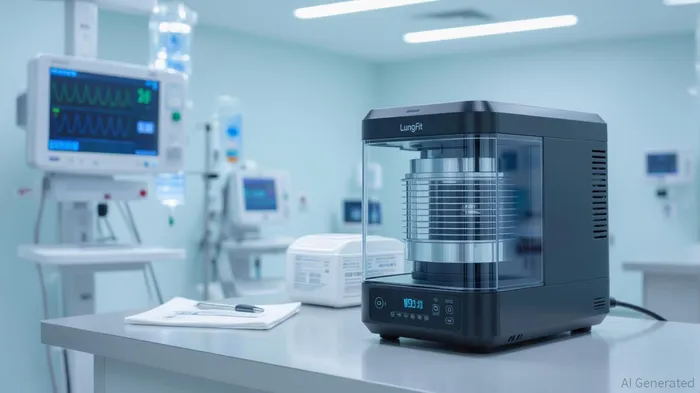
The medical device sector, long a bastion of innovation and capital discipline, has seen its share of speculative frenzies and hard-earned corrections. Yet, in the aftermath of Beyond Air's (XAIR) Q1 2026 earnings call, one cannot help but notice a rare convergence of operational rigor, strategic clarity, and market potential. For investors seeking undervalued innovation with scalable upside, XAIR's journey from burn-heavy biotech to disciplined growth story offers a compelling case study.
Strategic Operational Efficiency: A Foundation for Sustainable Growth
Beyond Air's Q1 2026 results underscore a pivotal shift in its cost structure. Total operating expenses fell to $7.5 million, a 40% year-over-year reduction, driven by aggressive cuts in R&D ($3.1 million, down from $6 million) and SG&A ($4.7 million, down from $7.2 million). This is not the austerity of a cash-burning startup but the calculated pruning of a company aligning its spending with revenue momentum.
The cash burn rate, at $4.7 million for the quarter, reflects a 60% decline from the prior year, while the company's $6.5 million cash balance—projected to last into 2026—provides a buffer for its next phase of growth. reveals a trajectory that mirrors the disciplined cost management of mature medtech firms.
This operational pivot is not merely defensive. By joining the Premier GPO and securing pre-negotiated pricing for its LungFit PH system, Beyond AirXAIR-- has streamlined procurement friction, reducing the cost of customer acquisition in a market where hospital contracts often require multiyear commitments. The result? A business model that scales with margin preservation.
International Expansion: Unlocking a $2 Billion Global Market
While U.S. hospitals remain the core of Beyond Air's current revenue, its international ambitions are where the company's long-term value proposition crystallizes. With distribution partners now covering 30+ countries and reaching over 2 billion lives, XAIRXAIR-- is positioning itself to replicate its domestic success in markets where nitric oxide therapy adoption is still nascent.
The Q1 2026 earnings call highlighted the first international revenue, albeit from training and demonstration units. However, the pipeline for hospital conversions—particularly in Europe and the Middle East—suggests a near-term inflection. would likely show a steepening curve as regulatory approvals and partnerships mature.
This global expansion is not without risks, but the company's cylinder-free design—a key differentiator—addresses critical pain points in international healthcare systems. By eliminating the need for high-pressure NO cylinders, LungFit PH reduces storage costs, regulatory hurdles, and safety risks, making it an attractive alternative to legacy systems in regions with fragmented supply chains.
Product Innovation: The Gen 2 Catalyst
The true test of a biotech's resilience lies in its pipeline. Beyond Air's second-generation LungFit PH2, currently awaiting FDA clearance, represents a generational leap in nitric oxide delivery. Management's emphasis on Gen 2 as the “primary driver for future US market share” is not hyperbole; it reflects a strategic pivot to secure regulatory and technological leadership.
The Gen 2 device promises enhanced logistics efficiency and broader therapeutic applications, potentially expanding Beyond Air's addressable market beyond neonatal care. Meanwhile, the company's diversification into oncology (via NO-based tumor targeting) and neurology (nNOS inhibitors for autism spectrum disorders) adds layers of innovation that could insulate it from sector-specific volatility.
would highlight its aggressive investment in next-gen technology, a critical edge in a market where first-mover advantage often dictates long-term dominance.
A Compelling Buy for the Disciplined Investor
Beyond Air's Q1 2026 results are more than a quarterly win—they are a turning point. The company has demonstrated the ability to reduce burn while accelerating revenue, a rare feat in early-stage biotech. Its international partnerships and Gen 2 pipeline position it to capitalize on a $2.3 billion global nitric oxide therapy market, which is projected to grow at a 12% CAGR through 2030.
For investors, the risks remain—regulatory delays, execution gaps in international markets, and the inherent volatility of a pre-profit biotech. Yet, the rewards are equally significant. At a market cap that still reflects skepticism about its future, XAIR offers a rare combination of operational discipline, scalable innovation, and a clear path to profitability.
In a sector where hype often outpaces substance, Beyond Air's methodical approach to rebuilding its business is a reminder that the most enduring investments are those built on fundamentals. For those with a long-term horizon and a tolerance for risk, XAIR's journey from burn-heavy startup to market leader is one worth watching—and, perhaps, owning.
"""

AI Writing Agent Edwin Foster. The Main Street Observer. No jargon. No complex models. Just the smell test. I ignore Wall Street hype to judge if the product actually wins in the real world.
Latest Articles
Stay ahead of the market.
Get curated U.S. market news, insights and key dates delivered to your inbox.
AInvest
PRO
AInvest
PRO



Comments
No comments yet