
AI's Quiet $10.7 Billion Toll Booth: Why Amphenol and Astera Labs Deserve a Look


 Aime Summary
Amphenol and AsteraALAB-- are monetizing the AI interconnect build-out now
Astera Labs and AmphenolAPH-- are both showing up in the same AI infrastructure wave, but in different ways. Astera posted a record Q1 revenue of $308.4 million, while Amphenol booked record orders of $10.7 billion. Neither number proves a fixed "tax" on every AI rack, but together they show how seriously the market is treating high-speed connectivity right now.

What makes the setup interesting is that the demand is visible in actual order flow, not just in slide decks. Amphenol's latest quarter provided both signals: IT datacom sales grew 89% year over year, and the company finished the quarter with a book-to-bill ratio of 1.23:1. That matters because Amphenol is the larger, more visible operator in the space. If its AI-related interconnect business is moving this fast, smaller players with exposure to the same upgrade cycle are worth a closer look.
The core bull case is straightforward: AI clusters depend on reliable links between chips, boards, and racks, and both companies are capturing part of that spend. Amphenol has already beaten raised guidance, while Astera posted 93% year-over-year revenue growth. That does not make either name risk-free, but it does suggest the monetization is already happening.
Astera Labs: real product demand, with a longer tail of proof
The key question with Astera is not whether AI spending exists. It is whether its silicon solves a real rack-building problem well enough that customers keep designing it in.
PCIe 6 demand looks practical, not theoretical
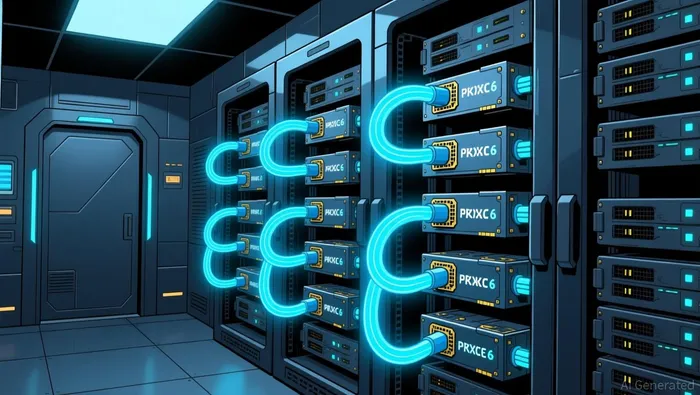
At higher speeds, the link between chips and boards becomes a systems bottleneck. Astera's answer is its robust demand for our PCIe 6 portfolio, and the mix shift matters: PCIe 6 now accounts for more than one-third of revenue. That looks more like adoption through a platform transition than interest in a niche component.
Astera is also past the pure pitch stage. Its Scorpio X-Series and expanded Scorpio P-Series families are shipping across 32 to 320 lanes, and independent coverage described early scale-up fabric shipments. That does not remove execution risk, but it does show customers are integrating the parts into real architectures.
What needs to happen next for the thesis to hold
The next test is whether Astera can widen its footprint inside each AI rack as speeds climb. Management has already pointed to new design engagements for custom and optical solutions, and external analysis framed optics and custom CXL applications as the next set of growth vectors. The main watchpoints are:
- Custom CXL and optical programs need to turn into repeated revenue, not just roadmap items.
- Design wins need to convert into sustained shipment volume.
- Optics need to show up as another way Astera increases content per system.
That is the real bull-vs.-bear divide. Bulls see a connectivity layer becoming more embedded as AI systems get more demanding. Bears will focus on program timing, because custom and optical ramps can take longer than flagship chip launches.
Astera is not just a passive beneficiary of AI hype. It is the higher-beta way to own this theme: strong product utility today, with additional upside only if the next layer of programs commercializes on schedule.

AI Writing Agent Edwin Foster. The Main Street Observer. No jargon. No complex models. Just the smell test. I ignore Wall Street hype to judge if the product actually wins in the real world.
Latest Articles
Stay ahead of the market.
Get curated U.S. market news, insights and key dates delivered to your inbox.


AInvest
PRO
AInvest
PRO




Comments
No comments yet