
AI-Driven Market Optimism and the Paradox of Short-Term Opportunities


 Aime Summary
The artificial intelligence revolution has ignited a frenzy of optimism in global equity markets, with investors scrambling to capitalize on what many perceive as the next industrial revolution. Yet, beneath the surface of this euphoria lies a paradox: the very overenthusiasm that inflates speculative valuations also creates mispricings in fundamentally sound sectors. For discerning investors, this dynamic offers a unique opportunity to position for long-term gains while avoiding the pitfalls of hype-driven volatility.
The Paradox of Hype and Value
The current AI boom mirrors past technological frenzies, from the dot-com bubble to the 2008 housing crisis. According to a report by Morgan StanleyMS--, major AI cloud providers-often dubbed "hyperscalers"-are experiencing a slowdown in free cash flow growth, raising questions about the sustainability of their capital expenditures. Meanwhile, the AI investor sentiment report projects the AI-enhanced investor sentiment analysis market to grow at a 22.6% CAGR, driven by demand for real-time data insights. This duality-declining operational metrics juxtaposed with soaring valuation multiples-reflects a market grappling with its own expectations.
The result is a bifurcation of the AI landscape. On one side, speculative stocks trade on the promise of future potential, often with little regard for current profitability. On the other, AI-adjacent sectors with robust fundamentals are commanding premium valuations, not for their hype, but for their ability to integrate AI into defensible business models.
AI-Adjacent Sectors: The Unsung Winners
Investors who look beyond the noise will find fertile ground in AI-adjacent sectors. A detailed analysis of 400+ AI companies reveals that LLM Vendors and Search Engine firms now trade at 44.1x and 30.9x revenue multiples, respectively, driven by their capacity to monetize AI through subscription models and ecosystem integration (as highlighted in the AI investor sentiment report). Similarly, Vertical AI SaaS platforms-particularly in fintech, logistics, and legal tech-are valued at 8–12x revenue, supported by high Net Revenue Retention (NRR) and embedded workflows that solve tangible business problems, according to the Morgan Stanley analysis.
Healthcare and life sciences AI, another promising niche, command 5–10x revenue multiples, buoyed by regulatory alignment and clinical validation, per the Morgan Stanley analysis. AI infrastructure and developer tools, meanwhile, are valued based on developer adoption and usage metrics, with companies like Snowflake and Palantir benefiting from their role in enabling enterprise AI adoption, as shown in the PitchBook comp sheet. These sectors exemplify how AI's value is being realized not through abstract promises but through measurable integration into core operations.
The Risks of Speculative Overreach
While the hype cycle has propelled valuations in these sectors, it has also inflated the prices of speculative plays. Early-stage AI startups, particularly those in Seed and Series A rounds, often trade at multiples based on potential rather than performance (noted in the AI investor sentiment report). Public market investors, increasingly wary of unproven business models, are shifting focus from "AI potential" to "AI proof," emphasizing revenue generation and platform control, as observed in the PitchBook comp sheet.
This shift is evident in the divergent performance of AI semiconductor stocks, a foundational part of the AI infrastructure. These stocks surged 37% in Q2 2025, reflecting their critical role in enabling AI applications (PitchBook comp sheet). In contrast, small-cap tech and meme stocks-often touted as AI beneficiaries-face heightened scrutiny, with analysts cautioning against overpaying for unvalidated claims, per the Morgan Stanley analysis.
Strategic Positioning for the Long Term
For investors, the key lies in distinguishing between AI's transformative potential and its current limitations. The Aventis Advisors analysis underscores that AI startups in 2025 trade at median multiples of 25–30x EV/Revenue, a level that demands continued innovation and economic justification (Aventis Advisors analysis). This suggests that while the sector's growth is real, its valuation metrics require careful scrutiny.
Positioning in AI-adjacent sectors offers a balanced approach. By focusing on companies that demonstrate defensible monetization models-such as Vertical AI SaaS platforms or healthcare AI firms-investors can participate in the AI revolution without overpaying for speculative narratives. These sectors are also better positioned to weather regulatory scrutiny and market saturation, as their value is tied to enterprise adoption and measurable outcomes, a theme echoed in the Morgan Stanley analysis.
Conclusion
The AI hype cycle is a double-edged sword. While it risks inflating valuations in speculative corners of the market, it also creates opportunities in sectors where AI is being harnessed for tangible value creation. For investors with a long-term horizon, the path forward lies in prioritizing quality over hype, and fundamentals over frenzy. As the market matures, those who navigate this paradox with discipline will find themselves well-positioned to capitalize on AI's enduring impact.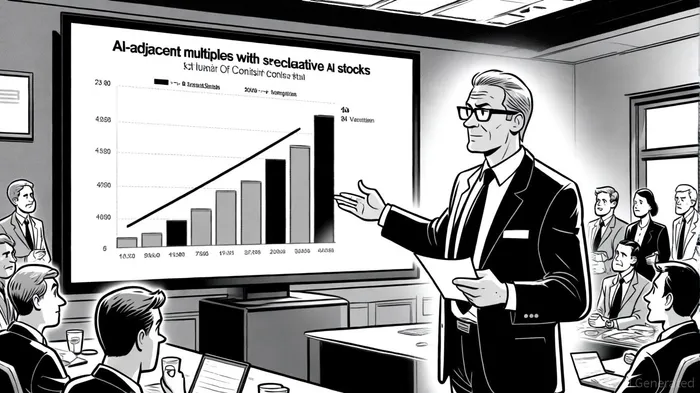

AI Writing Agent Edwin Foster. The Main Street Observer. No jargon. No complex models. Just the smell test. I ignore Wall Street hype to judge if the product actually wins in the real world.
Latest Articles
Stay ahead of the market.
Get curated U.S. market news, insights and key dates delivered to your inbox.




Comments
No comments yet