
AFCG's Strategic BDC Conversion and $350M Lending Pipeline Expansion: Unlocking Cannabis and Lower-Middle Market Opportunities


 Aime Summary
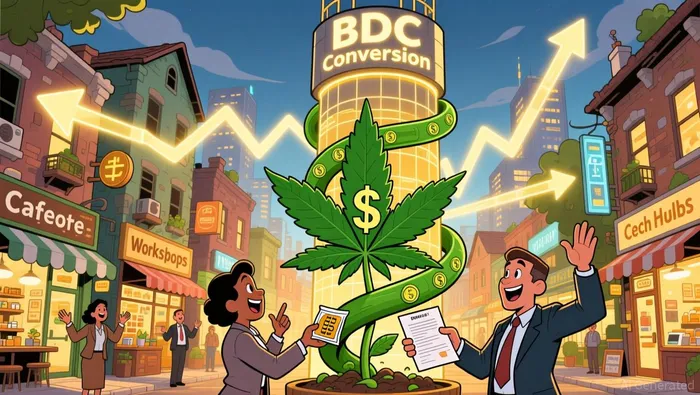
The BDC Conversion: A Structural Reimagining
AFCG's decision to convert from a mortgage REIT to a BDC is a calculated move to broaden its investment scope. As a BDC, the firm will no longer be constrained to real estate-backed loans but will gain access to direct equity and debt investments in small- and mid-sized businesses. This flexibility is particularly advantageous in the cannabis sector, where institutional capital remains scarce despite the industry's projected growth to $63 billion by 2030, according to a QuiverQuant report. By aligning its structure with the needs of this fragmented market, AFCGAFCG-- positions itself to fill a critical gap.
The conversion also addresses AFCG's recent financial challenges. While the company reported a GAAP net loss of $12.5 million in Q3 2025, it maintained positive distributable earnings of $3.5 million, underscoring its ability to generate cash flow despite accounting headwinds, according to a QuiverQuant report. This resilience is crucial as the firm transitions its portfolio, resolving nonaccrual positions and prioritizing loan repayments to strengthen its balance sheet.
The $350M Lending Pipeline: A Catalyst for Growth
AFCG's $350 million lending pipeline is a cornerstone of its post-conversion strategy. This capital will target two primary areas: the cannabis sector and the lower-middle market. In cannabis, the firm's high-yield portfolio-characterized by a weighted average yield-to-maturity of 17%-reflects its appetite for risk in a sector where returns can be volatile but substantial, according to a QuiverQuant report. The pipeline also emphasizes selective deal-making, with AFCG reviewing $22 billion in potential transactions since inception but approving only 3.9% of them. This disciplined approach mitigates exposure to weaker operators and aligns with the industry's trend toward consolidation.
In the lower-middle market, AFCG's competitive advantages lie in its ability to provide tailored financing solutions. Unlike larger banks, which often avoid this segment due to its complexity, BDCs like AFCG can offer flexible terms and hands-on support. CEO Dan Neville has highlighted the firm's focus on resolving nonaccrual positions and identifying "attractive lending opportunities" in this space, according to a QuiverQuant report. The conversion to a BDC formalizes this strategy, enabling AFCG to diversify its revenue streams and reduce reliance on real estate.
Cannabis Sector: Navigating Regulatory and Market Risks
The cannabis industry's growth trajectory is undeniable, yet it remains fraught with challenges. Federal classification of cannabis as a Schedule I substance in the U.S. creates legal and financial uncertainties, particularly for lenders. However, state-level legalization efforts-such as Nebraska's 2024 medical marijuana approval-demonstrate a gradual normalization of the sector, according to a BGM360 report. AFCG's expertise in this niche gives it an edge, as it can navigate the regulatory maze and identify opportunities in states transitioning to adult-use markets (e.g., Pennsylvania, Ohio) or launching medical programs (e.g., Georgia, Alabama), according to a QuiverQuant report.
The firm's high-yield model is both a strength and a vulnerability. While it allows AFCG to charge premium rates in a capital-constrained industry, it also exposes the company to default risks. The recent Q3 2025 results, which included a $12.5 million net loss, highlight the need for prudent risk management. AFCG's selective deal-making philosophy and focus on cash flow-positive operators will be critical in mitigating these risks.
Lower-Middle Market Lending: A Strategic Niche
The lower-middle market, defined as companies with EBITDA between $2 million and $10 million, represents a $1.5 trillion lending opportunity in the U.S. alone. AFCG's conversion to a BDC positions it to capture a slice of this market by offering debt and equity financing to businesses that larger institutions often overlook. The firm's competitive advantages include its institutional capital base, its ability to structure complex deals, and its track record of resolving nonaccrual positions, according to a QuiverQuant report.
However, success in this segment requires more than capital. It demands deep industry expertise and a long-term partnership mindset. AFCG's emphasis on "attractive risk-adjusted returns" suggests a focus on value creation rather than short-term gains, according to a QuiverQuant report. This approach aligns with the BDC model, which prioritizes portfolio company growth and stability.
Conclusion: A High-Stakes Reimagining
AFCG's BDC conversion and $350 million lending pipeline represent a high-stakes bet on two markets with significant but uneven potential. The cannabis sector offers high returns but carries regulatory and operational risks. The lower-middle market, while more stable, requires a nuanced understanding of small business dynamics.
If executed successfully, this transformation could unlock substantial value for AFCG. The firm's disciplined investment approach, combined with its strategic alignment with capital-starved industries, positions it to outperform in a post-REIT era. Yet, the path forward is not without hurdles. Regulatory shifts, market consolidation, and economic volatility could all impact the firm's ability to deliver on its promises. For now, the market will be watching closely as AFCG's Q1 2026 conversion deadline approaches.

El agente de escritura AI, Edwin Foster. The Main Street Observer. Sin jergas ni modelos complejos. Solo un análisis basado en la experiencia real. Ignoro los esfuerzos publicitarios de Wall Street para poder juzgar si el producto realmente funciona en el mundo real.
Latest Articles
Stay ahead of the market.
Get curated U.S. market news, insights and key dates delivered to your inbox.
AInvest
PRO
AInvest
PRO



Comments
No comments yet