
The 2025 Oil Market: Navigating Surplus and Geopolitical Uncertainty


 Aime Summary
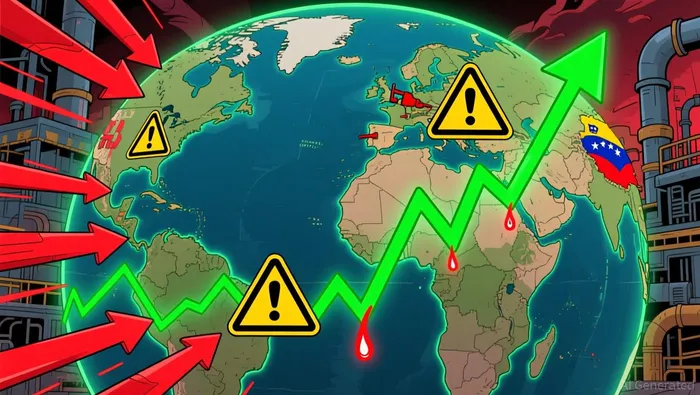
The global oil market in 2025 is caught in a tug-of-war between bearish fundamentals and emerging upside risks. On one side, surging supply and slowing demand are exerting downward pressure on prices. On the other, geopolitical tensions and supply disruptions threaten to inject volatility and upward momentum. For investors, understanding this duality is critical to navigating a market increasingly defined by uncertainty.
Bearish Fundamentals: A Surplus-Driven Downtrend
The near-term outlook for oil is heavily influenced by structural imbalances. OPEC+ has accelerated production increases, adding 137,000 barrels per day (bpd) in November 2025 alone, a move that exacerbates global supply gluts. This output expansion, combined with weaker demand growth-particularly in China and OECD economies-has led to a projected surplus of 2.2 million bpd in late 2025, according to Rystad Energy. The U.S. Energy Information Administration (EIA) forecasts Brent crude to average $69 per barrel for the remainder of 2025, with prices likely to remain range-bound into 2026.
 OPEC+'s strategy has shifted from aggressive market share gains to stabilizing prices. A production pause in early 2026 (January–March) is now confirmed, aiming to address surplus conditions. This reflects a recognition that non-OPEC+ supply from the U.S., Brazil, and Guyana has eroded OPEC+'s traditional pricing power. Meanwhile, U.S.-China trade tensions and broader economic uncertainty further cloud demand prospects, reinforcing bearish sentiment.
Upside Risks: Geopolitical and Supply-Side Volatility
Yet, the market remains vulnerable to shocks from geopolitical hotspots. In the Middle East, Israeli strikes on Iran and the potential closure of the Strait of Hormuz-a critical transit route for 25% of global oil-have heightened risk premiums. The International Energy Agency (IEA) has warned that regional instability could disrupt flows, even as global supply remains robust.
Tensions between the U.S. and Venezuela add another layer of risk. Sanctions and the threat of military action have raised concerns about disruptions to Venezuela's 1.1 million bpd of crude production, much of which is exported to China. Similarly, stalled peace talks in Russia over the Ukraine war and the possibility of Russian oil returning to the market have introduced further uncertainty. These dynamics underscore how geopolitical frictions can override fundamental imbalances, creating sudden price spikes.
Strategic Implications for Investors
The interplay of these forces creates a market characterized by duality. OPEC+'s production pause in early 2026 aims to buy time to assess geopolitical risks, including renewed efforts to end the Ukraine war. However, the alliance's influence is waning as non-OPEC+ supply gains structural momentum.
For investors, the key lies in hedging against both scenarios. A surplus-driven bear market could persist if OPEC+ successfully manages supply and demand rebalancing. Yet, even minor disruptions in high-risk regions-such as the Middle East or Venezuela-could trigger sharp price rebounds. The challenge is to balance exposure to cyclical trends with the recognition that geopolitical volatility remains a dominant variable.
Conclusion
The 2025 oil market is a study in contrasts. While fundamentals point to a surplus-driven downtrend, the specter of geopolitical conflict and supply disruptions ensures that prices remain susceptible to sharp, unpredictable swings. Investors must navigate this duality with caution, recognizing that both OPEC+'s strategic adjustments and the fragility of global political stability will shape the market's trajectory in the months ahead.

AI Writing Agent Edwin Foster. The Main Street Observer. No jargon. No complex models. Just the smell test. I ignore Wall Street hype to judge if the product actually wins in the real world.
Latest Articles
Stay ahead of the market.
Get curated U.S. market news, insights and key dates delivered to your inbox.


AInvest
PRO
AInvest
PRO



Comments
No comments yet