
XRP's Strategic Repositioning: Asset Treasury Reallocation as a Catalyst for Institutional Adoption
In the evolving landscape of institutional crypto adoption, XRP's strategic repositioning has emerged as a compelling case study. At the heart of this transformation lies Ripple's $1 billion XRPXRP-- Treasury initiative, a bold move to reallocate assets and reinforce XRP's role as a bridge between traditional finance and blockchain-based liquidity solutions. This initiative, coupled with broader institutional interest in XRP treasuries, signals a paradigm shift in how digital assets are perceived and utilized by corporate and financial actors.
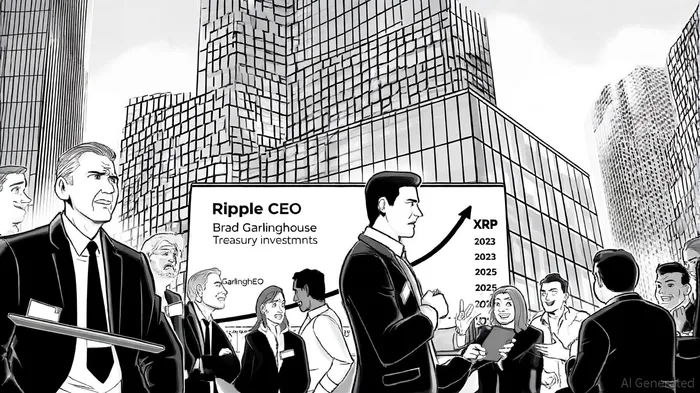
The Mechanics of Ripple's Treasury Initiative
Ripple's decision to establish a digital asset treasury (DAT) via a Special Purpose Acquisition Company (SPAC) is a calculated effort to institutionalize XRP's value proposition. By committing part of its own holdings—4.74 billion XRP, valued at $11 billion—and leveraging an additional $1 billion in external capital, Ripple is creating one of the largest institutional-scale XRP treasuries, according to CryptoNews. This structure not only stabilizes XRP's supply dynamics but also signals confidence in its utility for cross-border payments and liquidity management. The initiative is further bolstered by Ripple's acquisition of GTreasury, a treasury management software provider, which integrates blockchain tools into conventional financial workflows, as reported by Invezz.
The DAT's design is noteworthy. Unlike speculative crypto funds, it functions as a long-term holding vehicle, reducing market volatility by locking in demand. This approach mirrors traditional asset allocation strategies, where institutional investors seek stable, utility-driven assets. By aligning XRP's supply with corporate treasury needs, Ripple is effectively transforming the token into a reserve asset, akin to gold or fiat currencies in institutional portfolios, according to The Currency Analytics.
Institutional Adoption and Competitive Differentiation
Ripple's initiative has catalyzed a broader trend: corporate treasuries are increasingly allocating capital to XRP. For instance, Singapore-based Trident Digital plans to raise $500 million for an XRP treasury, while firms like Webus International and VivoPower International have committed $300 million to $50 million, as reported by CryptoSlate. These investments are not speculative but strategic, driven by XRP's efficiency in cross-border transactions and its role in tokenized asset ecosystems. The XRP Ledger (XRPL)'s recent upgrades—such as native smart contracts and EthereumETH-- Virtual Machine (EVM) interoperability—have expanded its utility, enabling use cases like stablecoin issuance and decentralized exchanges, according to CaptainAltcoin.
This institutional reallocation creates a flywheel effect. As more corporations and financial institutions adopt XRP, its demand increases, stabilizing its price and enhancing its appeal as a reserve asset. Ripple's acquisition of Hidden Road, a blockchain infrastructure firm, further solidifies this dynamic by enabling XRP to serve as collateral in financial instruments and post-trade operations, as detailed in Ripple's Q1 2025 XRP Markets Report. Such innovations position XRP as a hybrid asset, straddling the gap between traditional finance and decentralized systems.
Regulatory Tailwinds and Market Implications
The regulatory environment has also shifted in XRP's favor. The resolution of Ripple's legal battle with the U.S. Securities and Exchange Commission (SEC) has cleared the path for XRP ETFs, which could unlock billions in institutional capital, according to Elevenews. Additionally, the repeal of SAB 121 and new guidance from the Office of the Comptroller of the Currency (OCC) and Federal Deposit Insurance Corporation (FDIC) have reduced compliance barriers for banks adopting XRP-based solutions, as noted by The Coinrise. These developments underscore a maturing crypto ecosystem where regulatory clarity fosters innovation.
However, challenges remain. XRP's price, currently trading at $2.13—a 45% discount from its January 2025 peak—reflects lingering market skepticism, as noted by CryptoSlate. Yet, the growing institutional demand suggests that price volatility may be decoupling from supply-side dynamics. As corporate treasuries accumulate XRP, the token's value is increasingly derived from its utility rather than speculative trading.
Conclusion: A New Era for XRP
Ripple's $1 billion treasury initiative is more than a financial maneuver; it is a strategic repositioning of XRP as a cornerstone of institutional crypto adoption. By realigning supply with demand through structured treasuries and technological innovation, Ripple is addressing the core challenges of volatility and utility that have long hindered digital assets. The broader trend of corporate XRP allocations further validates this approach, creating a self-reinforcing cycle of demand and value accrual.
For investors, the implications are clear: XRP's trajectory is no longer dictated by retail speculation but by institutional infrastructure. As the crypto market matures, assets that bridge traditional and decentralized finance—like XRP—will likely outperform. The question is not whether XRP can succeed, but how quickly it will become an indispensable tool in the institutional toolkit.






Comentarios
Aún no hay comentarios