
Winnebago Industries: Navigating Turbulence with Affordable Towables and Operational Precision
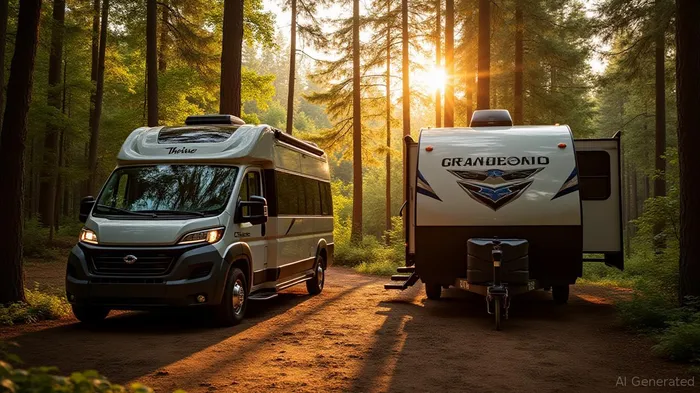
Winnebago Industries (WGO) faces a pivotal crossroads. As the RV market grapples with slowing demand for high-end motorhomes, the company is doubling down on its affordable towable RV strategy—a move that could redefine its resilience and growth trajectory. By pivoting toward value-driven products like the Winnebago Thrive and Grand Design Transcend, the firm is betting on shifting consumer preferences while addressing margin pressures through operational discipline. For investors, this transition presents a compelling contrarian opportunity amid near-term volatility.
The Strategic Shift: Towables as the New Growth Engine
The RV industry's landscape is shifting. While motorhome sales have stagnated—driven by high prices, inventory overhang, and macroeconomic headwinds—towable RVs (travel trailers, fifth wheels) are emerging as the sector's growth driver. Winnebago's response has been swift: launching the Thrive (a lightweight, modern travel trailer) and Grand Design Transcend (a budget-friendly fifth wheel) to target price-sensitive buyers seeking “glamping” amenities without premium tags.
These products are engineered to attract younger, design-conscious consumers and families, offering features like U.S.-built furniture, JBL sound systems, and versatile floorplans—all at entry-level price points. The Thrive, for instance, starts at $46,760, undercutting traditional luxury towables while retaining brand equity. This shift has already paid dividends: despite a 3.8% revenue decline in Winnebago's Towable segment in Q3 2025, unit volume grew, signaling a successful product mix adjustment.
Margin Pressures and the Path to Optimization
The trade-off is clear: prioritizing affordability has compressed margins. Winnebago's Q3 2025 Adjusted EBITDA fell 19.8% year-over-year to $46.5 million, with motorhome margins collapsing due to inventory write-downs and warranty costs. However, the company's margin recapture plan—targeting 2026—offers a roadmap. By refreshing motorhome product lines, improving supply chain efficiency, and leveraging its strong Marine segment (which saw a 37% EBITDA jump in Q3), Winnebago aims to stabilize margins without sacrificing growth.
The Towable segment's volume resilience is also critical. Even as average selling prices dip, higher unit sales can offset margin erosion. Management's focus on “operational discipline” and inventory management—reducing overstocked motorhomes—suggests a pragmatic approach to balancing short-term pain with long-term health.
Risks: Navigating Economic Uncertainty
The strategy is not without risks. The broader RV market faces macroeconomic headwinds: rising interest rates, fuel costs, and cautious consumer spending. Winnebago's motorhome division, while undergoing restructuring, remains vulnerable to delayed recoveries. Additionally, intense competition from industry giants like Thor Industries (THO) and Forest River (FREV) could limit towable market share gains.
Why WGO is a Contrarian Play
Despite these challenges, Winnebago's pivot to towables aligns with structural trends:
1. Demographic Shifts: Younger buyers are prioritizing flexibility and affordability over traditional RV ownership.
2. Glamping's Rise: The $1.2 billion glamping market (projected to grow at 12% annually) favors compact, feature-rich towables.
3. Operational Leverage: The Marine segment's profitability (up 14.6% in Q3) provides a cash flow buffer to fund RV innovation.
Critically, WGOWGO-- trades at 10.2x forward EV/EBITDA, a discount to its five-year average of 13.5x, reflecting investor pessimism about near-term margins. Yet, the stock's 25% underperformance versus the S&P 500 over the past year creates a buying opportunity if towables deliver sustained volume growth and motorhome restructuring succeeds.
Investment Thesis
Winnebago's strategy is a calculated bet on its ability to trade margin for market share in towables while stabilizing its core motorhome business. For investors with a 12–18-month horizon, WGO's valuation and strategic focus make it a compelling contrarian pick. Key catalysts include:
- Motorhome margin recovery in 2026.
- Towable unit sales growth outpacing industry declines.
- Marine segment resilience supporting cash flow.
While risks like a prolonged economic slowdown remain, Winnebago's product diversification and operational focus position it to outperform peers in a consolidating industry. This is a stock to buy on dips—and hold for the RV market's next upcycle.





Comentarios
Aún no hay comentarios