
WeRide's Q2 2025 Results: A Pivotal Step Toward Sustainable Robotaxi Profitability
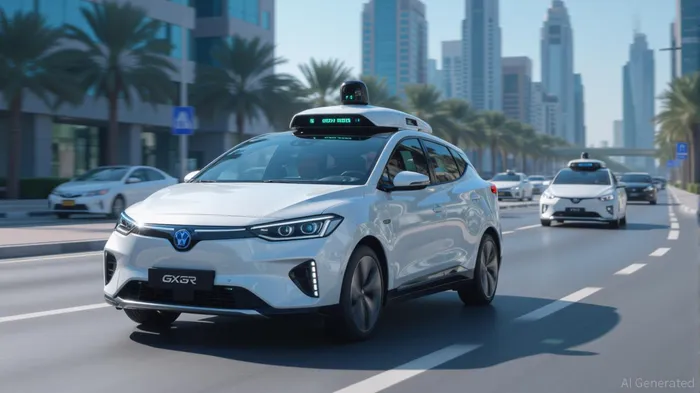
The autonomous vehicle industry has long been a realm of promise and peril. For years, investors have grappled with the question: when will robotaxis transition from experimental curiosities to commercially viable assets? WeRide's Q2 2025 results suggest that the answer may be closer than many anticipated. The company's financial and operational performance reveals not just growth, but the emergence of a scalable, economically sustainable model—one that could redefine the future of urban transportation and create substantial value for shareholders.
Scalability: From Niche to Mass Market
WeRide's robotaxi business grew by an astonishing 836.7% year-over-year in Q2 2025, contributing $6.4 million to total revenue and accounting for 36.1% of the company's total revenue. This surge was driven by the tripling of its Abu Dhabi fleet since December 2024, now covering half of the city's core areas. Such rapid scaling is not merely a function of capital expenditure; it reflects the company's ability to replicate its model across geographies and regulatory environments.
The expansion into Saudi Arabia, where WeRideWRD-- secured the first autonomous driving permit for robotaxis, and its pilot operations in Riyadh, underscore its global ambition. With robotaxi fleets now operating in 10 cities across six countries—including the UAE, Saudi Arabia, Singapore, and the U.S.—WeRide has demonstrated that its technology can adapt to diverse urban infrastructures. This geographic diversification reduces the risk of over-reliance on a single market and positions the company to capture growth in regions with high population density and rising demand for last-mile mobility solutions.
Unit Economics: The Cost of Innovation
A critical test for any autonomous mobility company is whether its unit economics can support profitability. WeRide's gross margin of 28.1% in Q2 2025—up 40.6% year-over-year—suggests that the company is nearing this threshold. This margin, described as “industry-leading,” is a result of two key innovations:
- The HPC 3.0 Platform: Launched in July 2025, this high-performance computing system, developed with Lenovo and powered by NVIDIA's DRIVE AGX Thor chips, slashes autonomous driving suite costs by 50%. By reducing hardware expenses while delivering 2,000 TOPS of AI compute power, WeRide has addressed one of the most persistent challenges in the sector—balancing computational power with affordability.
- Operational Efficiency: The company's 2,200 days of safe robotaxi operations without regulatory disciplinary action due to system failures highlight its reliability. Such operational discipline reduces the cost of liability and insurance, further improving margins.
While WeRide still reported a net loss of $56.7 million for the quarter, this was a modest improvement from the previous year's $56.8 million. The loss is primarily attributable to R&D and personnel costs—investments that, if managed effectively, could yield long-term gains. The company's $570.6 million in cash reserves as of June 30, 2025, provide a buffer to sustain these expenditures while scaling.
Global Expansion and Strategic Partnerships
WeRide's ability to secure regulatory approvals in six countries—more than any competitor—underscores its strategic agility. In Dubai, a partnership with Uber and the Roads and Transport Authority is set to launch pilot robotaxi operations in 2025, with a commercial rollout expected in 2026. These partnerships are critical: they reduce the cost of market entry and accelerate trust-building with regulators and consumers.
The company's diversification into adjacent services, such as robobuses in Singapore and robosweepers in Saudi Arabia, also mitigates risk. These offerings address niche but growing demand in urban sanitation and public transportation, creating additional revenue streams while reinforcing WeRide's brand as a comprehensive mobility provider.
Implications for Shareholders
For investors, WeRide's Q2 results present a compelling case. The company is transitioning from a capital-intensive R&D phase to a revenue-generating model with improving margins. Its gross margin of 28.1% is not just a number—it signals that the economics of robotaxis can be viable at scale.
However, risks remain. The industry is highly competitive, with players like TeslaTSLA-- and Waymo advancing their own technologies. WeRide's reliance on regulatory approvals means that delays in new markets could slow growth. Additionally, the path to net profitability is still long, and the company's R&D expenses must be managed carefully.
That said, the fundamentals are strong. WeRide's HPC 3.0 platform, global regulatory wins, and expanding fleet size position it as a leader in a sector poised for disruption. For patient investors willing to ride the volatility, the company's current valuation offers an opportunity to participate in a transformational industry.
Conclusion: A New Era in Autonomous Mobility
WeRide's Q2 2025 results mark a pivotal moment. The company has demonstrated that robotaxis can scale, generate revenue, and achieve profitability in a commercial context. While the road to sustained profitability is not without potholes, the progress made in unit economics and global expansion provides a solid foundation.
For shareholders, the key question is whether WeRide can maintain its momentum. If the company continues to innovate, expand its fleet, and improve margins, it could become a cornerstone of the autonomous mobility revolution. In a world increasingly defined by automation, WeRide's success is not just about technology—it's about reimagining the future of urban life.





Comentarios
Aún no hay comentarios