
WaterBridge’s $540M IPO and Its Strategic Positioning in the Post-Pandemic Real Estate Market
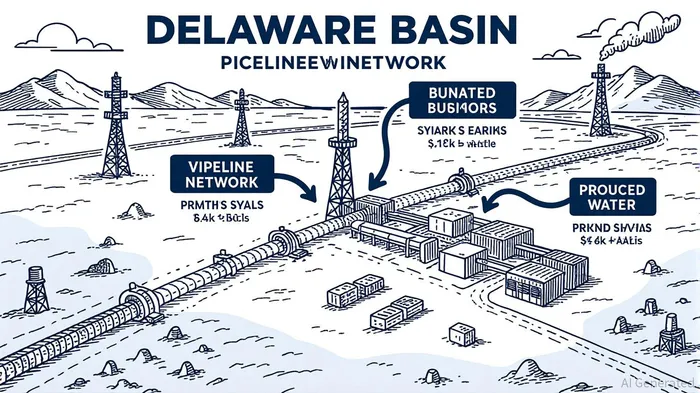
The recent filing for an initial public offering (IPO) by WaterBridge Infrastructure, a private equity-backed operator in the water management sector, underscores a compelling case for capital efficiency and institutional backing as catalysts for high-growth real estate ventures. With a target raise of $540 million, the company aims to capitalize on the surging demand for produced water management in the Delaware Basin, a region where water-handling volumes have expanded from 1.6 million barrels per day (MMbbl/d) in 2014 to 13.2 MMbbl/d in 2024 [2]. This trajectory reflects a structural shift in energy infrastructure, driven by the post-pandemic rebound in oil and gas production and the growing emphasis on sustainable resource management.
Capital Efficiency: A Model for Scalable Growth
WaterBridge’s business model is inherently capital-efficient, relying on long-term contracts with energy producers to manage produced water—a byproduct of oil and gas extraction. As of July 2025, the company operates 2,500 miles of pipelines and 196 facilities, with a capacity to handle 4.5 MMbbl/d of produced water [2]. This infrastructure is designed to minimize capital expenditures (CAPEX) while maximizing operational leverage. For instance, the company’s Desert Environmental brand manages non-hazardous waste from energy activities, further diversifying revenue streams without significant incremental costs [1].
Technology plays a critical role in enhancing capital efficiency. WaterBridge leverages digital tools for logistics optimization and scenario planning, enabling it to scale operations in the Permian Basin without incurring excessive CAPEX [4]. This approach aligns with broader trends in infrastructure-as-a-service models, where asset utilization and operational flexibility drive profitability. The Speedway Pipeline partnership, for example, is expected to boost water volumes and revenue growth by integrating underutilized pore space into the company’s network [2].
Institutional Backing: A Pillar of Credibility and Scale
WaterBridge’s institutional backing, led by Five PointFPH-- Infrastructure and Singapore’s sovereign wealth fund GIC, provides a robust foundation for its IPO. The company’s Registration Rights Agreement, signed by entities such as NDB Holdings, WBR Holdings, and Ashburton Investment, ensures that key stakeholders can sell shares post-IPO, aligning investor interests with long-term growth [5]. This structure not only enhances liquidity but also signals confidence in the company’s strategic direction.
The underwriting agreement, led by J.P. Morgan, Goldman SachsGS--, and Morgan StanleyMS--, further reinforces institutional credibility. These firms, known for their expertise in infrastructure and energy transitions, validate WaterBridge’s positioning in a sector poised for regulatory and technological disruption [1]. Additionally, the Directed Share Program, which reserves a portion of shares for insiders, underscores the alignment between management and institutional investors [3].
Strategic Positioning in the Post-Pandemic Real Estate Market
The post-pandemic real estate market is increasingly defined by infrastructure-driven value creation, particularly in energy and water sectors. WaterBridge’s focus on the Delaware Basin—a hub for unconventional oil and gas—positions it to benefit from the region’s $100 billion in planned energy infrastructure investments by 2030 [2]. Moreover, the company’s expansion into data center cooling solutions via PowerBridge, a Five Point-backed venture with a $1 billion equity commitment, illustrates its adaptability to emerging markets [3].
This diversification is critical in a post-pandemic economy where demand for water management extends beyond traditional energy sectors. For example, PowerBridge’s gigawatt-scale data center campuses require cooling water, a niche where WaterBridge’s expertise in produced water recycling offers a competitive edge [3]. Such strategic partnerships amplify the company’s growth potential while mitigating sector-specific risks.
Conclusion
WaterBridge’s IPO represents more than a capital raise—it is a testament to the power of capital efficiency and institutional backing in transforming infrastructure into high-growth real estate ventures. By leveraging long-term contracts, technology-driven operations, and strategic partnerships, the company is well-positioned to capitalize on the post-pandemic demand for sustainable resource management. For investors, the alignment of institutional stakeholders and the scalability of its business model present a compelling case for participation in this pivotal transition.
**Source:[1] WaterBridge Infrastructure - Valuation, Funding & Investors [https://pitchbook.com/profiles/company/150935-86][2] Delaware Basin-Focused WaterBridge Plans IPO [https://www.hartenergy.com/exclusives/delaware-basin-focused-waterbridge-plans-ipo-213928][3] Five Point Infrastructure Announces the Formation of PowerBridge With a $1 Billion Equity Commitment to Develop and Build Gigawatt-Scale Powered Data Center Campuses in North America [https://www.businesswire.com/news/home/20250515364198/en/Five-Point-Infrastructure-Announces-the-Formation-of-PowerBridge-With-a-%241-Billion-Equity-Commitment-to-Develop-and-Build-Gigawatt-Scale-Powered-Data-Center-Campuses-in-North-America][4] S-1 [https://www.sec.gov/Archives/edgar/data/2064947/000095017025111048/wbi-20250822.htm][5] Registration Rights Agreement among WaterBridge Infrastructure LLC and several investor entities [https://contracts.justia.com/companies/waterbridge-infrastructure-llc-103960/contract/1339328/]







Comentarios
Aún no hay comentarios