
WaterBridge's $540M IPO: A Strategic Bet on Energy Transition Infrastructure
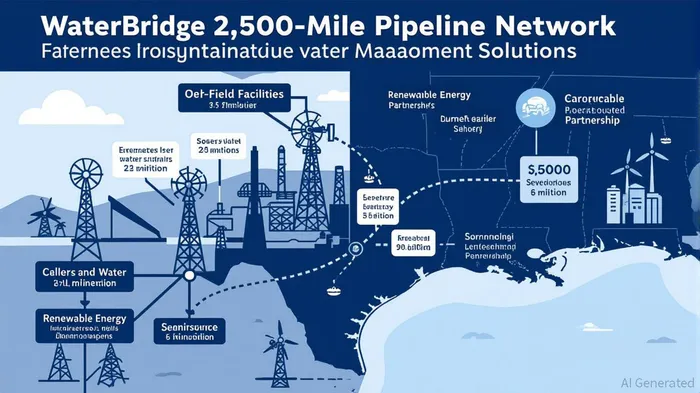
The energy transition is no longer a distant aspiration but a pressing imperative. As the global economy grapples with the dual challenges of decarbonization and resource efficiency, industries traditionally seen as peripheral to sustainability—such as oilfield water management—are emerging as critical battlegrounds. WaterBridge Infrastructure’s $540 million initial public offering (IPO), announced in August 2025, represents a compelling case study in this shift. By positioning itself as a pure-play water infrastructure company, WaterBridge is not merely capitalizing on the demand for produced water management in the oil and gas sector but aligning its operations with the broader goals of the energy transition.
The Energy Transition and Oilfield Water Management
The oil and gas industry’s environmental footprint has long been scrutinized, but the energy transition has forced operators to rethink their approach to resource use. Produced water, a byproduct of oil extraction, has historically posed significant environmental risks due to its high salinity and potential for contamination. However, advancements in recycling and disposal technologies have transformed this challenge into an opportunity. According to the S-1 filing submitted by WaterBridge, its infrastructure network—comprising 2,500 miles of pipelines and 196 produced water facilities—enables operators to reduce reliance on truck hauling, a practice linked to carbon emissions and road degradation [1]. By centralizing water management, WaterBridge not only mitigates environmental harm but also enhances operational efficiency for its clients.
This alignment with sustainability goals is further underscored by strategic partnerships. For instance, WaterBridge’s 10-year pore space reservation deal with LandBridgeLB-- in the Permian Basin, announced in August 2025, exemplifies how infrastructure-driven solutions can support long-term decarbonization [3]. Similarly, its collaboration with BPX Energy to develop 400,000 barrels per day of new produced water handling capacity highlights the growing emphasis on scalable, sustainable practices in the midstream sector [5]. These initiatives reflect a broader industry trend: oil and gas operators are increasingly prioritizing partnerships that reduce their environmental impact while maintaining operational viability.
Carbon Reduction and ESG Commitments
WaterBridge’s environmental impact is not merely incidental. The company has quantified its contributions to carbon reduction, with historical data showing that its operations eliminated over 95,000 metric tons of CO₂ emissions in 2019—equivalent to 52 million truck miles or 120,000 round-trip flights from Houston to New York [5]. While the 2025-specific metrics remain undisclosed, the company’s ESG program, launched in 2020, underscores its commitment to water recycling and reuse. For example, the construction of a produced water recycling pond in the Southern Delaware Basin, with a capacity of one million barrels, demonstrates a tangible effort to minimize freshwater consumption and reduce waste [5].
These efforts are gaining traction in a market where investors are increasingly demanding transparency. The IPO’s prospectus notes that proceeds will be allocated to growth and operational expansion, including a new $500 million revolving credit facility and $750 million in senior financing [4]. Such capital allocation signals confidence in the scalability of WaterBridge’s model, particularly as regulatory pressures mount to address water-related risks in oil and gas operations.
Financial Structure and Market Position
WaterBridge’s IPO structure reflects its strategic positioning. Backed by major investors such as Magnetar Capital, Mubadala Capital, and GIC Private, the company has raised $5.61 billion in funding to date [2]. The offering of Class A shares, as outlined in the S-1 filing, is designed to attract a broad range of investors, from institutional players to retail shareholders [1]. This capital infusion is critical for scaling its infrastructure and securing long-term contracts, which are essential for maintaining cash flow stability in a cyclical industry.
However, the IPO also raises questions about valuation and market appetite. While the energy transition narrative is compelling, the midstream sector remains sensitive to commodity price fluctuations and regulatory changes. For instance, Texas regulators have recently raised concerns about the environmental risks of wastewater injection in the Permian Basin, a challenge WaterBridge must navigate [6]. Yet, the company’s focus on infrastructure—rather than commodity exposure—positions it as a more resilient player in a sector increasingly defined by sustainability.
Strategic Risks and Opportunities
The energy transition is not without its complexities. WaterBridge’s success hinges on its ability to balance growth with environmental stewardship. For example, while its partnerships with BPX and Devon EnergyDVN-- highlight its relevance to energy transition goals, the company must also address concerns about seismicity linked to water disposal practices [6]. Additionally, the integration of renewable energy partnerships, such as WattBridge’s carbon-negative peaker plants, could further diversify its revenue streams but requires careful execution [2].
Conclusion
WaterBridge’s IPO is more than a financing event; it is a strategic bet on the convergence of energy transition and infrastructure innovation. By leveraging its expertise in oilfield water management, the company is addressing a critical pain point for the energy sector while aligning with global sustainability goals. For investors, the IPO presents an opportunity to participate in a sector that is both capital-intensive and increasingly mission-driven. Yet, as with any investment, the risks of regulatory shifts and market volatility must be carefully weighed. In the end, WaterBridge’s ability to adapt its infrastructure to the evolving demands of the energy transition will determine whether this bet pays off.
Source:
[1] S-1, [https://www.sec.gov/Archives/edgar/data/2064947/000095017025111048/wbi-20250822.htm]
[2] WaterBridge Infrastructure - Valuation, Funding & Investors, [https://pitchbook.com/profiles/company/150935-86]
[3] Energy in Transition Podcast, [https://metacast.app/podcast/energy-in-transition-podcast/v0w97KH7]
[4] WaterBridge IPO to test appetite for water midstream | GWI, [https://www.globalwaterintel.com/articles/water-bridge-ipo-to-test-appetite-for-water-midstream]
[5] WaterBridge Highlights Environmental Initiatives and ... [https://fivepointenergy.com/waterbridge-highlights-environmental-initiatives-and-launches-2020-esg-program/]
[6] Permian basin at risk of poisonous water leaks, warns Texas regulator, [https://www.worldoil.com/news/2025/5/22/permian-basin-at-risk-of-poisonous-water-leaks-warns-texas-regulator/]







Comentarios
Aún no hay comentarios