
Volatile IPO Performance and the Forces Shaping 2025's Market Dynamics
The initial public offering (IPO) market in 2025 has been a study in contrasts. After a prolonged period of caution, the sector has experienced a dramatic rebound, driven by macroeconomic shifts and sector-specific optimism. Yet, beneath the surface of this recovery lies a complex interplay of valuation exuberance, shifting investor sentiment, and persistent execution risks. Understanding these dynamics is critical for investors navigating a market that remains as volatile as it is promising.
Valuation Volatility: A Tale of Two Sectors
The resurgence of IPO activity in 2025 has been marked by sharp divergences in valuation outcomes. According to EY's Global IPO Trends Q3 2025, global IPO proceeds surged by 89% year-over-year, with the U.S., India, and China dominating the landscape. The Federal Reserve's rate cuts in mid-2025 acted as a catalyst, spurring a 19% increase in deal volume in Q3 alone. However, this optimism has not been evenly distributed.
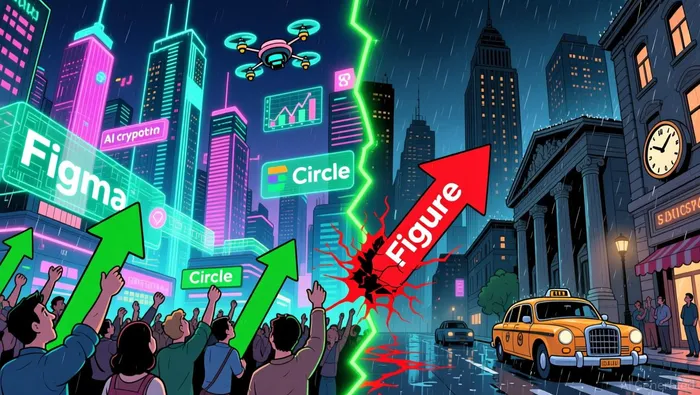
High-profile successes, such as Figma's 250% first-day gain and Circle Internet's 168% outperformance, highlight the potential for explosive returns in technology and fintech. Conversely, the blockchain lender Figure, which opened 44% above its IPO price, has since lost 61% of its value, underscoring the fragility of speculative narratives. These extremes reflect a market where valuation multiples are increasingly tied to sector-specific narratives-particularly in artificial intelligence (AI) and crypto-rather than traditional metrics like earnings or cash flow.
 The fourth quarter of 2025 saw a further intensification of this trend. AI and crypto-related IPOs accounted for over half of the $15.7 billion raised in Q3, with investors prioritizing innovation over profitability. Yet, as one analyst noted, "The market is rewarding companies that can articulate a clear path to monetizing AI, even if their current financials are unproven." This divergence between valuation and fundamentals raises questions about sustainability.
Investor Sentiment: Between Optimism and Skepticism
Investor sentiment in 2025 has been shaped by a delicate balance of macroeconomic hope and regulatory caution. The Federal Reserve's rate cuts and the apparent stabilization of inflation have restored confidence in risk assets, but lingering uncertainties-such as geopolitical tensions and the pace of AI adoption-have kept sentiment volatile.
A key driver of this volatility is the market's selective appetite for quality. According to EY's Q4 2025 outlook, investors are increasingly favoring companies with strong balance sheets and clear profitability pathways. For example, SPACs, which had been sidelined in 2024, saw a partial revival in Q2 2025, with 46 deals raising $8.8 billion-a sign that investors are cautiously reopening to alternative listing structures. However, this optimism is conditional: companies lacking governance rigor or operational clarity continue to face skepticism.
The Cooley Post-IPO Governance Trends Report further illuminates this dynamic. It reveals that 99% of active IPO companies received at least one negative governance recommendation from Institutional Shareholder Services (ISS), signaling growing investor demands for transparency. This scrutiny is not merely academic; it reflects a broader shift toward ESG and corporate governance as key valuation drivers.
Post-IPO Execution Risks: The Hidden Challenges
While valuation and sentiment capture headlines, the true test of an IPO's success lies in post-listing execution. The 2025 IPO class has faced significant operational and governance hurdles, often exacerbating volatility.
One of the most striking trends is the high turnover in leadership. Cooley's report notes that 68% of IPO companies have changed their CEO or CFO within a decade of going public. Such instability can disrupt strategic continuity and erode investor confidence. For instance, FactSet's Q4 2025 earnings miss-falling 1.94% below expectations-triggered a 6.62% stock price drop, despite a 6.2% revenue increase. This case highlights how operational missteps, even in otherwise strong performers, can amplify market volatility.
Governance structures also play a critical role. While 88% of IPO companies retain multi-class share structures, these arrangements often concentrate power in the hands of founders, potentially alienating institutional investors. Such conflicts are magnified in sectors like AI, where rapid innovation requires agile decision-making but is often constrained by rigid governance frameworks.
Moreover, macroeconomic headwinds have added to the complexity. PwC's analysis notes that AI-driven optimism has not always translated into revenue growth, with overinvestment in infrastructure and rising competition from Chinese alternatives creating downward pressure on margins. For companies reliant on speculative narratives, these challenges can lead to sharp corrections, as seen in the blockchain sector.
Conclusion: Navigating the 2025 IPO Landscape
The 2025 IPO market is a microcosm of broader financial trends: the interplay of technological innovation, macroeconomic shifts, and evolving investor expectations. While the sector has rebounded, its volatility underscores the importance of rigorous due diligence. Investors must weigh not only valuation metrics but also governance quality, operational resilience, and the ability to adapt to shifting market conditions.
For companies going public, the path forward requires more than a compelling story. It demands a commitment to transparency, profitability, and strategic alignment with investor priorities. As the market continues to recalibrate in 2026, those that navigate these challenges with discipline will likely emerge as the true winners.





Comentarios
Aún no hay comentarios