
Is Visteon (VC) a Buy at a Potential 50% Undervaluation?
The automotive technology sector is undergoing a seismic shift, driven by the rise of electric vehicles (EVs), software-defined architectures, and AI integration. Amid this transformation, VisteonVC-- (VC) stands out as a compelling case study in valuation dislocation and growth potential. With a price-to-earnings (P/E) ratio of 9.1x, significantly below both its peer average of 23.1x and the US Auto Components industry average of 18.9x, Visteon appears to trade at a material discount to its intrinsic value. This raises a critical question: Is VC a buy at what could be a 50% undervaluation?
Valuation Dislocation: A Stark Contradiction to Fundamentals
Visteon's valuation metrics defy its operational strength. While its P/E ratio suggests a 59% discount to the industry average, its price-to-book (P/B) ratio of 1.903 aligns closely with the sector's 2.102 average, indicating no overhang from balance sheet concerns. More striking is its enterprise value-to-EBITDA (EV/EBITDA) ratio of 5.7x, which lags far behind the industry's 5-year average of 9.15x. This divergence implies that the market is underappreciating Visteon's cash flow generation and strategic positioning.
Such dislocation is rare in a sector where investors typically pay a premium for companies with exposure to EVs and software innovation. For context, competitors like Magna International and Harman International trade at P/E ratios exceeding 20x, despite offering comparable or weaker growth profiles. 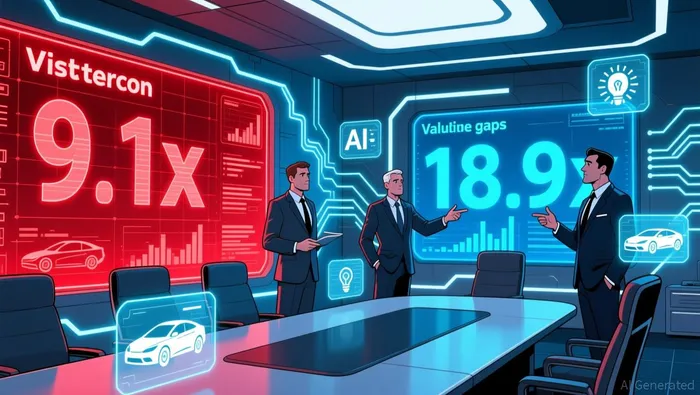 Visteon's undervaluation may stem from short-term skepticism about its ability to scale its software-driven offerings-a skepticism that appears misplaced given its recent business momentum.
Growth Catalysts: Software-Defined Vehicles and Strategic Partnerships
Visteon's third-quarter 2025 results underscore its role as a key enabler of the software-defined vehicle (SDV) revolution. The company secured $1.8 billion in new business wins, driven by advanced digital cockpit solutions, AI-enhanced software, and EV architecture programs. These contracts include high-performance compute systems with AI capabilities for a Chinese OEM and multi-display modules for global and premium luxury automakers.
The company's product innovation is equally compelling. Visteon launched 28 new products with ten different car manufacturers in 2025, including SmartCore cockpit domain controllers and dual OLED displays. These technologies are central to the SDV trend, where software accounts for up to 30% of a vehicle's value. By partnering with automakers like Ford, Renault, Chevrolet, and Suzuki, Visteon is embedding itself into the core of next-generation vehicle platforms.
Moreover, Visteon's focus on EVs positions it to capitalize on a $600 billion global market. Its integrated EV architecture programs align with automakers' urgent need to reduce costs while accelerating electrification timelines. This strategic alignment, combined with its AI-driven software capabilities, creates a durable competitive moat.
The Case for a Buy
The combination of a 50%+ valuation discount and robust growth catalysts makes Visteon an attractive long-term investment. Its P/E and EV/EBITDA ratios suggest the market is pricing in a worst-case scenario, despite evidence of margin expansion, strong order growth, and leadership in high-margin software solutions. For investors willing to look beyond short-term volatility, VC offers a rare opportunity to participate in the automotive tech transition at a significant discount to intrinsic value.
However, risks remain. The EV and software markets are highly competitive, and execution missteps could delay value realization. That said, Visteon's track record of innovation and its deep partnerships with global automakers provide a strong buffer against such risks.
Conclusion
Visteon's valuation dislocation is not a reflection of its fundamentals but rather a mispricing by the market. With a P/E ratio nearly half the industry average and a clear line of sight to growth through EVs, software, and strategic partnerships, VC presents a compelling case for a buy. As the automotive sector continues its digital and electrified transformation, Visteon is poised to deliver outsized returns for investors who recognize its potential.





Comentarios
Aún no hay comentarios