
Why Vertiv Is the Hidden Powerhouse in the AI Data Center Boom
The artificial intelligence revolution is reshaping the global economy, but its most profound infrastructure challenges lie beneath the surface of the data center. As AI workloads intensify, the demand for high-density computing, energy efficiency, and scalable power and cooling solutions has created a new frontier for innovation. At the heart of this transformation is VertivVRT--, a company that has quietly positioned itself as a critical enabler of the AI cloud computing era. By combining modular, vendor-neutral infrastructure with cutting-edge thermal and power technologies, Vertiv is not only addressing today's challenges but also future-proofing data centers for the next decade of AI-driven growth.
Infrastructure Innovation: Modular Design Meets AI's Unique Demands
AI workloads differ fundamentally from traditional computing. They require not only massive computational power but also advanced cooling systems to manage the heat generated by high-density GPU clusters. Vertiv's 2025 innovations, unveiled at the OCP Global Summit, exemplify its ability to meet these demands. The Vertiv™ SmartIT OCP rack solution, for instance, supports loads up to 142 kW while offering prefabricated configurations that reduce deployment timelines by up to 50%. This modular approach aligns with the industry's shift toward standardized, open-architecture systems, which are critical for scaling AI infrastructure at speed and scale.
Complementing this is the Vertiv™ PowerIT rack power distribution unit (PDU), which delivers 57.6 kW of power with real-time load balancing and cybersecurity features. Such precision in power management is essential for AI environments, where even minor inefficiencies can lead to significant energy waste. Meanwhile, the Vertiv™ PowerBar Track-a scalable overhead power distribution system-optimizes rack space in high-density environments, a feature that becomes increasingly vital as data centers transition from CPU-based to GPU-driven architectures.
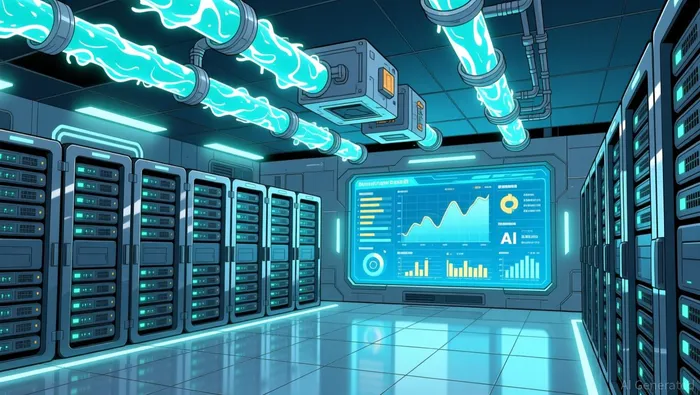 Thermal management remains a bottleneck for AI scalability, and Vertiv's CoolChip Fluid Network manifolds and CoolChip CDU family address this with flexible, closed-loop liquid cooling. These systems integrate seamlessly with immersion and cold-plate cooling technologies, enabling data centers to maintain optimal temperatures without sacrificing adaptability. According to a report by Vertiv, such innovations are already driving a shift toward hybrid cooling systems, which combine liquid cooling with high-density uninterruptible power supply (UPS) solutions to ensure continuous operation.
Market Adoption and Financial Performance: A Sustained Growth Story
Vertiv's technological prowess is matched by its strong market traction. In Q3 2025, the company reported a 29% year-over-year increase in net sales, reaching $2.68 billion, driven by surging demand for AI infrastructure. This growth was most pronounced in the Americas and Asia-Pacific regions, where AI adoption is accelerating. The Americas saw a 43% organic sales increase, while APAC grew by 21%-a testament to Vertiv's global reach and relevance.
The company's strategic acquisitions have further solidified its position. The $1.0 billion acquisition of Purge Rite Intermediate expanded Vertiv's liquid-cooling and thermal-management capabilities, while the purchase of Waylay, a generative AI software firm, enhanced its predictive maintenance and real-time monitoring tools. According to a Q3 2025 presentation, these moves reflect a broader industry trend: as AI workloads grow, infrastructure providers must integrate software intelligence to optimize performance.
Vertiv's collaboration with NVIDIA underscores its forward-looking strategy. The two companies are co-developing 800 VDC power solutions for NVIDIA's next-generation AI platforms, which promise to reduce copper usage and thermal losses by centralizing power delivery. According to NVIDIA's roadmap, this partnership is not merely speculative; it aligns with NVIDIA's own roadmap for gigawatt-scale AI factories, where power efficiency is a non-negotiable requirement.
Long-Term Scalability: Beyond the Current Cycle
What sets Vertiv apart is its focus on long-term scalability. The company's AI-assisted planning tools and modular designs allow data centers to adapt to evolving workloads without costly overhauls. For example, Vertiv's open, vendor-neutral systems ensure compatibility with diverse hardware ecosystems, a critical advantage in an industry where lock-in can stifle innovation.
Moreover, Vertiv is preparing for the next phase of the AI infrastructure race. By 2026, it plans to roll out 800 VDC power solutions, which will support NVIDIA's AI-centric platforms and reduce energy consumption by up to 20%. This aligns with broader industry efforts to decarbonize data centers, as AI's energy demands are projected to consume 3% of global electricity by 2030. Vertiv's experience with DC power over two decades positions it as a leader in this transition, offering safer, more efficient designs for high-voltage architectures.
Conclusion: A Strategic Bet on the Future of Computing
The AI data center boom is not a fleeting trend but a structural shift in global computing. Vertiv's ability to innovate at the intersection of power, cooling, and software intelligence makes it a hidden powerhouse in this transformation. With a 30% year-over-year increase in backlog to $9.5 billion, strong financial performance, and a pipeline of cutting-edge solutions, the company is well-positioned to capitalize on the $1 trillion data center infrastructure market by 2030. For investors, Vertiv represents not just a play on AI's growth but a bet on the infrastructure that will sustain it.





Comentarios
Aún no hay comentarios