
Venezuela's Oil Sector: A High-Risk, High-Reward Rebuild Opportunity for U.S. Energy Firms
The re-entry of U.S. energy firms into Venezuela's oil sector under President Donald Trump's proposed framework represents a bold, if precarious, gamble. Venezuela holds the world's largest proven oil reserves-303 billion barrels-but its production capacity has plummeted to 900,000 barrels per day, a fraction of its historical peak of 3.5 million barrels in the late 1990s. Trump's plan, which includes sanctions relief, taxpayer-funded infrastructure repairs, and subsidies for energy firms, aims to revive this dormant giant. Yet the venture is fraught with geopolitical, financial, and operational risks that demand rigorous scrutiny.
Trump's Framework: Incentives and Constraints
The Trump administration has outlined a multifaceted strategy to lure U.S. oil companies back to Venezuela. Central to this plan is the selective relaxation of sanctions to enable the sale of Venezuelan crude in global markets, with proceeds held in U.S. banks until the administration deems the country "ready" to receive them. Additionally, Trump has proposed reimbursing firms for infrastructure repairs using taxpayer funds, a move designed to mitigate the upfront costs of rebuilding Venezuela's crumbling oil infrastructure. Subsidies for energy companies further sweeten the deal, though industry experts remain skeptical about their efficacy.
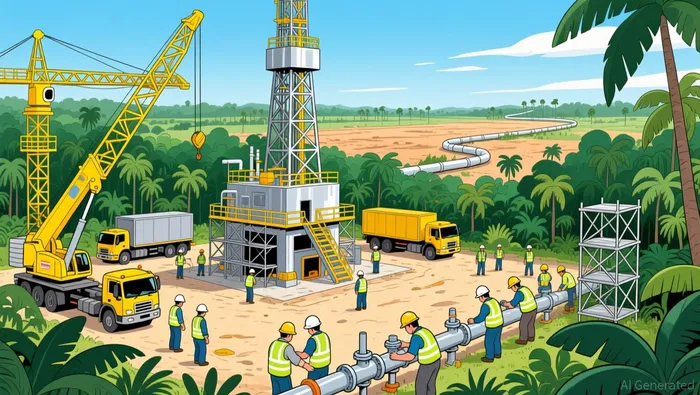 This framework hinges on a delicate balance: providing enough relief to incentivize investment while retaining leverage over the interim Venezuelan government. Secretary of Energy Chris Wright has noted "tremendous" interest from U.S. firms, particularly ChevronCVX--, ExxonMobilXOM--, and ConocoPhillipsCOP--, which previously operated in Venezuela before their assets were expropriated. However, these companies have yet to engage in formal discussions with the government, underscoring the uncertainty surrounding the plan's execution.
Venezuela's Current State: A Nation in Transition
Venezuela's oil sector is a paradox of immense potential and profound decay. Decades of mismanagement under Hugo Chávez, followed by U.S. sanctions and the recent military intervention that ousted President Nicolás Maduro, have left the country's infrastructure in disarray. The state-owned oil company PDVSA, once a pillar of the industry, now struggles with outdated equipment and a lack of technical expertise. Rebuilding production capacity to even 1.3–1.4 million barrels per day-a modest target-would require $10 billion annually for a decade.
Political instability remains a critical barrier. The U.S.-led removal of Maduro and the subsequent assumption of power by Vice President Delcy Rodríguez have created a volatile environment. While the Trump administration claims it will "run" Venezuela temporarily, the interim government's compliance with U.S. demands is far from guaranteed. Financial institutions, too, are wary, given the history of U.S. sanctions being revoked after prior authorizations. This uncertainty complicates long-term planning for energy firms, which require stable regulatory frameworks to justify massive investments.
Risks and Rewards: A Calculus of Uncertainty
For U.S. energy companies, the potential rewards are staggering. Venezuela's extra-heavy crude reserves, though technically challenging to extract, could provide a strategic foothold in a global energy market increasingly dominated by OPEC+ and China. The Trump administration's promise to subsidize infrastructure repairs and reimburse firms for costs could offset some of the financial burden. Moreover, companies like ExxonMobil and ConocoPhillips hold arbitration awards from expropriations under the Maduro regime, offering a secondary incentive to re-enter the market.
Yet the risks are equally daunting. The upfront investment required-tens of billions of dollars-far exceeds the immediate returns, particularly given Venezuela's current production levels. Political instability, coupled with the technical complexity of upgrading Venezuela's oil infrastructure, could delay profitability for years. Furthermore, the U.S. military intervention has drawn international criticism and could provoke retaliatory measures from rival powers, complicating the geopolitical landscape.
Conclusion: A Gamble Worth Taking?
The Trump administration's Venezuela oil plan is a high-stakes proposition. For U.S. energy firms, the allure of vast reserves and potential subsidies is undeniable. However, the path to profitability is littered with obstacles: political volatility, infrastructure decay, and the specter of renewed sanctions. Success will depend on the interim government's ability to stabilize the country, the Trump administration's commitment to sustained sanctions relief, and the willingness of energy firms to absorb short-term losses for long-term gains.
As one industry analyst aptly noted, "Venezuela's oil sector is a sleeping giant", but waking it up will require more than subsidies-it will demand a decade of patience and political will. For now, the question remains whether the U.S. and its energy partners are prepared to make that bet.





Comentarios
Aún no hay comentarios