
Vanke's Debt Extension Strategy: A Harbinger of Sector-Wide Liquidity Crises?
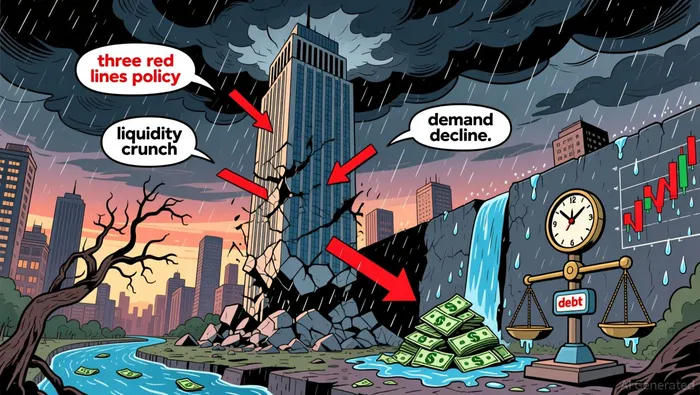
The recent actions of China Vanke, one of the nation's most prominent real estate developers, have reignited concerns about the fragility of the sector's liquidity position. By seeking one-year extensions on key bond repayments, the company is not merely managing its own financial distress but signaling a broader systemic vulnerability. This strategy, while temporarily delaying defaults, underscores the challenges of a sector still reeling from the "three red lines" policy and a prolonged slump in demand. For investors, the question is no longer whether a liquidity crisis will materialize but rather how it will unfold and what it portends for the wider economy.
 Vanke's liquidity risks are stark. As of September 2025, its total interest-bearing debt stood at 362.9 billion yuan, with 42.7% maturing within a year, while its cash-to-short-term debt ratio of 0.48 highlights acute strain. To avert immediate defaults, the company has requested extensions on two onshore bonds totaling 5.7 billion yuan, deferring principal and interest payments for 12 months. These moves, however, are not without cost. The market has reacted harshly, with Vanke's bonds plummeting to record lows and its shares hitting multi-decade troughs. Such volatility reflects a loss of confidence, not only in Vanke but in the sector's ability to self-correct.
The company's reliance on its largest shareholder, Shenzhen Metro Group, further illustrates the precariousness of its position. While Shenzhen Metro has provided 22 billion yuan in loans through mid-2026, this support appears insufficient to address a maturity wall of over $50 billion in liabilities. Analysts warn that each incremental extension erodes credibility, making future financing increasingly difficult and raising the likelihood of a full-scale restructuring. This dynamic is not unique to Vanke. Across the sector, developers like Sunac China and Yuzhou Group have navigated similar paths, with creditors now more willing to accept steep haircuts or liquidation terms.
The broader implications are profound. The real estate sector, once the engine of China's economic growth, now faces a structural transformation. The "three red lines" policy, introduced in 2020 to curb excessive leverage, inadvertently accelerated a liquidity crisis by restricting access to financing. Compounded by pandemic-related demand shocks and a lack of effective policy support, the sector's decline has forced a shift in economic priorities. Household savings, now at a record 160 trillion yuan, have become a buffer for the government, enabling investments in high-tech industries and industrial subsidies. Yet this transition is far from painless. The decline in housing-related expenditure has left a void that has yet to be filled, and the spillover risks to financial stability remain significant.
The key risks lie in the interplay between corporate restructuring and policy responses. While the government has introduced measures such as reduced mortgage rates and relaxed purchase restrictions, these interventions have failed to restore demand. The market is now betting on a "market-driven" restructuring, where developers like Vanke will have to negotiate terms with creditors without substantial state support. This process, however, is likely to be protracted and painful, with weaker developers-both private and state-owned-facing similar challenges according to analysis.
For investors, the path forward for Vanke and the sector hinges on two critical factors: the willingness of creditors to extend further relief and the effectiveness of policy measures in stabilizing demand. If Shenzhen Metro and other stakeholders continue to provide liquidity, Vanke may avoid a full-scale default. However, without broader policy interventions-such as a more aggressive easing of credit conditions or targeted fiscal support-the sector's recovery will remain elusive. For now, Vanke's debt extensions serve as a canary in the coal mine, warning of a liquidity crisis that could reshape China's economic landscape for years to come.







Comentarios
Aún no hay comentarios