
Vale S.A.: Contrarian Buy or Warning Sign? Analyzing the Underperformance
In the past year, VALEVALE-- S.A. (VALE), the Brazilian mining giant, has lagged behind major market benchmarks, raising questions about whether its underperformance signals a contrarian buying opportunity or a deteriorating outlook. This analysis examines VALE's stock performance relative to indices like the S&P 500 and MSCIMSCI-- Emerging Markets, evaluates revised earnings forecasts, and scrutinizes valuation metrics to determine the stock's investment merit.
VALE's Underperformance: A Broad Market Tale?
VALE's shares have fallen 13% over the past 12 months, contrasting sharply with the +4% gain of Brazil's Bovespa index (Ibovespa) and the -13.9% decline of the S&P 500 as of April 2025. While emerging markets like Brazil have thrived due to commodity exports and structural reforms, VALE's struggles highlight sector-specific challenges.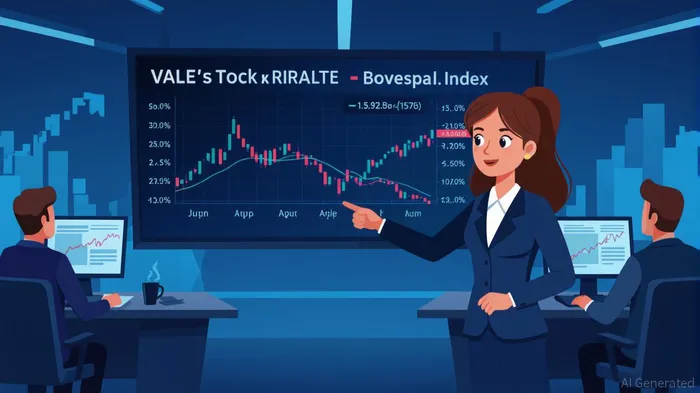
The S&P 500's decline reflects broader U.S. macroeconomic pressures, including tariff volatility and rising interest rates. In contrast, Brazil's economy—bolstered by its status as a commodity exporter—has outperformed. Yet VALE's stock languishes, suggesting market skepticism about its ability to navigate headwinds like China's economic slowdown (China accounts for 65% of Vale's exports) and regulatory shifts in Brazil.
Earnings Forecasts: Headwinds Ahead?
Analysts project a 9.3% year-over-year decline in VALE's Q2 2025 EPS to $0.39, with full-year EPS expected to drop 2.75% to $1.77. Revenue is also forecasted to fall 3.96% to $9.53 billion in the quarter, reflecting weak iron ore demand and pricing pressures. These revisions underscore the risks of reliance on a single market (China) and cyclical commodity prices.
The Basic Materials sector, to which VALE belongs, has risen just 1.51% over the past month, underperforming both VALE's 3.42% gain and the S&P 500's 3.85% rise. This suggests investors are pricing in sector-wide risks, not just VALE-specific issues.
Valuation: A Contrarian's Bargain?
VALE trades at a Forward P/E of 5.63, aligning with its industry average but significantly below the S&P 500's 20x+ multiple. Its PEG ratio of 0.32—matching its industry—hints at undervaluation relative to growth expectations. Additionally, VALE offers an 8.7% dividend yield, 3.2x the Brazilian Selic rate, making it attractive to income-focused investors.
The company's operational resilience adds nuance. Despite earnings headwinds, VALE achieved record 2024 iron ore production (328 million tons) and cut C1 cash costs to $18.8/ton, outperforming peers. Strategic projects like the Saudi Arabia Mega Hub and GreenIron decarbonization initiative could unlock long-term value.
Risks and Catalysts: What Could Turn the Tide?
- China's Economic Recovery: A rebound in Chinese demand for iron ore could immediately boost VALE's margins.
- Global Commodity Supercycle: If inflation fears ease and infrastructure spending accelerates, commodity prices (and VALE's stock) may rise.
- Regulatory Risks: Brazil's new mining code and environmental compliance costs could weigh on profitability.
- Currency Fluctuations: A weaker U.S. dollar, which benefits Brazilian exporters, is already factored into VALE's valuation.
Investment Thesis: The Case for a Contrarian Buy
VALE's low valuation and robust operational metrics (e.g., debt-to-EBITDA ratio of 0.8x) suggest it is pricing in worst-case scenarios. While near-term earnings are pressured, the stock's historical P/E discount and dividend yield offer a margin of safety.
Buy Signal: If China's economy stabilizes and iron ore prices rebound, VALE could outperform. Its valuation leaves room for multiple expansion, especially if the broader market's focus on emerging markets intensifies.
Warning Sign: Persistent China slowdowns or regulatory overreach in Brazil could prolong underperformance. Investors must weigh these risks against VALE's structural advantages as a low-cost producer and global commodity leader.
Conclusion: A High-Reward, High-Risk Opportunity
VALE presents a compelling contrarian play for investors willing to bet on a recovery in commodity demand and a reversal of China's economic headwinds. While risks are significant, the stock's valuation, dividend, and operational strength suggest it could rebound sharply if macro conditions improve. However, investors must remain cautious: VALE's success hinges on factors beyond its control, such as global trade dynamics and emerging market sentiment.
For now, the Zacks Rank of #3 (Hold) understates VALE's potential upside. Aggressive investors with a long-term horizon might consider a gradual position buildup, while others await clearer signals of stabilization in China and the commodity cycle.
Final Verdict: Hold with a cautious bullish bias—wait for confirmation of improved fundamentals before committing capital.







Comentarios
Aún no hay comentarios