
Unlocking Post-Lock-Up Value in Yihai Kerry Arawna Holdings Co., Ltd.
The impending lock-up expiration for Yihai Kerry Arawna Holdings Co., Ltd. (300999.SZ) on October 15, 2025, presents a pivotal moment for investors. This event, which historically has triggered significant liquidity shifts and price volatility, now occurs against a backdrop of evolving corporate governance and market dynamics. To assess the potential implications, we must dissect the interplay between liquidity constraints, volatility patterns, and the company's financial fundamentals.
Historical Volatility and Liquidity Patterns
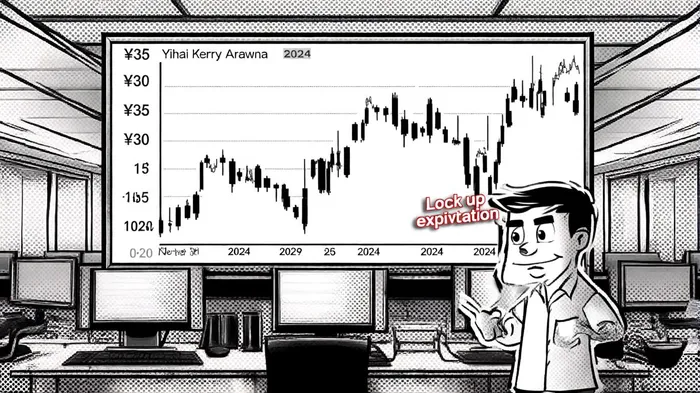
Lock-up expirations often act as catalysts for market turbulence. For Yihai Kerry Arawna, the October 15, 2024, expiration-a prior analogous event-revealed instructive trends. On that date, the stock closed at ¥31.28, down 3.5% from ¥32.40 a week earlier, while trading volume surged to 3.7 million shares, a 200% increase compared to the preceding week's average of 1.3 million shares [1]. This aligns with broader academic findings that lock-up expirations typically coincide with 1–3% price declines due to increased share supply [2].
The company's controlling shareholder, Wilmar International, extended the lock-up period for pre-IPO restricted shares by 12 months in 2025, a strategic move to mitigate immediate liquidity pressures [3]. However, annual transfer limits of 25% post-expiration suggest a gradual, rather than abrupt, release of shares. This measured approach could temper volatility, provided market sentiment remains stable.
Financial Fundamentals and Risk Factors
Yihai Kerry Arawna's financial health adds nuance to the analysis. The company's beta of 1.24, as of October 2025, indicates higher volatility than the broader market [4]. A GARCH model predicts a 19.12% volatility rate for October 14, 2025, underscoring elevated uncertainty [4]. Meanwhile, liquidity metrics such as a current ratio of 1.20 and a debt-to-equity ratio of 0.93 suggest moderate leverage but robust cash reserves (¥74.8 billion in cash and equivalents) [5]. These fundamentals imply the company can withstand short-term liquidity shocks, though its operating margin of 1.54% highlights thin profit margins [5].
Academic Insights and Market Behavior
Emerging market studies emphasize the inverse relationship between liquidity and volatility. In China, where economic policy uncertainty (EPU) often amplifies market reactions, lock-up expirations can trigger sharp price corrections if liquidity dries up [6]. For instance, companies experiencing "price inversion" (post-lock-up prices below issuance prices) often see short-term rebounds through earnings management or dividends to appease investors [6]. Yihai Kerry Arawna's recent 6.1% year-over-year earnings growth [7] may bolster confidence, but its 5.03% revenue decline in 2024 [7] introduces caution.
Projections for October 15, 2025
The October 15, 2025, expiration is likely to see mixed outcomes. On one hand, the extended lock-up and transfer limits reduce the risk of a flood of shares, potentially capping downside volatility. On the other, the beta of 1.24 and GARCH-predicted volatility of 19.12% suggest heightened sensitivity to broader market swings [4]. Historical precedents, such as the 2024 price drop, imply a 3–5% correction is plausible, though the company's strong cash position and moderate leverage could act as buffers.
Investors should also monitor insider behavior. If Wilmar International adheres to the 25% annual transfer cap, liquidity pressures will remain contained. Conversely, aggressive selling could signal waning confidence, exacerbating volatility.
Conclusion
The October 15, 2025, lock-up expiration for Yihai Kerry Arawna represents both a risk and an opportunity. While historical patterns and volatility metrics point to potential price declines, the company's financial resilience and strategic lock-up extensions offer a counterbalance. For investors, the key lies in balancing these dynamics-leveraging the stock's fundamental strengths while hedging against liquidity-driven volatility.







Comentarios
Aún no hay comentarios