
TSMC's Dominance in the AI Chip Race and Its Implications for 2026 Growth
The global semiconductor industry is undergoing a seismic shift, driven by the explosive demand for artificial intelligence (AI) infrastructure. At the heart of this transformation lies Taiwan Semiconductor Manufacturing Company (TSMC), whose technological leadership and strategic foresight position it as the linchpin of the AI-driven semiconductor boom. As we approach 2026, TSMC's dominance in advanced chip manufacturing-particularly in AI-specific processes-has not only solidified its market position but also created a self-reinforcing cycle of innovation and demand.
Technological Leadership: The 2nm and CoWoS Revolution
TSMC's ability to stay ahead of the curve in process node development is a cornerstone of its competitive advantage. The company's transition to 2nm production in Q4 2025, utilizing nanosheet transistor technology, marks a critical milestone. This process offers a 10–15% speed improvement over its 3nm counterpart (N3E) at the same power level, while reducing power consumption by up to 30% at equivalent performance. Such advancements are indispensable for AI accelerators, where energy efficiency and computational density are paramount.
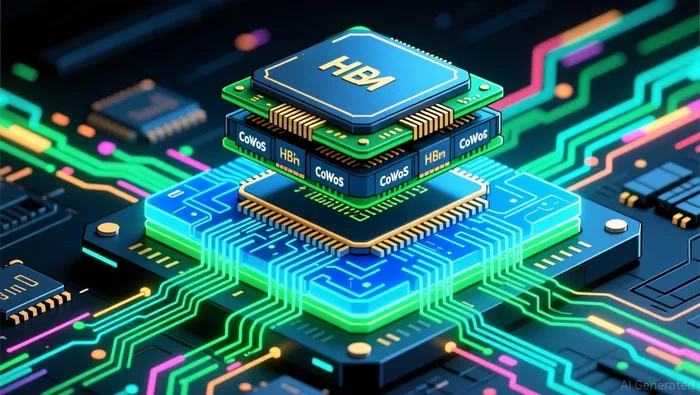
Equally transformative is TSMC's mastery of advanced packaging technologies, particularly its Chip-on-Wafer-on-Substrate (CoWoS) platform. As stated by a report from , CoWoS is a key enabler for next-generation AI chips, including NVIDIA's Blackwell and AMD's MI300-series accelerators. By integrating high-bandwidth memory (HBM) with logic dies, CoWoS addresses the bandwidth and yield challenges inherent in AI workloads. However, this technology remains a bottleneck: capacity is fully booked through 2025 and into 2026, underscoring the structural constraints in meeting surging demand.
Strategic Partnerships: Anchoring the AI Ecosystem
TSMC's dominance is further reinforced by its partnerships with leading AI chip developers. For instance, NVIDIA-a company whose GPUs power a significant share of the AI training market- relies on TSMC for manufacturing its most advanced accelerators. Similarly, AMD's pivot toward AI has resulted in contracts with TSMCTSM-- for its MI300 series, while Apple's adoption of 2nm chips for the iPhone 18 Pro series in 2026 highlights TSMC's role in consumer electronics.
Google, too, is a key player in this ecosystem. Its 7th-generation Tensor Processing Units (TPUs), known as Ironwood, are manufactured at TSMC's advanced nodes. While Google's ambitions to challenge NVIDIANVDA-- in the AI chip market are notable, its reliance on TSMC's fabrication capabilities underscores the foundry's irreplaceable role. Even as Google explores direct partnerships-such as supplying TPUs to Meta starting in 2027-it remains tethered to TSMC's technological roadmap.
Financial Strength and Global Expansion: Mitigating Risks
TSMC's financial performance in 2025 has been nothing short of stellar. Q2 revenue hit a record $30.1 billion, with gross margins reaching 59%. The company has raised its full-year revenue growth forecast to 30%, driven by the AI wave. This financial muscle enables TSMC to invest aggressively in capacity expansion. For example, its $38–42 billion capital expenditure in 2025 is focused on advanced process technologies and CoWoS packaging.
Geopolitical risks, however, necessitate a diversified manufacturing footprint. TSMC's expansion into Arizona, Europe, and Japan is not merely a strategic hedge but a proactive move to align with global supply chain priorities. These investments ensure that TSMC remains indispensable to clients like Apple and AMDAMD--, even as regulatory pressures intensify.
The Road Ahead: 1.4nm and Beyond
Looking further ahead, TSMC's roadmap includes the 1.4nm node (A14), with mass production slated for late 2028. This trajectory ensures that TSMC will continue to outpace competitors in process innovation, maintaining its lead in the race for exascale computing and beyond. Meanwhile, its collaboration with packaging partners like ASE and Amkor will be critical in scaling CoWoS capacity to meet the insatiable demand for AI chips.
Conclusion: A Strategic Imperative for 2026
For investors, TSMC's dominance in the AI chip race is not merely a function of its current market share but a reflection of its long-term strategic positioning. Its leadership in 2nm and CoWoS technologies, coupled with deep partnerships across the AI ecosystem, creates a moat that is difficult to replicate. While bottlenecks like CoWoS capacity constraints pose short-term challenges, TSMC's aggressive expansion plans and financial strength position it to overcome these hurdles.
As the AI-driven semiconductor boom accelerates, TSMC's ability to innovate, scale, and adapt will determine not only its own growth trajectory but also the pace at which the world transitions to an AI-centric future. For 2026, the stakes have never been higher-and TSMC is poised to lead the charge.







Comentarios
Aún no hay comentarios