
Trump's Push for Fed Control: Implications for Monetary Policy and Market Stability
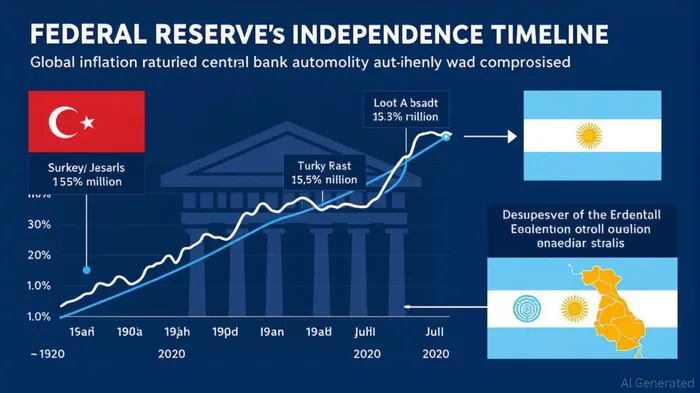
The recent turbulence in U.S. monetary policy underscores a critical juncture in the history of central bank independence. President Donald Trump's aggressive attempts to remove Federal Reserve Governor Lisa Cook and publicly pressure Fed Chair Jerome Powell have ignited a fierce debate about the risks of politicizing monetary policy. These actions, framed as efforts to stimulate economic growth, threaten to erode the foundational principle of central bank autonomy—a principle that has long safeguarded global financial stability.
The Legal and Historical Context of Fed Independence
The Federal Reserve's independence is enshrined in its structure, with governors removable only “for cause,” a legal standard designed to insulate monetary policy from political cycles [1]. This framework has historically prevented short-term political considerations from distorting long-term economic goals. However, Trump's recent actions—alleging mortgage fraud against Governor Cook without sufficient evidence—have tested these safeguards. A federal judge temporarily blocked her removal, ruling the allegations “insufficient grounds for dismissal” [1], yet the administration's persistence signals a broader strategy to reshape the Fed's composition.
Historical precedents warn of the dangers of such interference. In countries like Turkey and Argentina, where central banks lost independence, inflation spiraled out of control, eroding public trust and destabilizing economies [3]. The European Central Bank's Christine Lagarde has explicitly warned that U.S. political pressure on the Fed could pose a “very serious danger” to global markets [1]. These examples illustrate a recurring pattern: when monetary policy becomes a political tool, the result is often inflationary chaos and diminished credibility.
The Risks of Politicized Rate Cuts
Trump's demands for aggressive rate cuts, framed as a means to reduce borrowing costs and boost growth, ignore the delicate balance central banks must strike between inflation and employment. The Fed's current stance—holding rates in a 4.25–4.50% range as of late July 2025—reflects its cautious approach to monitoring inflationary pressures from tariffs and global uncertainties [4]. Yet Trump's public criticism of Powell as “too late” to cut rates has created a volatile environment, where market expectations clash with the Fed's data-driven mandate [2].
The risks of premature rate cuts under political pressure are manifold. First, they could exacerbate inflation by lowering the cost of borrowing, encouraging spending and investment at a time when supply chains remain fragile. Second, they risk undermining the Fed's credibility. If investors perceive the Fed as a political pawn, long-term interest rates may rise as confidence in price stability wanes [4]. This paradox—lower short-term rates but higher long-term borrowing costs—could backfire on the very economic goals Trump seeks to achieve.
Market Implications and Global Repercussions
The potential fallout extends beyond U.S. borders. As the dollar remains the dominant global reserve currency, a loss of confidence in the Fed's independence could accelerate the shift in economic power toward nations like China and Russia [4]. The Bank of Russia's 21% key rate in 2025, maintained to curb inflation, serves as a stark reminder of the consequences of failing to anchor inflation expectations [4]. If the Fed's credibility is compromised, similar scenarios could unfold, with capital flight and currency volatility destabilizing global markets.
Investors are already signaling concern. Market pricing suggests an 83% probability of a 25-basis-point rate cut at the September 2025 meeting, but this optimism may be misplaced. As Federal Reserve Bank of New York President John C. WilliamsWMB-- emphasized, the Fed must “let data drive decisions” [4]. Yet Trump's appointment of a “dovish” nominee to the Fed board indicates a strategic effort to tilt policy toward expansionary measures, regardless of economic fundamentals [4].
Conclusion: A Delicate Balance at Stake
The Federal Reserve's independence is not merely an institutional safeguard—it is a cornerstone of modern economic governance. Trump's push to control monetary policy risks repeating historical missteps, where political interference led to inflationary surges and prolonged recessions. While the Fed has thus far resisted overt political pressure, the legal battle over Governor Cook's removal and the administration's public criticisms create a precarious precedent.
For investors, the implications are clear: a Fed compromised by political agendas could trigger higher inflation, unstable interest rates, and a loss of confidence in U.S. financial institutionsFISI--. The challenge now lies in preserving the delicate balance between political leadership and institutional autonomy—a balance that has, until recently, underpinned decades of economic stability.







Comentarios
Aún no hay comentarios