
Trump's 'A+++++' Economy vs. Voter Dissatisfaction: What Investors Should Watch for in 2026
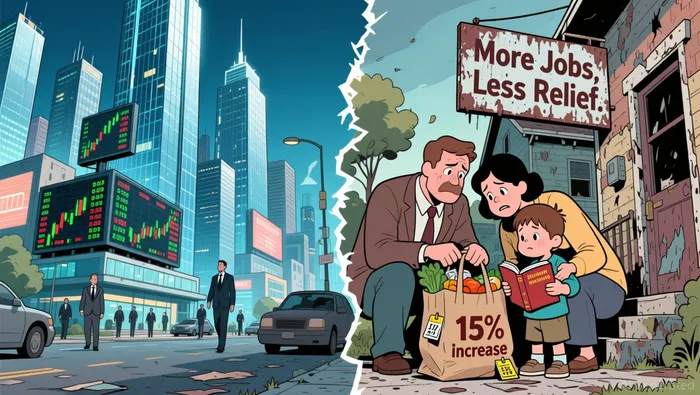
The United States stands at a crossroads in 2026, where official economic indicators and public sentiment appear to inhabit parallel universes. On one hand, the Trump administration touts a robust economy, projecting GDP growth of 2-3% and celebrating corporate profits buoyed by fiscal stimulus and AI-driven investment . On the other, voter dissatisfaction with inflation, affordability, and policy coherence has reached historic levels, with approval ratings for Trump's economic stewardship collapsing to 36%. This divergence-between the "A+++++" economy and the lived experience of households-poses profound risks for investors.
The Paradox of Divergence
The disconnect between macroeconomic data and consumer sentiment is not merely a political talking point but a structural challenge. While the administration highlights a resilient labor market and fiscal stimulus, households report grocery prices rising by 1.4% since the start of Trump's second term and perceive inflation as "not at all" under control. This chasm reflects the regressive nature of Trump's policies: tariffs on food and energy, cuts to social programs like SNAP, and a focus on corporate tax cuts have disproportionately burdened lower-income households.
 The Federal Reserve's anticipated rate cuts-0.25% in late 2025-may offer temporary relief, but they cannot erase the long-term drag of Trump's trade policies. Tariffs have pushed the effective U.S. tariff rate to 15.8% as of August 2025, the highest since 1943. These measures, while framed as tools of geopolitical leverage, have disrupted global supply chains and raised input costs for businesses and consumers alike.
Sector-Specific Impacts: Consumer Discretionary, Energy, and Tariff-Sensitive Industries
Consumer Discretionary: Tariffs have directly inflated prices for imported goods, squeezing discretionary spending. J.P. Morgan estimates that the average effective tariff rate on imports has risen to 11.2%, with sectors like pharmaceuticals and autos bearing the brunt. While large-cap firms may absorb these costs through pricing power, smaller players face margin compression. Investors should monitor retail sales data and consumer confidence indices, which remain below long-term averages.
Energy: Trump's tariffs on critical minerals-steel, aluminum, and copper-have stifled renewable energy projects, with $8 billion in solar and battery manufacturing canceled in early 2025. This undermines the administration's rhetoric of "energy dominance" and affordable energy. Higher input costs for energy infrastructure are likely to delay decarbonization efforts, creating regulatory and reputational risks for firms in the sector.
Tariff-Sensitive Industries: The Tax Foundation's General Equilibrium Model warns that Trump's tariffs could reduce U.S. GDP by 0.5% and long-run GDP by 0.2% from Section 232 tariffs alone. Sectors like semiconductors and autos face direct exposure to retaliatory measures from trading partners. The Supreme Court's pending ruling on IEEPA-based tariffs adds legal uncertainty, with potential replacements under Section 122 likely to maintain the status quo.
Investment Strategies: Navigating Policy Risks and Divergence
Investors must adopt a dual approach to manage the risks of this divergence. First, sector rotation toward AI-linked industries and defensive assets (e.g., utilities, healthcare) may offer resilience amid policy volatility. However, elevated valuations in AI stocks require caution, as earnings growth in Q3 2025 has already slowed to the weakest pace since early 2024 .
Second, hedging against policy risks demands diversification into alternative assets (e.g., real estate, commodities) and smaller-cap equities, which are less concentrated in large-cap tech . For example, energy firms pivoting to domestic mineral sourcing or tariff-protected markets may outperform peers.
Third, monitoring debt dynamics and supply chains is critical. Companies stockpiling inventory or diversifying suppliers to mitigate tariff impacts-such as those in the automotive sector-could gain a competitive edge . Conversely, firms reliant on imported goods (e.g., apparel, electronics) face margin pressures.
The Federal Reserve's Tightrope
The Fed's 2026 policy path will hinge on balancing inflation control with economic stability. While core CPI remains above 3%, the central bank may face political pressure to cut rates further, risking a return to accommodative conditions that could inflate asset bubbles . Investors should watch for divergent monetary policies between the U.S. and regions like Europe, where inflation is expected to stabilize more quickly .
Conclusion
The Trump-era economy of 2026 is a study in contradictions: a GDP growth narrative at odds with household-level pain, and a trade policy that promises protectionism but delivers fragility. For investors, the key lies in dissecting the data behind the headlines. Diversification, sectoral agility, and a focus on policy resilience will be paramount. As the 2026 election approaches, the stakes for both markets and democracy have never been higher.







Comentarios
Aún no hay comentarios