
Trishakti Industries' Strategic Growth through its Tata Steel Work Order: A Blueprint for Supply Chain Resilience and Earnings Visibility
In an industrial landscape increasingly defined by volatility and the imperative for resilience, Trishakti Industries has emerged as a case study in strategic adaptation. The recent award of a significant work order by Tata Steel-a contract valued at ₹50–65 lakh with a fresh capital expenditure of ₹1.5–2 crore-underscores the company's ability to align its operational capabilities with the evolving demands of India's infrastructure and heavy industries sectors, as reported by Business Standard. This order, part of a broader ₹41–49.5 crore capital expenditure plan for fiscal year 2026, reflects not merely a transaction but a calculated move to fortify supply chain reliability and secure long-term earnings visibility, according to a MarketScreener release.
Supply Chain Resilience: A Strategic Imperative
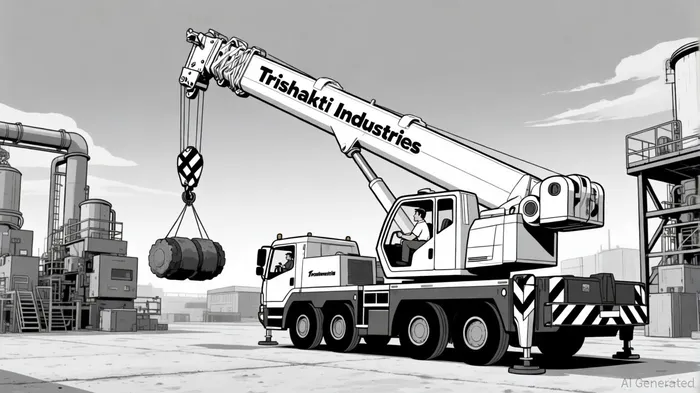
The Tata Steel contract exemplifies Trishakti's pivot toward enhancing supply chain resilience, a priority for global manufacturers in 2025 amid geopolitical tensions, climate risks, and economic uncertainty, according to a Global Banking & Finance report. By deploying advanced hydraulic truck-mounted cranes and skilled manpower, Trishakti addresses two critical dimensions of resilience: technological sophistication and human capital. These assets enable the company to meet the stringent demands of complex projects while mitigating bottlenecks in equipment availability and execution quality, as noted in a BusinessUpturn report.
This strategy aligns with broader industry trends. As noted in a Maersk insight, firms are increasingly prioritizing nearshoring, supplier diversification, and technology-driven risk mitigation. Trishakti's focus on expanding its high-capacity fleet-supported by a ₹43 crore capex allocation-positions it to serve marquee clients like Tata Steel with reduced dependency on external suppliers and minimized downtime, as covered in Construction World. The company's emphasis on "arm's length" partnerships, devoid of promoter-group conflicts, further strengthens trust in its operational independence, according to a MarketScreener note.
Earnings Visibility and Financial Turnaround
Trishakti's financials, while mixed in the short term, reveal a compelling narrative of recovery and growth. For Q3 2025, the company reported a 99% quarter-on-quarter revenue surge to ₹4.08 crore, albeit a 64% year-on-year decline, per Business Standard results. However, the Q1 FY26 results tell a different story: revenue jumped 86% QoQ to ₹408.38 lakh, while EBITDA soared 130.9% to ₹270.3 lakh, according to India Today Updates. This turnaround is attributed to the Tata Steel order and similar contracts with Larsen & Toubro and the Adani Group, which validate Trishakti's strategic transformation into a specialized equipment rental provider, as noted in MarketScreener results.
The Tata Steel work order, in particular, is a cornerstone of this transformation. With a 12-month execution period and a focus on high-margin infrastructure projects, the contract provides immediate revenue visibility and reinforces the company's ability to secure repeat business from top-tier clients, according to The Economic Times. Moreover, Trishakti's capex plan-targeting ₹400 crore by FY28-signals confidence in sustained demand, with management projecting revenue of ₹900–1,000 million by FY28, as noted in the MarketScreener release.
Long-Term Partnerships and Sector Dynamics
Beyond the Tata Steel deal, Trishakti's strategy hinges on cultivating long-term client relationships. The company's partnerships with industry leaders are not transactional but rooted in shared goals of operational efficiency and risk mitigation, as described in the BusinessUpturn report. For instance, its deployments in steel, civil infrastructure, and renewable energy sectors highlight its versatility in addressing sector-specific challenges, as reported by India Today Updates. This diversification reduces exposure to cyclical downturns in any single industry, enhancing earnings stability.
The industrial engineering sector itself is a tailwind. India's push for infrastructure development, coupled with the global shift toward localized supply chains, creates a favorable environment for firms like Trishakti. By investing in AI-driven simulations and digital twins-technologies cited as critical for modern supply chains in the Global Banking & Finance report-the company is future-proofing its operations against disruptions.
Conclusion: A Model for Resilient Growth
Trishakti Industries' collaboration with Tata Steel is more than a single contract; it is a microcosm of a broader strategic realignment. By prioritizing supply chain resilience through advanced technology, capital discipline, and long-term client partnerships, the company is positioning itself as a critical player in India's industrial ecosystem. For investors, the combination of immediate earnings visibility, a robust capex plan, and sector tailwinds presents a compelling case for long-term value creation.
As global supply chains continue to evolve, Trishakti's approach offers a blueprint for navigating uncertainty while capitalizing on growth opportunities-a testament to the power of strategic foresight in an unpredictable world.







Comentarios
Aún no hay comentarios