
TPG RE Finance Trust's $0.24 Dividend: A Strategic Play in the High-Yield Real Estate Credit Market
The high-yield real estate credit market has long been a magnet for income-seeking investors, offering returns that often outpace traditional fixed-income assets. TPG RE Finance TrustTRTX-- (TRF), with its $0.24 per share annual dividend, stands out as a compelling player in this space. But the critical question remains: Is this dividend sustainable? To answer it, one must look beyond the trust itself and into the broader ecosystem of TPG's $99 billion credit and real estate platform, which forms the bedrock of TRF's operational resilience and income-generation potential.
The Foundation of Stability: TPG's Credit and Real Estate Platforms
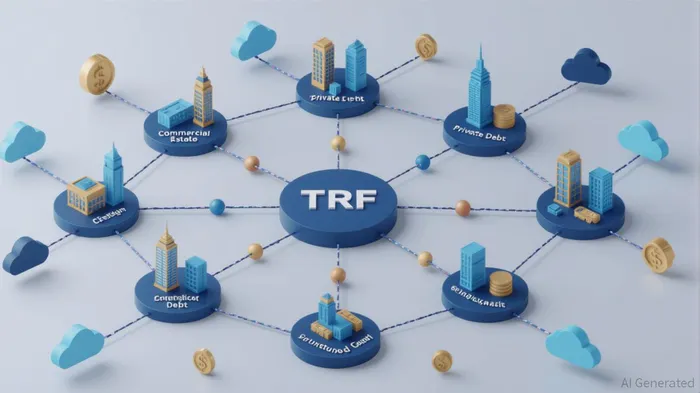
TPG's real estate and credit platforms, anchored by TPGTPG-- Angelo Gordon, manage a staggering $99 billion in assets, spanning global credit opportunities and real estate investments[1]. This scale is not merely a function of size but of strategic diversification. By deploying capital across commercial real estate, private debt, and structured credit, TPG mitigates sector-specific risks while capturing returns from multiple levers of growth. For TRFTFC--, this means access to a robust pipeline of high-conviction investments, which are critical for maintaining consistent cash flows to support its dividend.
The firm's operational performance, though not granularly detailed in recent public filings, is underpinned by its disciplined approach to risk management. TPG Angelo Gordon emphasizes rigorous underwriting and active portfolio management, traits that are particularly valuable in volatile markets. In an era of rising interest rates and economic uncertainty, such strategies help preserve capital and stabilize returns—key prerequisites for dividend sustainability.
Strategic Acquisitions and Operational Synergies
While specific details on TPG's recent acquisitions in the credit and real estate sectors remain opaque[1], the firm's historical playbook suggests a focus on bolt-on deals that enhance operational efficiency and expand market reach. For instance, TPG's integration of Angelo Gordon into its broader infrastructure has likely streamlined cost structures and improved liquidity management. These synergies indirectly bolster TRF's ability to generate and distribute income, as lower operational costs and higher leverage of resources translate to stronger net asset values.
Moreover, TPG's diversified asset base acts as a buffer against sector-specific downturns. If one segment, say commercial real estate, faces headwinds, gains in private credit or structured finance can offset losses. This balance is crucial for a dividend-focused vehicle like TRF, which relies on consistent income streams to meet its payout obligations.
The Dividend: A Product of Prudent Capital Allocation
TRF's $0.24 dividend, yielding approximately 6% for risk-aware investors, reflects a careful balance between shareholder returns and capital preservation. Unlike many high-yield vehicles that stretch for returns, TRF's strategy appears anchored in TPG's broader credit platform, which prioritizes quality over quantity. By leveraging TPG's $269 billion in total assets under management[1], the trust gains access to non-correlated investments that generate stable, recurring income.
However, sustainability hinges on TPG's ability to navigate macroeconomic challenges. Rising borrowing costs and regulatory scrutiny of non-bank lenders could pressure margins. Yet, TPG's deep expertise in structuring complex credit products—such as mezzanine loans and distressed debt—positions it to adapt. For example, its focus on floating-rate instruments insulates it from rate hikes, while its global footprint allows it to capitalize on regional dislocations.
A Compelling Case for Income Investors
For investors seeking yield without excessive risk, TRF's dividend represents a strategic play. Its sustainability is not a standalone feat but a product of TPG's ecosystem-wide strengths: scale, diversification, and operational discipline. While granular data on recent performance remains scarce, the firm's track record and resource base suggest a durable model.
That said, prudence is warranted. The high-yield real estate credit market is inherently cyclical, and TRF's future performance will depend on TPG's agility in recalibrating its strategies. For now, though, the $0.24 dividend appears well-supported by the firm's broader credit and real estate platforms—a testament to the power of integrated asset management in today's fragmented markets.





Comentarios
Aún no hay comentarios