
Toyota Tsusho's Strategic Momentum and Shareholder Value Creation: A Deep Dive into Upgraded Forecasts and Dividend Commitments
Strategic Momentum: Supply Chain and Africa as Growth Engines
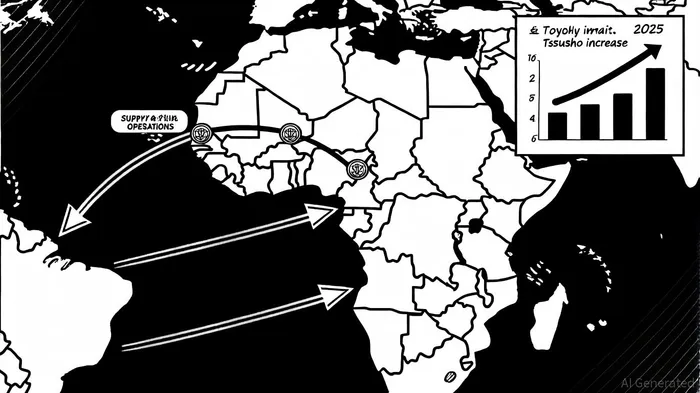
Toyota Tsusho's supply chain division has emerged as a critical growth driver, reflecting broader trends in global manufacturing. Data from Railly News indicates that Toyota's global vehicle production rose by 4.9% in August 2025, with domestic production in Japan surging 12% and overseas output growing 2.4%. These figures highlight the company's ability to adapt to demand fluctuations, a testament to its agile supply chain infrastructure. While specific metrics for the Africa division in the most recent quarter remain undisclosed, the division's inclusion in the profit forecast upgrade suggests its strategic importance. Africa's markets, though volatile, offer high-growth potential, particularly in resource extraction and infrastructure development-sectors where Toyota Tsusho has historically maintained a strong presence.
However, external risks loom. The impending expiration of the African Growth and Opportunity Act (AGOA) on September 30, 2025, could disrupt trade flows, particularly in textiles and apparel; a UNCTAD warning highlights the potential for heavier U.S. tariffs if AGOA is not renewed. If not renewed, increased U.S. tariffs on African exports may erode margins for companies reliant on these markets. This context underscores the need for Toyota Tsusho to diversify its African operations or hedge against policy-driven volatility.
Shareholder Value Creation: Dividends, Buybacks, and Capital Allocation
Toyota Tsusho's commitment to shareholder value creation is evident in its revised payout ratio and announced share repurchase program. By raising its dividend to 116 yen per share, the company signals confidence in its cash flow generation, even as it maintains a conservative approach to capital allocation, as noted in the Zawya report. The inclusion of buybacks in its 40%+ payout ratio further aligns with modern corporate governance trends, where returning capital to shareholders is prioritized over excessive reinvestment in low-return projects.
A forthcoming share repurchase program, slated to begin in March 2026, adds another layer of value creation, according to a Barchart report. While the scale and funding sources of the buyback remain unspecified, the mere announcement reflects a strategic intent to optimize capital structure. This move is particularly noteworthy given Toyota Tsusho's recent acquisition of Toyota Industries Corporation, which likely bolstered its liquidity position. Investors should monitor regulatory approvals and the program's execution timeline, as these will determine its immediate impact on earnings per share.
Risks and Long-Term Considerations
Despite its strengths, Toyota Tsusho faces challenges that could test its strategic momentum. The Africa division's exposure to geopolitical and regulatory shifts, as highlighted by UNCTAD's warnings on AGOA, necessitates proactive risk management. Additionally, the company's reliance on cyclical sectors-such as automotive and commodities-means its profitability could fluctuate with global economic cycles.
For long-term value creation, Toyota Tsusho must balance short-term returns with investments in innovation. Its supply chain expertise, for instance, could be leveraged to pioneer sustainable logistics solutions, a growing demand in ESG-focused markets. The absence of detailed Q3 2025 Africa performance data also raises questions about transparency; investors may seek more granular reporting to assess the division's resilience.
Conclusion
Toyota Tsusho's upgraded forecasts and shareholder-friendly policies reflect a company in strategic alignment with its stakeholders' interests. By leveraging its supply chain agility and Africa's growth potential, while committing to disciplined capital returns, the firm is positioning itself as a model of sustainable value creation. However, navigating external risks-particularly in Africa-and maintaining operational transparency will be critical to sustaining this momentum. For investors, the current trajectory suggests a compelling blend of growth and prudence, though vigilance remains essential in an unpredictable global economy.





Comentarios
Aún no hay comentarios