
Toromont Industries' Share Repurchase Strategy: A Catalyst for Shareholder Value in a Reshoring-Driven Industrial Sector
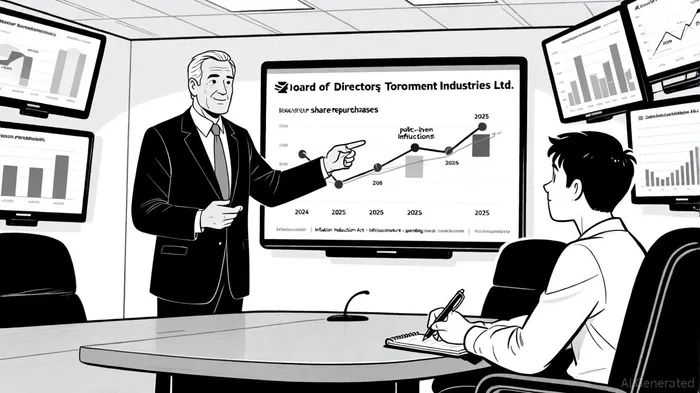
The recent renewal of Toromont Industries Ltd.'s Normal Course Issuer Bid (NCIB) underscores a strategic commitment to enhancing shareholder value amid a transformative period for the industrial equipment sector. By authorizing the repurchase of up to 8,128,838 common shares—10% of its public float—Toromont signals confidence in its capital structure and long-term prospects, even as it navigates a landscape shaped by policy-driven reshoring and infrastructure investment[1]. This move aligns with broader trends in the industrial sector, where companies are leveraging favorable macroeconomic conditions to reward shareholders through disciplined buybacks and dividends[2].
Strategic Implications of the NCIB Renewal
Toromont's latest NCIB, effective from September 23, 2025, to September 22, 2026, builds on its prior success. During the 2024–2025 period, the company repurchased 986,000 shares at an average price of $116.47 CAD, demonstrating a consistent approach to capital allocation[1]. The renewed program allows for daily repurchases of up to 35,919 shares, with an automatic securities purchase plan (ASPP) ensuring continuity during regulatory blackout periods[1]. By canceling repurchased shares, Toromont reduces its outstanding equity base, potentially boosting earnings per share (EPS) and reinforcing its appeal to value-conscious investors.
This strategy gains added significance in a sector experiencing structural shifts. According to a report by Fidelity, the industrial equipment industry is poised to benefit from U.S. and Canadian government policies such as the Inflation Reduction Act and CHIPS Act, which are accelerating domestic manufacturing and infrastructure projects[1]. As demand for construction and electrification equipment rises, companies like Toromont—operating through its CaterpillarCAT-- dealership and thermal management solutions divisions—are well-positioned to capitalize on these trends. Share repurchases, in this context, serve as both a financial tool and a signal of management's conviction in the company's ability to generate sustainable cash flows[2].
Market Confidence and Sector-Wide Trends
The industrial sector's broader embrace of buybacks further validates Toromont's approach. Goldman SachsGS-- estimates that corporate repurchases will exceed $1 trillion in 2025, driven by low borrowing costs and tax incentives such as the impending expiration of the Tax Cuts and Jobs Act (TCJA)[3]. For industrial firms, buybacks act as a counterbalance to stock price volatility, particularly in cyclical industries where earnings can fluctuate with macroeconomic conditions[3]. Toromont's decision to renew its NCIB, coupled with its steadfast quarterly dividend of $0.52 per share, reinforces a dual focus on capital returns and operational resilience[4].
However, the effectiveness of such strategies hinges on execution. While Toromont's recent repurchase of 132,600 shares in Q2 2025 for $15.1 million suggests a disciplined approach[1], analysts caution that margin pressures and input cost inflation remain risks. The company's ability to maintain profitability while funding buybacks will be critical to sustaining investor trust.
Conclusion: A Prudent Path Forward
Toromont Industries' NCIB renewal reflects a nuanced understanding of its operating environment. By aligning its capital allocation with sector-wide tailwinds—such as reshoring and infrastructure spending—the company is not only enhancing shareholder value but also signaling its confidence in the industrial equipment sector's long-term trajectory. As the global economy grapples with uncertainty, such strategic clarity will be essential for firms seeking to differentiate themselves in a consolidating market.







Comentarios
Aún no hay comentarios