
Toll Brothers (TOL): Is the Q4 Earnings Outlook Justifying Optimism in a Slowing Housing Market?
The U.S. housing market in 2025 is a study in contradictions. On one hand, it is shackled by high mortgage rates, affordability crises, and a "lock-in effect" that has frozen inventory at record lows. On the other, pockets of resilience persist, particularly in the luxury segment, where demand remains relatively insulated from broader economic headwinds. For investors, the question is whether companies like Toll BrothersTOL-- (TOL) can navigate these challenges and offer contrarian value.
A Market in Transition
The U.S. housing market is defined by a fragile equilibrium. Mortgage rates, which climbed from 2.99% in June 2021 to 6.82% in June 2025, have rendered homeownership unattainable for many. Existing home sales and inventory remain subdued, though normalization is emerging in key metropolitan areas. Meanwhile, the rise of single-family rentals (SFRs) has created a new dynamic, with institutional investors boosting property values through renovations, while smaller players may depress them.
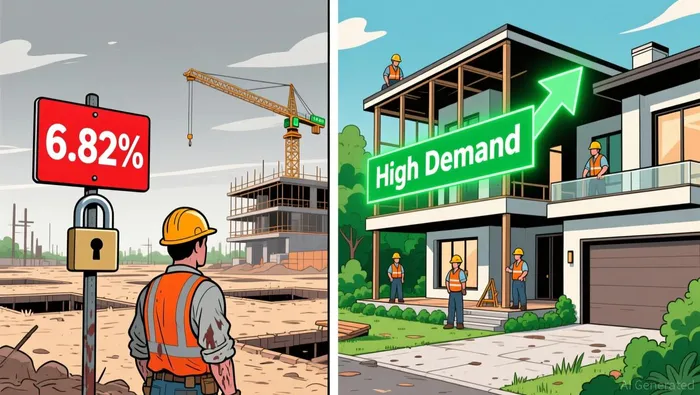
Yet, the market is not without hope. Redfin forecasts a "Great Housing Reset" by 2026, where income growth will outpace home-price growth, offering some relief. For now, however, affordability constraints and high rates dominate the landscape.
Toll Brothers: A Contrarian's Dilemma
Toll Brothers, the nation's leading luxury homebuilder, is poised to report Q4 2025 earnings on December 8, 2025 according to Nasdaq. Analysts expect earnings per share (EPS) of $4.88, a 5.2% increase year-over-year, and revenue of $3.32 billion, a marginal 0.3% decline according to Nasdaq. These figures reflect a company navigating a challenging environment with disciplined pricing and cost control.
The average selling price (ASP) of delivered homes is projected to rise to $970,000–$980,000, up from $950,200 in the prior-year quarter. This resilience is attributed to Toll Brothers' luxury positioning, which targets affluent buyers less sensitive to rate hikes. However, the company faces margin compression, with adjusted home sales gross margin expected to contract 90 basis points to 27%, driven by a shift toward lower-margin products in key regions like the Pacific.
Backlog metrics tell a mixed story. Total backlog units are forecast to decline 17.7% year-over-year to 4,935 units, with potential revenues dropping 9% to $5.89 billion. While this suggests waning demand, the company's focus on high-end communities-where demand remains robust-provides a buffer.
Valuation and Analyst Sentiment
Toll Brothers' stock has underperformed in the past year, with a 52-week decline of -10.90% according to StockAnalysis. Yet, its valuation appears compelling: a trailing P/E of 10.21 and a forward P/E of 10.22, alongside an enterprise value-to-EBITDA ratio of 8.09 according to StockAnalysis. Analysts have set an average price target of $151.60, implying a 9.11% upside from current levels according to StockAnalysis. A "Strong Buy" consensus, based on 10 Buy, 5 Hold, and 1 Sell ratings according to Yahoo Finance, underscores confidence in the company's ability to weather macroeconomic turbulence.
For contrarian investors, the allure lies in Toll Brothers' market position. While the broader homebuilding sector struggles with affordability constraints, the luxury segment-Toll Brothers' core-remains relatively insulated. Affluent buyers, less affected by rate hikes, continue to prioritize premium housing, allowing the company to maintain pricing power.
Risks and Realities
The risks are not trivial. A further rise in mortgage rates or a prolonged economic slowdown could erode demand even in the luxury segment. Moreover, converting backlogs into sales will depend on the broader market's ability to absorb inventory-a challenge given the "lock-in effect" and low inventory levels.
Additionally, margin pressures from lower-margin product mix and supply chain dynamics could persist. Toll Brothers' success in 2026 will hinge on its ability to adapt to shifting conditions while maintaining its premium brand equity.
Conclusion: A Calculated Bet
Toll Brothers' Q4 2025 outlook suggests a company that is neither immune to macroeconomic headwinds nor entirely vulnerable to them. Its luxury positioning and disciplined cost controls offer a degree of insulation, but the broader housing market's fragility cannot be ignored. For contrarian investors, the stock represents a calculated bet: a high-conviction play on a sector that has historically underperformed during rate hikes but may rebound as affordability improves in 2026 according to Fortune.
The key question is whether the market has overcorrected. If the "Great Housing Reset" materializes, Toll Brothers' focus on affluent buyers could position it to outperform. However, patience and a long-term perspective will be essential. In a market defined by uncertainty, the contrarian's edge lies in distinguishing between temporary turbulence and structural decline.







Comentarios
Aún no hay comentarios