
Tesla's Valuation Dilemma: Navigating Slumping EV Sales and Distant Technological Hopes
The investment case for TeslaTSLA--, Inc. (TSLA) has long balanced on a precarious fulcrum: the tension between its immediate financial performance and its audacious long-term vision. In Q4 2025, the company delivered 418,227 vehicles, a 16% decline from the same period in 2024 and below analyst expectations of 422,850 units. This slump, driven by the expiration of the U.S. federal $7,500 EV tax credit in September 2025 and intensifying competition, has raised urgent questions about its short-term resilience. Yet, Tesla's speculative allure persists, anchored in its bets on artificial intelligence, autonomous driving, and energy storage. The challenge for investors lies in reconciling these two narratives.
Short-Term Risks: A Perfect Storm of Demand and Margin Pressures
Tesla's Q4 2025 results underscore a confluence of headwinds. The pull-forward of demand into Q3 2025-when the tax credit expired-left a void in subsequent quarters, exacerbating the 16% year-over-year decline in deliveries. For the full year, total deliveries fell to 1.64 million vehicles, a 8.6% drop from 2024. This trend reflects not only policy-driven distortions but also structural challenges: an aging Model 3 and Y lineup, and rising competition from BYD, Kia, and Hyundai, which have eroded Tesla's market share in key regions.
Financially, Tesla's operating margin compressed to 5.8% in Q3 2025, a 501-basis-point decline year-over-year, as higher production costs and operating expenses squeezed profitability. While the automotive segment still accounts for 72.6% of total revenue, its growth has slowed compared to the 44% expansion in energy and services. This divergence highlights a critical vulnerability: Tesla's reliance on EV sales, a market now saturated with cheaper, more feature-rich alternatives.
Long-Term Potential: The Silicon-Energy Gambit 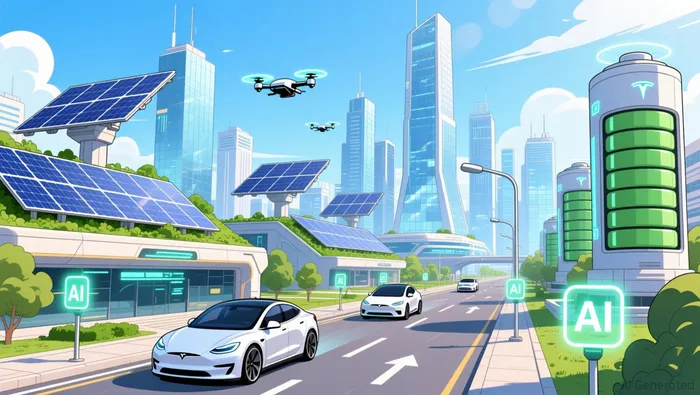
Yet, Tesla's long-term narrative hinges on its transformation into a "Silicon-Energy" ecosystem. The energy business, for instance, has emerged as a bright spot, with 14.2 gigawatt-hours of battery storage deployed in Q4 2025-a record for the quarter and a 113% annual increase. This growth signals Tesla's pivot toward utility-scale energy storage, a market with recurring revenue potential through software-as-a-service models.
More ambitiously, Tesla's Full Self-Driving (FSD) and Robotaxi initiatives aim to redefine its valuation. By mid-2026, the company plans to roll out Unsupervised FSD in geofenced areas and expand its Robotaxi network to 8–10 new markets, including Florida and Arizona. The Cybercab, a dedicated robotaxi without traditional controls, could further reduce operational costs and scale autonomous ride-hailing. Analysts argue that successful execution here could unlock a $2 trillion market cap, positioning Tesla as a leader in AI-driven mobility.
The Valuation Dilemma: Balancing Act
The crux of Tesla's valuation dilemma lies in its dual identity: a struggling EV automaker and a speculative tech play. Short-term risks-declining margins, competitive pressures, and regulatory hurdles for FSD-threaten to undermine its premium valuation. Yet, the long-term potential of its energy and AI bets offers a compelling counterpoint.
For instance, Tesla's energy segment already contributes 113% more deployments than in 2024, suggesting a path to diversification. Meanwhile, its AI-driven software, particularly Supervised FSD, could generate high-margin revenue streams, offsetting automotive margin compression. However, these outcomes remain contingent on regulatory approvals, technological execution, and market adoption-uncertainties that investors must weigh carefully.
Conclusion: A High-Stakes Rebalancing
Tesla's Q4 2025 results are a cautionary tale for investors who have long treated the company as a tech stock. The automotive business, once a growth engine, now faces headwinds that cannot be ignored. Yet, the energy and AI segments offer a lifeline, provided Tesla can navigate execution risks. The January 28, 2026 earnings call will be pivotal, as the market scrutinizes progress on FSD, Megapack margins, and energy-as-a-service monetization.
In the end, Tesla's valuation hinges on a delicate balancing act: mitigating short-term risks while accelerating long-term value creation. For now, the stock remains a high-stakes proposition, where optimism about the future must contend with the realities of the present.







Comentarios
Aún no hay comentarios