
Tesla's Strategic Shift and Market Reactions Amid Dwindling EV Sales: Assessing Long-Term Investment Viability
The electric vehicle (EV) revolution, once spearheaded by TeslaTSLA--, now faces a pivotal inflection point. In Q4 2025, Tesla delivered 418,227 vehicles, a 15% decline from Q4 2024's 495,570 units, falling short of analyst expectations of 426,000 to 440,260 vehicles. For the full year, deliveries totaled 1.64 million vehicles, a 9% drop from 2024, marking its second consecutive annual decline. This erosion of core business performance, driven by the expiration of the U.S. federal EV tax credit in September 2025 and intensifying competition from Chinese automakers like BYD, has forced Tesla to pivot toward its AI and autonomous technology initiatives as a growth engine.
The Erosion of EV Dominance
Tesla's waning dominance is evident in both production and market share metrics. Q4 2025 production fell 5.5% year-over-year to 434,358 vehicles, while its U.S. EV market share remains robust at 56.7% in November 2025, masking broader vulnerabilities. In Europe, Tesla's registrations plummeted by 39% year-to-date through November 2025, as Chinese rivals like BYD captured market share. These trends underscore a maturing EV market where Tesla's first-mover advantage is no longer sufficient to insulate it from competitive pressures.
The AI and Autonomous Tech Gambit
In response, Tesla has doubled down on its AI-driven ambitions. The company's Full Self-Driving (FSD) v14 system, deployed in Q4 2025, demonstrated a six-fold improvement in miles between interventions, nearing "near-human" safety levels. Meanwhile, driverless robotaxi prototypes tested in Austin, Texas, without safety drivers, signaled progress toward its Cybercab vision. However, these advancements are tempered by delays: the Model 2 remains slated for late 2026, and Optimus humanoid robots have yet to achieve commercial scalability.
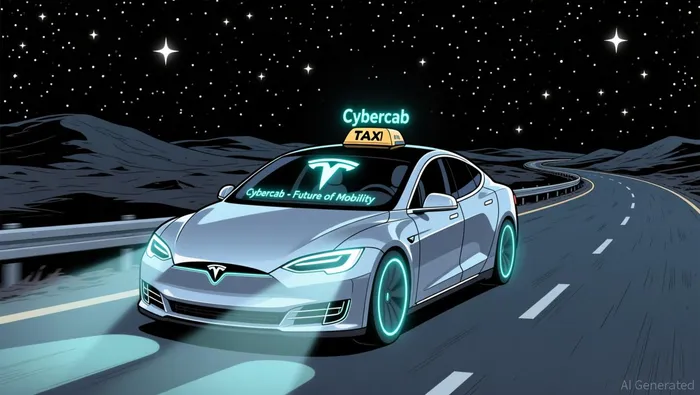 Market reactions to these initiatives are mixed. Analysts like Dan Ives highlight the potential for Tesla's AI and robotics divisions to reach a $3 trillion valuation by late 2026, while others caution against overestimating the commercial viability of projects like Optimus and Cybercab. Regulatory hurdles, technical complexities and the need for infrastructure (e.g., charging networks for robotaxis) remain significant barriers.
Financial Projections and Valuation Risks
Tesla's stock, trading at a forward P/E ratio of 259.78, reflects a valuation heavily predicated on the success of its AI and autonomous tech bets. Analysts project a wide range of outcomes for 2026, with price targets spanning $150 to $510. Optimistic forecasts hinge on the commercialization of Cybercab, which some estimate could generate $756 billion annually by 2029, while bearish scenarios factor in execution risks, regulatory delays, and the uncertain timeline for Optimus 3's mass production (expected by late 2026).
The disconnect between Tesla's current valuation and its core business performance raises critical questions. While its EV segment faces declining sales and margin pressures, its AI initiatives remain unproven revenue generators. For instance, FSD software monetization is still in its infancy, and the Cybercab's profitability depends on achieving scale-a process that could take years.
A Credible Growth Path or Speculative Distraction?
Tesla's strategic shift hinges on a delicate balance: leveraging its AI expertise to create new revenue streams while mitigating the risks of overreliance on speculative bets. The company's progress in FSD and Optimus demonstrates technical prowess, but commercial success requires more than innovation-it demands execution, regulatory approval, and market acceptance.
For investors, the key question is whether these initiatives can offset the decline in EV sales. While the potential rewards are immense, the path is fraught with uncertainties. Chinese automakers are rapidly advancing their own AI and autonomous tech capabilities, and global regulatory environments remain fragmented. Moreover, Tesla's core business is not immune to macroeconomic headwinds, such as inflation and interest rates, which could further strain its financials according to market analysts.
Conclusion
Tesla's pivot to AI and autonomous technology represents both a bold vision and a high-stakes gamble. The company's ability to transform these initiatives into sustainable revenue streams will determine its long-term investment viability. However, investors must remain cautious: the gap between technological promise and commercial reality is wide, and Tesla's current valuation reflects a level of optimism that may not be justified by near-term outcomes. In an increasingly competitive landscape, the road ahead for Tesla is as much about execution as it is about innovation.





Comentarios
Aún no hay comentarios