
Tesla's Strategic Expansion: Navigating Market Share Challenges and Long-Term Investment Potential
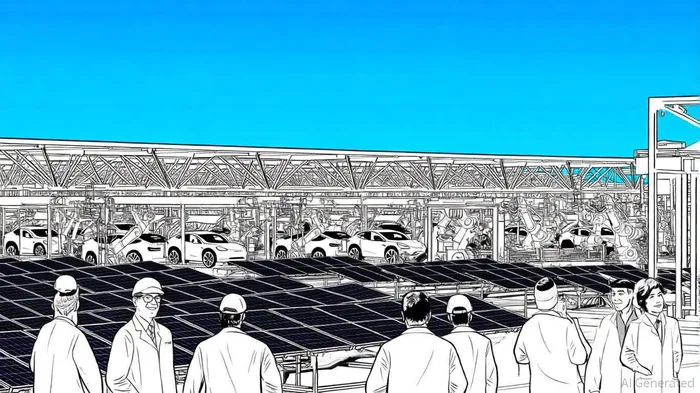
The electric vehicle (EV) industry is at a pivotal juncture, with TeslaTSLA-- Inc. (TSLA) navigating a complex landscape of innovation, competition, and shifting consumer preferences. For investors, the question remains: Can Tesla's aggressive product expansion and technological bets sustain its market leadership and deliver long-term returns? The answer lies in dissecting its strategic moves, financial resilience, and the evolving dynamics of global markets.
Strategic Product Expansion: A Double-Edged Sword
Tesla's recent investments in manufacturing and AI underscore its ambition to dominate not just the EV sector but also the broader energy transition. The company's $3.6 billion expansion of its Nevada Gigafactory, including production of 4680 battery cells and electric semi-trucks, signals a commitment to vertical integration and cost efficiency, according to an Autotimes report. Meanwhile, Autotimes also notes the planned Gigafactory in Mexico, set to begin production by 2026, aims to leverage lower labor costs and proximity to North American markets. These moves are critical for maintaining economies of scale, a cornerstone of Tesla's competitive edge.
However, such expansions come with risks. The European and Chinese markets, once key growth drivers, have seen Tesla's sales decline by 45% and 7.8%, respectively, in 2025, due to fierce competition from local players like BYD and legacy automakers, according to Honest John. This highlights a broader challenge: as the EV market matures, Tesla's early-mover advantage is eroding. According to Electrek, Tesla's U.S. market share in EVs fell to 38% in August 2025, the lowest since 2017, as legacy automakers like Ford and GM close the technological gap; CSIMarket data show similar pressure on Tesla's competitive position.
Financial Resilience and Diversification
Despite these headwinds, Tesla's financial position remains robust. The company's $37 billion in cash reserves provide a buffer against short-term volatility, enabling continued investment in R&D and global expansion, Autotimes reports. Its energy segment, which includes the Megapack and solar products, grew 570% since 2019, reaching $10.1 billion in revenue in 2024, according to StockDividendScreener. This diversification into renewable energy solutions is a strategic hedge against automotive sector volatility and aligns with global decarbonization trends.
Yet, profitability is under pressure. Honest John also reports that Tesla's net income fell by 71% in Q1 2025 compared to the prior year, driven by rising operational costs and interest rates. While the company's automotive segment still accounts for 90% of total revenue, its ability to sustain margins will depend on scaling new products and managing supply chain bottlenecks, the StockDividendScreener analysis notes.
Long-Term Prospects: Innovation as a Moat
Tesla's long-term appeal to investors hinges on its ability to innovate. The company's $5 billion investment in AI for 2025, including the Cortex training cluster and 10,000 Optimus humanoid robots, positions it to revolutionize manufacturing and reduce labor costs, according to Quanta Intelligence. These initiatives, if successful, could reinforce Tesla's "software-defined" business model, where AI-driven efficiencies and autonomous driving capabilities create a durable competitive advantage.
However, the path to dominance is fraught with uncertainty. Traditional automakers are accelerating their EV transitions, while startups like BYD and Rivian are gaining traction. Data from CSIMarket shows Tesla's global EV market share at 4.42% in Q2 2025, trailing Toyota (14.69%) and Volkswagen (13.09%). This underscores the need for Tesla to differentiate through innovation rather than market share alone.
Investment Implications
For investors, Tesla represents a high-conviction, high-risk proposition. Its strategic bets on AI, robotics, and energy solutions could unlock significant value over the next decade, particularly if it maintains leadership in software and automation. However, near-term challenges-including margin pressures, regulatory scrutiny, and intensifying competition-pose risks to its growth trajectory.
The key question is whether Tesla can scale its innovations profitably while defending its brand premium. Its direct-to-consumer sales model and strong brand loyalty provide a foundation, but these advantages may erode as rivals adopt similar strategies. As stated by Quanta Intelligence, Tesla's "long-term growth potential remains intact, but short-term challenges require careful navigation."
In conclusion, Tesla's strategic product expansion is a double-edged sword: it offers a pathway to sustained leadership in the EV and energy sectors but demands disciplined execution and adaptability. For patient investors, the company's vision and financial flexibility justify a long-term stake, albeit with a clear-eyed assessment of the risks.





Comentarios
Aún no hay comentarios