
Why Tesla's Robotaxi Ambitions May Fall Short of Valuation Expectations
The stock market has long been a theater of hope and hype, but few spectacles are as striking as Tesla's robotaxi initiative. Since Elon Musk first hinted at a future of autonomous ride-hailing, the company has woven this vision into the fabric of its valuation. Yet, as 2025 draws to a close, the gap between Tesla's marketing narrative and its technological execution has become impossible to ignore. This disconnect raises urgent questions about whether the company's soaring valuation-partly predicated on robotaxi potential-can withstand the scrutiny of reality.
The Marketing Mirage
Tesla's strategy for robotaxi has been as much about storytelling as it has been about engineering. Musk's repeated assurances-ranging from 2024 launch promises to claims of "best-of-breed" AI-have fueled investor optimism, with Morgan Stanley estimating that robotaxi accounts for 30% of Tesla's current stock valuation. The company's recent website revamp, emphasizing a "2026 Cybercab" rollout, further stokes expectations. Yet, the operational reality remains starkly underwhelming. As of late 2025, Tesla's robotaxi service operates in only two U.S. cities-Austin and San Francisco-with fewer than 150 vehicles deployed, far below the 500-vehicle scale Musk had forecasted. These vehicles still require human safety drivers, a detail conspicuously absent from promotional materials.
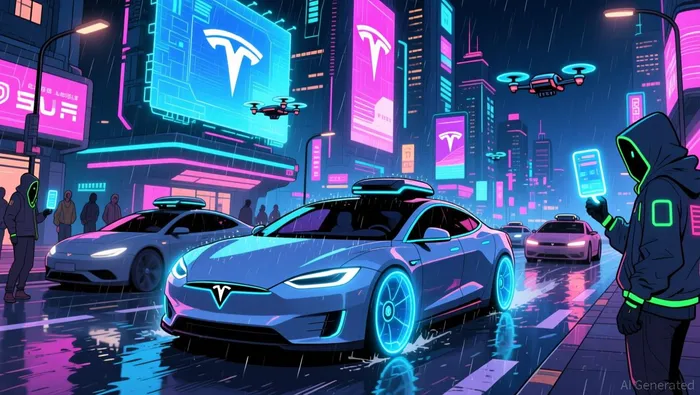 This pattern of overpromising is not new. TeslaTSLA-- has a history of missing deadlines for FSD (Full Self-Driving) software, a critical enabler of robotaxi. Analysts argue that the company's marketing has created a "perception of progress" that outpaces actual development. For instance, while Tesla touts its camera-only system as a cost advantage, third-party assessments reveal persistent flaws: the software struggles with adverse weather, misinterprets traffic signs, and exhibits erratic behavior in complex urban environments. Competitors like Waymo, which uses lidar and operates thousands of fully autonomous vehicles in multiple cities, have left Tesla trailing in both technical maturity and regulatory approval.
Technological Hurdles and Safety Scrutiny
The core of Tesla's robotaxi vision hinges on achieving Level 5 autonomy-a state where vehicles operate without any human intervention. Yet, as of late 2025, FSD remains in supervised mode, requiring constant oversight. This limitation is not merely technical but existential: a robotaxi service that cannot operate unsupervised cannot generate the recurring revenue streams that justify its current valuation.
Third-party evaluations underscore these challenges. The U.S. National Highway Traffic Safety Administration is investigating 58 incidents involving Tesla's FSD system, including crashes and red-light violations, with 2.9 million vehicles under scrutiny. Meanwhile, Tesla's own safety data, while presented as a benchmark, has been criticized for methodological flaws. Experts like Philip Koopman argue that Tesla's metrics exclude critical data-such as injury rates and near-misses-while selectively comparing its vehicles to older models. Even if the company's collision rates are lower than average, the absence of independent verification erodes trust. Regulatory hurdles further complicate matters. In Europe, stringent approval processes and safety investigations have delayed FSD deployment. Globally, Tesla faces stiff competition from Chinese firms like Baidu and WeRide, which have already scaled thousands of robotaxis and are projected to dominate the market by 2030. These challenges suggest that Tesla's technological execution lags not only behind its marketing but also behind the pace of its rivals.
Valuation at Risk
The disconnect between Tesla's robotaxi ambitions and its execution has profound implications for its valuation. At over 200x forward earnings, Tesla's stock is priced on the assumption of near-perfect execution of unproven technologies. Yet, the company's declining profitability-net profit margins have halved since 2022-casts doubt on its ability to sustain such a premium. Analysts warn that the current valuation assumes a "best-case scenario" where robotaxi becomes a $100 billion business by 2030, a target that hinges on overcoming both technical and regulatory hurdles.
Moreover, Tesla's core automotive business is under pressure. In China and Europe, it is losing market share to lower-cost EV producers, while its profitability excluding regulatory credit income remains fragile. These fundamentals suggest that the company's valuation is increasingly decoupled from its near-term financial performance, relying instead on speculative bets about its AI and robotics potential.
The Road Ahead
The next 12 to 18 months will be pivotal. If Tesla can demonstrate scalable, unsupervised FSD operations and secure regulatory approvals, it may yet validate its valuation. However, given the company's history of missed deadlines and the technical complexity of autonomy, skepticism is warranted. Investors must ask whether the current price reflects a realistic assessment of progress or a continuation of the "hype cycle" that has defined Tesla's robotaxi narrative.
For now, the evidence points to a market that is overestimating Tesla's ability to deliver on its promises. As one analyst put it, "The robotaxi dream is still a dream. The question is whether investors are willing to keep funding it."





Comentarios
Aún no hay comentarios