
Tesla's Resilience Amid Regulatory Headwinds: A Test of Market Confidence in Its AI-Driven Future
The story of Tesla's autonomous vehicle ambitions is one of audacious innovation and persistent regulatory friction. As California regulators scrutinize the company's marketing of "Full Self-Driving" (FSD) and "Autopilot" features, the broader question emerges: Can Tesla's robotaxi and AI initiatives overcome legal and reputational hurdles to justify the market's growing enthusiasm? The answer lies in the interplay between regulatory rigor, technological progress, and investor psychology-a dynamic that defines the company's trajectory in 2025 and beyond.
Regulatory Challenges: A Double-Edged Sword
California's Department of Motor Vehicles (DMV) has taken a firm stance against TeslaTSLA--, alleging that its marketing of autonomous features creates a "misleading impression" of full autonomy without human oversight. The state has even proposed a 30-day sales suspension if Tesla fails to revise its advertising according to DMV officials. This legal pressure is compounded by a Miami jury's ruling that Tesla was 33% liable in a fatal Cybertruck crash involving Autopilot, awarding $243 million to the victim's family. Such precedents signal a shift in liability standards for autonomous systems, with courts increasingly holding companies accountable for real-world outcomes.
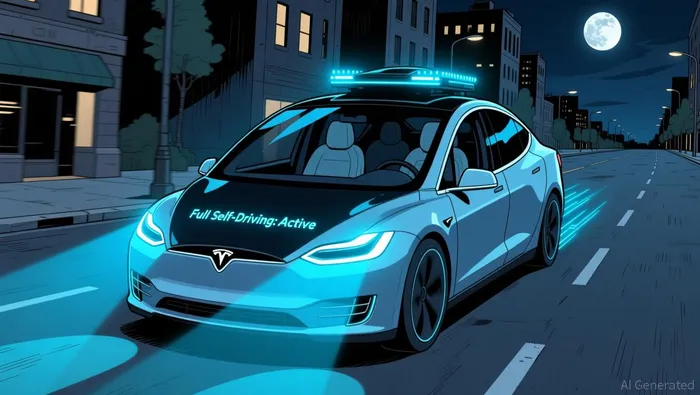 Yet these challenges are not without nuance. California's regulatory overhaul, aimed at aligning with the rapid evolution of driverless technology, requires companies to obtain permits for supervised testing before advancing to driverless operations. While this raises the bar for deployment, it also creates a framework that could eventually legitimize Tesla's ambitions-if the company adapts its messaging and compliance strategies.
Market Reactions: Optimism Amid Uncertainty
Despite the legal turbulence, Tesla's recent progress in robotaxi testing has sparked a surge in investor confidence. On December 15, 2025, the company confirmed trials of robotaxis without a safety monitor in Austin, a milestone that sent shares up 3.6% to $475.31. CEO Elon Musk's social media announcements-such as testing with no occupants in the car-have amplified the narrative of a company on the cusp of a breakthrough.
Analysts like Wedbush's Dan Ives have capitalized on this momentum, reiterating an "Outperform" rating and projecting a $600 price target. Ives argues that Tesla's fleet scale and AI capabilities could secure 70% of the global autonomous market by 2035. Such bullish forecasts reflect a broader reclassification of Tesla as a technology firm rather than merely an automaker, with its AI valuation beginning to materialize according to analysts.
However, skepticism persists. Morningstar analysts maintain a $300 fair value estimate, citing overvaluation risks amid regulatory uncertainties and the nascent state of the robotaxi business according to Morningstar research. The U.S. National Highway Traffic Safety Administration's (NHTSA) investigation into 2.9 million Tesla vehicles for traffic violations linked to FSD further underscores the fragility of this optimism.
Strategic and Competitive Realities
Tesla's approach to autonomy hinges on leveraging its vast fleet for real-world data, a strategy that contrasts with rivals like Waymo and Baidu's Apollo Go, which already operate commercial robotaxi services according to industry analysis. While this data-centric model offers long-term potential, it also exposes the company to short-term volatility. The competitive landscape is intensifying, with fragmented regulatory frameworks adding complexity to scaling operations.
Moreover, Tesla's legal defenses-framing its marketing as "mere corporate puffery"-have faced diminishing returns. Courts and juries now appear more willing to hold the company accountable for failures in its self-driving systems, a trend that could reshape liability norms across the industry.
The Path Forward: Balancing Hype and Reality
For investors, the key lies in distinguishing between Tesla's technological promise and its operational risks. The company's plans to expand robotaxi testing to Phoenix and Nevada, alongside the anticipated 2026 launch of the Cybercab, represent critical inflection points according to industry reports. If successful, these steps could validate the $3 trillion valuation forecasts floated by some analysts according to market analysis. Yet, as Gary Black of Future Fund cautions, Tesla's current valuation may already reflect much of its progress, leaving limited room for near-term surprises according to financial commentary.
Regulatory outcomes in California will also carry nationwide implications. A resolution favoring stricter oversight could slow Tesla's deployment timelines but might ultimately establish clearer standards for the industry, benefiting companies that comply proactively. Conversely, a lenient ruling could embolden Tesla's aggressive marketing, potentially reigniting market enthusiasm.
Conclusion
Tesla's journey through regulatory and legal challenges is emblematic of the broader struggle to define the future of autonomous mobility. While the company's robotaxi and AI initiatives have ignited investor optimism, the path to profitability remains fraught with uncertainty. For now, the market appears willing to bet on Tesla's ability to navigate these hurdles, but the ultimate test will be whether its technological vision can translate into sustainable revenue-and whether regulators will allow it to do so without compromising public safety.







Comentarios
Aún no hay comentarios