
Tesla's Door Handle Design and Safety Risks: Implications for EV Market Confidence and Shareholder Value
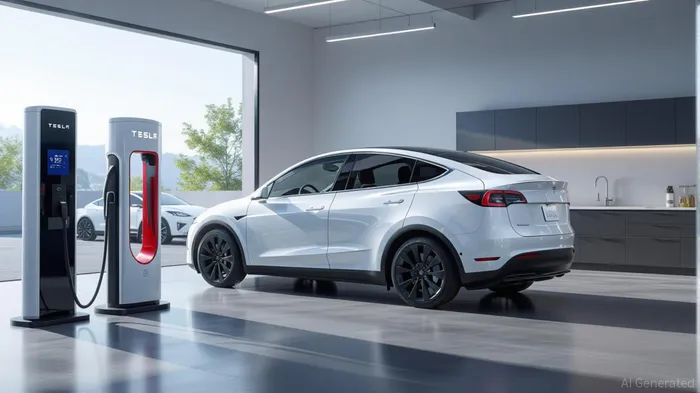
The electric vehicle (EV) revolution, once hailed as a triumph of innovation over tradition, now faces a sobering reckoning. At the heart of this challenge lies a seemingly minor design feature: the electronically operated, flush-mounted door handles pioneered by TeslaRACE--. What began as a symbol of futuristic elegance has become a focal point for systemic safety concerns, regulatory scrutiny, and investor unease. For Tesla, the stakes are high. For the broader EV sector, the implications could be even greater.
A Design Flaw with Systemic Consequences
Tesla's door handles, designed to retract seamlessly into the vehicle's body, epitomize the company's ethos of minimalism and aerodynamic efficiency. However, this innovation has exposed a critical vulnerability: reliance on electronic systems for a function that, in emergencies, must remain accessible without power. According to a report by Bloomberg, over 140 complaints have been logged with the U.S. National Highway Traffic Safety Administration (NHTSA) since 2018, detailing instances where door handles failed to operate during power outages, collisions, or fires[1]. In one tragic case in Toronto, four individuals perished in a fire when the door mechanisms became inoperable, underscoring the life-threatening risks of this design[4].
The NHTSA is now investigating over 174,290 Tesla Model Y vehicles for similar failures, with complaints citing scenarios such as parents needing to adjust rear-seat passengers or post-drive cycles[2]. Tesla's design, which hides mechanical release mechanisms behind panels or carpeting, has been criticized for complicating rescue efforts. As noted by Carscoops, first responders have resorted to breaking windows to extricate occupants trapped in vehicles with non-functional door handles[3]. These incidents have not gone unnoticed by regulators. China, a critical market for EVs, is reportedly drafting rules to ban fully retractable door handles unless mechanical redundancies are added[5].
Regulatory Scrutiny and the Cost of Innovation
The door handle issue is emblematic of a broader tension in EV design: the trade-off between aesthetic innovation and functional safety. Tesla's approach, while groundbreaking, has prioritized aesthetics over accessibility in emergency scenarios. This has drawn comparisons to the automotive industry's historical struggles with airbags and seatbelts—features that, while life-saving, required iterative improvements to address unintended risks.
Regulatory responses are beginning to catch up. In the U.S., the NHTSA has proposed new standards under Federal Motor Vehicle Safety Standard (FMVSS) No. 305a, which would mandate mechanical emergency releases for EVs[6]. Meanwhile, the European Union's Battery Regulation 2025, though focused on sustainability, signals a growing emphasis on safety in EV design[7]. These developments suggest that Tesla's design choices may soon face not just criticism but concrete regulatory constraints.
The financial implications are equally significant. Tesla's stock price has historically been volatile in the face of safety recalls. For instance, a 2024 recall of 694,304 vehicles due to a tire pressure monitoring system (TPMS) issue led to a 5.04% pre-market drop[8]. While no direct data links recent door handle issues to immediate stock declines, the pattern of investor reactions to past recalls suggests that systemic design flaws could erode confidence. Analysts have offered a wide range of price targets for Tesla, from $19.05 to $500.00, reflecting deep uncertainty[9].
A Sector-Wide Challenge
Tesla's door handle design is not an isolated case. Competitors such as RivianRIVN--, Mercedes, and FordF-- have adopted similar flush or electronically operated handles, exposing the entire EV sector to shared risks. In California, a lawsuit against Ford's E-Latch system argues that the absence of manual overrides could trap passengers in emergencies[10]. These parallels highlight a sector-wide overreliance on electronic systems for critical functions—a trend that regulators and consumers are increasingly scrutinizing.
China's proposed ban on fully retractable door handles could force a redesign across the industry, with cascading effects on costs and timelines. For Tesla, which has long positioned itself as a leader in innovation, such mandates could represent a reputational blow. Yet the broader EV sector may face even steeper challenges if regulatory harmonization pressures automakers to adopt standardized mechanical fail-safes.
Investor Sentiment and the Road Ahead
The door handle issue raises a critical question: Can Tesla's valuation, which has long been justified by its technological leadership, withstand the reputational and financial costs of systemic design flaws? The answer hinges on two factors. First, Tesla's ability to address the issue through software updates and design modifications—already underway—will determine whether the problem is perceived as a temporary setback or a fundamental flaw. Second, the broader regulatory environment will shape investor sentiment. If the NHTSA or other agencies impose stringent requirements, Tesla's costs could rise, and its market leadership could be challenged by competitors who prioritize safety from the outset.
For the EV sector as a whole, the door handle saga underscores a deeper truth: innovation must not come at the expense of safety. As Bloomberg notes, the industry's focus on aesthetics and efficiency has, in some cases, overshadowed the need for intuitive, fail-safe designs[1]. This lesson is not lost on regulators or consumers. The coming years will test whether automakers can balance innovation with responsibility—or whether the next phase of the EV revolution will be defined by a return to the fundamentals of automotive safety.





Comentarios
Aún no hay comentarios