
Teck Resources: Strategic Resilience in the Energy Transition Era
In the evolving landscape of base metals and energy transition, Teck ResourcesTECK-- Ltd (TSX:TECK-B) stands at a crossroads of opportunity and constraint. Stifel Canada's recent reaffirmation of a "Hold" rating and C$60 price target for the company, despite its strategic pivot toward energy transition metals and a transformative merger with Anglo American, raises critical questions about market sentiment and long-term valuation. Is this rating a prudent acknowledgment of near-term operational headwinds, or does it understate Teck's potential to capitalize on the decarbonization imperative?
Stifel's Cautious Stance: A Product of Short-Term Realities
Stifel's decision to maintain its Hold rating reflects a blend of operational caution and macroeconomic pragmatism. The firm revised its Q3 2025 earnings per share (EPS) forecast for TeckTECK-- downward from $0.37 to $0.32 per share, citing production cuts at key assets like the Quebrada Blanca (QB) tailings facility and the Red Dog zinc operation, as the MarketBeat alert noted. These constraints, compounded by a 15% reduction in four-year cumulative EBITDA, have tempered immediate growth expectations. Stifel also highlighted broader industry challenges, including a decade of underinvestment in copper capacity, which has removed 1.1 million tonnes of supply from the market over the next three years. Such dynamics suggest a market in flux, where short-term volatility may overshadow long-term structural demand.
Yet, Stifel's C$60 price target-aligned with the company's current share price-fails to fully account for Teck's strategic repositioning. The firm's analysis appears anchored to a conservative view of operational stability, rather than the transformative potential of Teck's energy transition initiatives.
Teck's Energy Transition Play: Copper as a Cornerstone
Teck's strategic pivot toward energy transition metals is both ambitious and timely. The company has committed to achieving net-zero Scope 2 emissions by 2025, with 50% of its QB operations and 100% of Carmen de Andacollo powered by renewables, according to Teck's sustainability materials. This aligns with a broader industry shift, as copper demand for electric vehicles (EVs) and grid infrastructure is projected to surge from 1.2 million tonnes in 2024 to 3.5 million tonnes by 2030, per the IEA copper report. Teck's focus on copper-its 2025 production guidance of 490,000–565,000 tonnes-positions it to benefit from this demand surge, particularly as it advances projects like the Quebrada Blanca optimization and the Highland Valley mine life extension.
The Anglo American merger further amplifies this potential. As detailed in the merger release, by forming Anglo Teck the combined entity will become a top-five global copper producer, with synergies projected to deliver $800 million in annual pre-tax savings and enhanced EBITDA from integrated Chilean operations. This merger not only strengthens Teck's balance sheet but also accelerates its ability to scale production to 800,000 tonnes of copper annually by the end of the decade. Such growth is critical in a market where supply constraints are expected to persist, driven by underinvestment and geopolitical risks.
The Valuation Dilemma: Conservative Optimism or Undervaluation?
Stifel's Hold rating and C$60 target may reflect a conservative optimism rooted in near-term operational risks. However, this approach risks overlooking Teck's long-term value proposition. The company's decarbonization efforts, including carbon capture trials at Trail Operations and a 35% reduction in research and innovation costs (noted in Teck's production update), demonstrate a disciplined approach to cost management and ESG alignment. Meanwhile, its focus on stable jurisdictions (e.g., Chile, Peru, Mexico) and partnerships with Indigenous communities, as described in the merger release, mitigates geopolitical and social risks, enhancing project viability.
Critically, Teck's strategic clarity-selling its steelmaking coal business for $8.6 billion to fund growth and shareholder returns, as outlined in the merger release-underscores a commitment to capital efficiency. This contrasts with the industry's historical overreliance on cyclical commodities. Yet, Stifel's price target does not fully incorporate the upside from Anglo Teck's synergies or the structural demand tailwinds for copper. At C$60, Teck's valuation appears to discount its potential to outperform peers in a decarbonizing world.
Conclusion: A Rating at Odds with Strategic Momentum
While Stifel's Hold rating is understandable in the context of short-term production challenges and industry-wide volatility, it may understate Teck's long-term growth trajectory. The company's alignment with energy transition trends, coupled with its merger with Anglo American, positions it to benefit from a copper-centric future. Investors who focus solely on near-term EBITDA reductions risk missing the broader narrative: Teck is not merely a base metals producer but a pivotal player in the infrastructure of a low-carbon economy.
In this light, Stifel's C$60 target appears cautiously optimistic but potentially undervalued. For a company poised to scale copper production to meet the demands of EVs and grid modernization, the market may yet reward patience with a re-rating.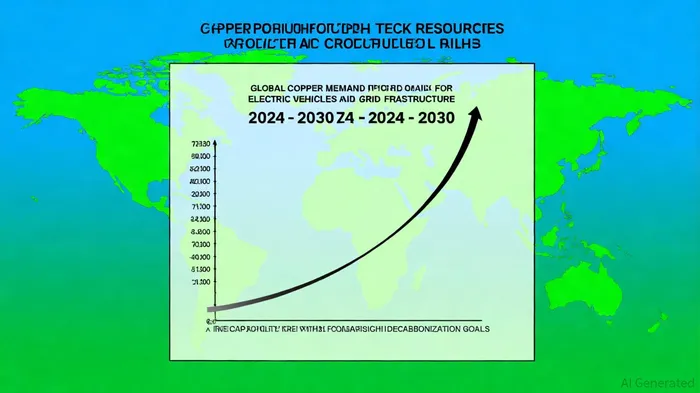





Comentarios
Aún no hay comentarios