
Taseko Mines' $150 Million Share Offering and Its Strategic Implications
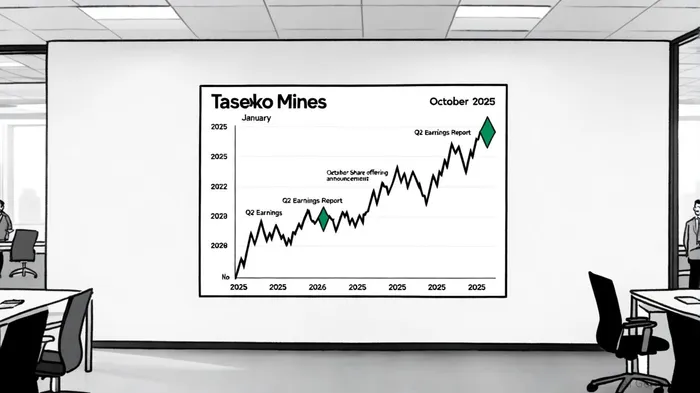
In the volatile world of base metals, where capital-intensive operations and commodity price swings dominate, Taseko Mines Limited's recent $150 million share offering represents both a tactical maneuver and a strategic recalibration. Announced on October 15, 2025, the bought-deal financing-comprising 37.1 million common shares at $4.05 apiece, with an over-allotment option-has drawn scrutiny for its implications on the company's capital structure and shareholder value. To assess its significance, one must situate Taseko's actions within the broader context of the base metals sector's evolving financial dynamics and the company's own operational challenges.
Capital Structure Optimization in a High-Risk Sector
The base metals industry, valued at $825 billion in 2025, faces a dual challenge: meeting surging demand from renewable energy and electric vehicle (EV) sectors while navigating supply constraints and environmental regulations, according to a FasterCapital report. For firms like Taseko, optimizing capital structure is not merely a financial exercise but a survival imperative. According to the same FasterCapital report, companies in this sector must balance debt and equity to minimize the weighted average cost of capital (WACC) while preserving flexibility to navigate commodity price volatility.
Taseko's decision to raise equity rather than deepen its debt load reflects a calculated risk. The company's Q2 2025 results-a net loss of $22 million and revenue below forecasts-were detailed in Taseko's Q2 financial statements. By repaying outstanding debt under its revolving credit facility, the offering reduces financial leverage, thereby lowering the risk of covenant breaches during periods of low commodity prices. This aligns with industry best practices, where hybrid financing tools and non-bank capital strategies are increasingly favored to mitigate exposure to traditional credit markets, as discussed in Taseko's Q1 financial statements.
Shareholder Value Preservation: A Delicate Balancing Act
The offering's impact on shareholder value is nuanced. On one hand, issuing 37.1 million new shares dilutes existing ownership, a move that historically depresses stock prices. Yet Taseko's shares rose modestly in after-hours trading following the announcement, closing at $4.26, suggesting investor confidence in the company's liquidity strategy noted in the Q2 filing. This optimism is partly fueled by the Florence Copper Project, which is on track for first production by year-end and expected to generate robust cash flows as it ramps up, according to the company's Q2 statements.
However, the company's recent financial performance complicates this narrative. A $29 million net loss in Q1 2025, attributed to lower-than-expected metallurgical recoveries at the Gibraltar mine, underscores operational inefficiencies that could erode value if unresolved, as described in the Q1 filing. Taseko's reliance on equity financing-raising $31 million in Q1 2025 via an at-the-market offering-also raises questions about its ability to maintain profitability without further dilution, a point documented in the same Q1 materials.
Strategic Rationale and Industry Benchmarks
Taseko's approach mirrors broader trends in the base metals sector. As noted by the Carnegie Endowment, securing domestic supply chains and diversifying financing sources are critical to mitigating geopolitical and market risks. The company's $150 million raise, coupled with a $75 million payment from the Province of BC for the New Prosperity Project, demonstrates a hybrid strategy of leveraging public-private partnerships and equity to fund growth.
Yet the offering's success hinges on execution. The base metals sector's projected 4.5% CAGR through 2033 (as projected by FasterCapital) depends on firms like Taseko not only securing capital but deploying it efficiently. For instance, Taseko's copper price protection at $4.00 per pound for 2025-a floor slightly above the offering price-suggests a hedging strategy to stabilize cash flows, a measure highlighted in the Q2 statements. This is a prudent move in a sector where price volatility can swiftly erase gains.
Conclusion: A Test of Resilience
Taseko Mines' $150 million share offering is a double-edged sword. While it strengthens liquidity and reduces debt risk, it also exposes the company to shareholder dilution and operational scrutiny. The true test of its strategic value will lie in how effectively the proceeds are deployed to accelerate Florence Copper's production and address Gibraltar's operational challenges. In a sector where capital structure optimization is synonymous with survival, Taseko's ability to balance short-term financial prudence with long-term growth will determine whether this offering becomes a cornerstone of its revival or a temporary reprieve.





Comentarios
Aún no hay comentarios