
U.S. Tariffs and the Petrochemical Sector: A Perfect Storm for Global Trade and Investment Risks
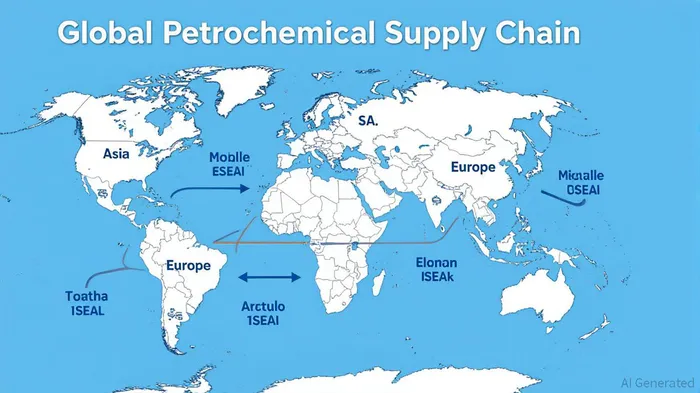
The U.S. petrochemical sector is facing a confluence of challenges as recent tariff policies exacerbate existing vulnerabilities in global trade. According to a report by Reuters, the sector has already experienced a 34% decline in global trade over the past five years, and new tariffs—ranging from a 10% baseline to 50% on certain countries—threaten to push this figure down by an additional 15% [1]. These measures, which took effect as early as August 7, 2025, include a 40% transshipment tariff on all countries, further complicating supply chain dynamics [4]. The cumulative impact of these policies is not merely a trade issue but a systemic risk to industries reliant on global integration, from semiconductors to agriculture [6].
The Tariff Shock and Its Immediate Effects
The Trump administration’s 2025 tariff regime has recalibrated the cost structures of petrochemical firms. A 25% duty on steel and aluminum, for instance, has raised input costs for U.S. manufacturers, while reciprocal tariffs on chemical imports have inflated freight costs by up to 228% [2]. These pressures are forcing companies to reengineer supply chains. For example, firms are shifting production to tariff-exempt regions like Vietnam and Mexico, leveraging tariff engineering techniques to reclassify products under lower tariff rates, and adopting localized sourcing strategies [4]. Such adjustments, however, require significant capital and operational flexibility, which not all firms possess.
Strategic Diversification: A Path to Resilience
In response to these shocks, petrochemical companies are prioritizing diversification and resilience. Sinopec, for instance, has expanded its global footprint with a major project in Yanbu, Saudi Arabia, aiming to produce 1.8 million metric tons of ethylene annually [1]. Similarly, PetroChina has invested in domestic chemical projects in Jilin and Guangxi, emphasizing renewable energy integration [1]. These moves reflect a broader industry trend: regional partnerships and localized manufacturing to mitigate geopolitical risks.
Data from KPMG underscores the urgency of such strategies, identifying geopolitical complexities as the top challenge for energy and chemicals sectors in 2025 [1]. Companies like Dow and BASF have scaled back non-core operations and divested assets to streamline costs, while others, such as ExxonMobil, continue to invest in North America despite broader industry caution [1]. These actions highlight a dual focus on short-term profitability and long-term resilience.
Quantifying the Risks and Rewards
The economic toll of these tariffs is profound. A Federal Reserve analysis estimates that a broad-based tariff scenario could reduce global GDP by 0.8%, with the U.S. and China suffering the largest losses—3.6% and 2.4%, respectively [2]. For the petrochemical sector, the implications are stark: overcapacity, pricing pressures, and disrupted trade flows are eroding margins. Yet, some firms are finding opportunities. In India, for example, the petrochemical market is projected to grow from $220 billion to $300 billion by 2025, driven by domestic demand and strategic investments in sustainable technologies [2].
Investment Considerations in a Fragmented World
For investors, the petrochemical sector’s response to tariffs offers both risks and opportunities. Firms that successfully localize production or innovate in bio-based alternatives—such as those highlighted in MarketsandMarkets’ analysis—may outperform peers [2]. However, the sector’s reliance on global supply chains means that even well-diversified companies remain exposed to trade frictions. The Biden-Harris Administration’s subsidies and supply chain policies add another layer of complexity, as firms navigate conflicting incentives to reduce reliance on single regions while maintaining cost efficiency [3].
The path forward demands a nuanced approach. As the industry grapples with decarbonization goals and geopolitical volatility, strategic diversification is no longer optional—it is existential. For investors, the key lies in identifying firms that balance innovation with operational agility, even as the “perfect storm” of tariffs and trade wars reshapes the global landscape.
Source:
[1] C&EN's Global Top 50 chemical firms for 2025 [https://cen.acs.org/business/finance/CENs-Global-Top-50-2025/103/web/2025/07]
[2] The Fed - Trade-offs of Higher U.S. Tariffs: GDP, Revenues ... [https://www.federalreserve.gov/econres/notes/feds-notes/trade-offs-of-higher-u-s-tariffs-gdp-revenues-and-the-trade-deficit-20250707.html]
[3] Supply Chain Diversification and Resilience in [https://www.elibrary.imf.org/view/journals/001/2025/102/article-A001-en.xml]







Comentarios
Aún no hay comentarios