
Target Hospitality's Strategic Expansion and Market Position in the Workforce Accommodations Sector
The industrial landscape of North America is undergoing a profound transformation, driven by the explosive growth of data centers, energy infrastructure, and mining operations. At the heart of this evolution lies a critical enabler: high-quality, vertically integrated workforce accommodations. Target HospitalityTH--, a leader in this niche, has positioned itself to capitalize on these trends through a strategic expansion that aligns seamlessly with the region's industrial demands. By leveraging its modular, turnkey solutions, the company is not only addressing immediate labor needs but also securing long-term revenue streams in a sector poised for sustained growth.
Strategic Expansion: A Catalyst for Growth
Target Hospitality's recent initiatives underscore its aggressive pursuit of market leadership. The company's Power Community contract in Northern Nevada, a $35 million, 25-month agreement to support power generation expansion for mining and data center development, exemplifies its ability to align with high-growth industrial projects. This contract builds on its prior regional presence, such as the Thacker Pass project, to minimize capital expenditures while maximizing operational efficiency. 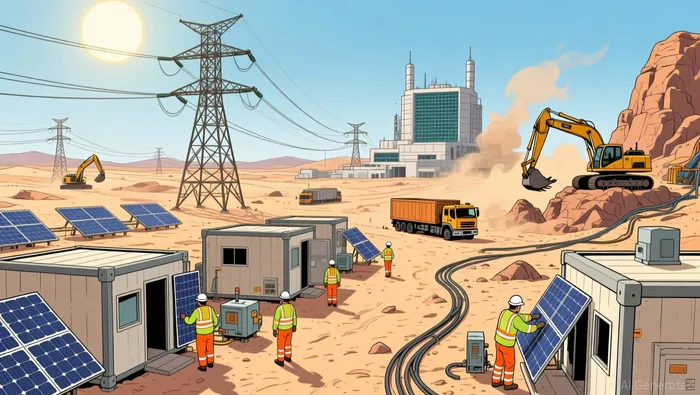 Simultaneously, Target has expanded its Data Center Community by 160%, increasing capacity from 250 to 650 beds, with a $10–$15 million investment projected to yield $40 million in committed revenue over two years. These moves reflect a strategic diversification into sectors where demand for workforce accommodations is surging.
The broader context for this expansion is the rapid acceleration of data center development. According to a report by BloombergNEF, North American data centers are expected to require 61.8 gigawatts of grid power in 2025, a 22% increase from 2024, driven by AI-driven workloads and hyperscale facilities. Target's vertically integrated model-combining modular housing, culinary services, and facilities management-positions it as an indispensable partner for companies operating in remote or resource-intensive environments.
Vertically Integrated Solutions: A Competitive Edge
Target's vertically integrated approach is a key differentiator in a market where traditional accommodations often fall short of industrial needs. By controlling the entire value chain-from modular construction to on-site hospitality services-the company ensures scalability, cost efficiency, and tailored solutions for clients. For instance, its newly launched sub-brand, Target Hyper/Scale, is explicitly designed to support data center development, offering purpose-built communities that address the unique demands of AI-driven infrastructure.
This model is particularly well-suited to the energy sector, where projects such as natural gas expansion and renewable energy installations require temporary yet high-capacity workforce housing. As the Annual Energy Outlook 2025 notes, electricity demand in North America is being reshaped by electrification and data center growth, with solar and storage accounting for 82% of new generating capacity in the first half of 2025. Target's ability to deploy modular, energy-efficient accommodations aligns with these trends, offering clients a sustainable and scalable solution.
Industrial Alignment: Mining, Energy, and Data Centers
The company's strategic alignment with industrial sectors is further evidenced by its multi-year contracts in mining and energy. The Northern Nevada Power Community, for example, supports power generation projects critical to mining operations, which remain a cornerstone of North America's resource economy. Similarly, its Data Center Community expansion in Virginia, a state projected to reach 12.1 gigawatts of data center demand by 2025, highlights its geographic targeting of high-growth regions.
These initiatives are underpinned by a broader shift in industrial labor dynamics. As data from the New Energy Outlook indicates, the transition to a low-carbon economy is accelerating, with oil demand expected to peak in 2032 and coal use declining rapidly. Target's focus on sectors such as data centers and renewable energy positions it to benefit from this transition, as these industries require sustained workforce support during infrastructure development phases.
Future Outlook: Sustaining Momentum
With over $530 million in multi-year contracts secured in 2025, Target Hospitality has demonstrated its ability to secure long-term revenue visibility in a volatile market. However, challenges remain, including regulatory shifts in the energy sector-such as the One Big Beautiful Bill Act (OBBBA), which has introduced uncertainty for solar projects. Target's vertically integrated model, however, provides flexibility to adapt to such changes, as its modular infrastructure can be repurposed or relocated to align with evolving client needs.
Looking ahead, the company's expansion into 1,500-bed data center communities and its emphasis on premium hospitality services-such as culinary offerings and facilities management-suggest a focus on enhancing client retention and value. As industrial growth in North America continues to outpace traditional sectors, Target's ability to deliver scalable, customized solutions will likely solidify its market position.
Conclusion
Target Hospitality's strategic expansion into workforce accommodations is a masterclass in aligning with industrial megatrends. By capitalizing on the surging demand for data centers, energy infrastructure, and mining operations, the company has positioned itself as a critical enabler of North America's industrial growth. Its vertically integrated model not only addresses immediate labor needs but also provides a blueprint for sustainable, long-term value creation in a sector poised for decades of expansion.





Comentarios
Aún no hay comentarios